









Εισαγωγή
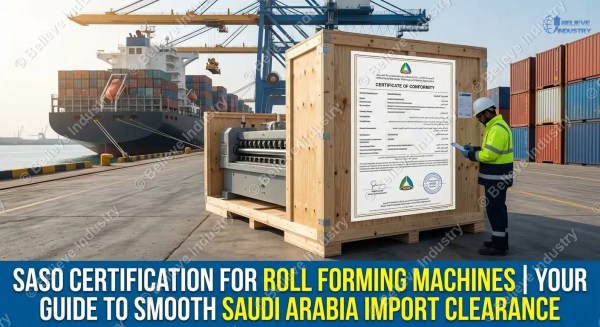
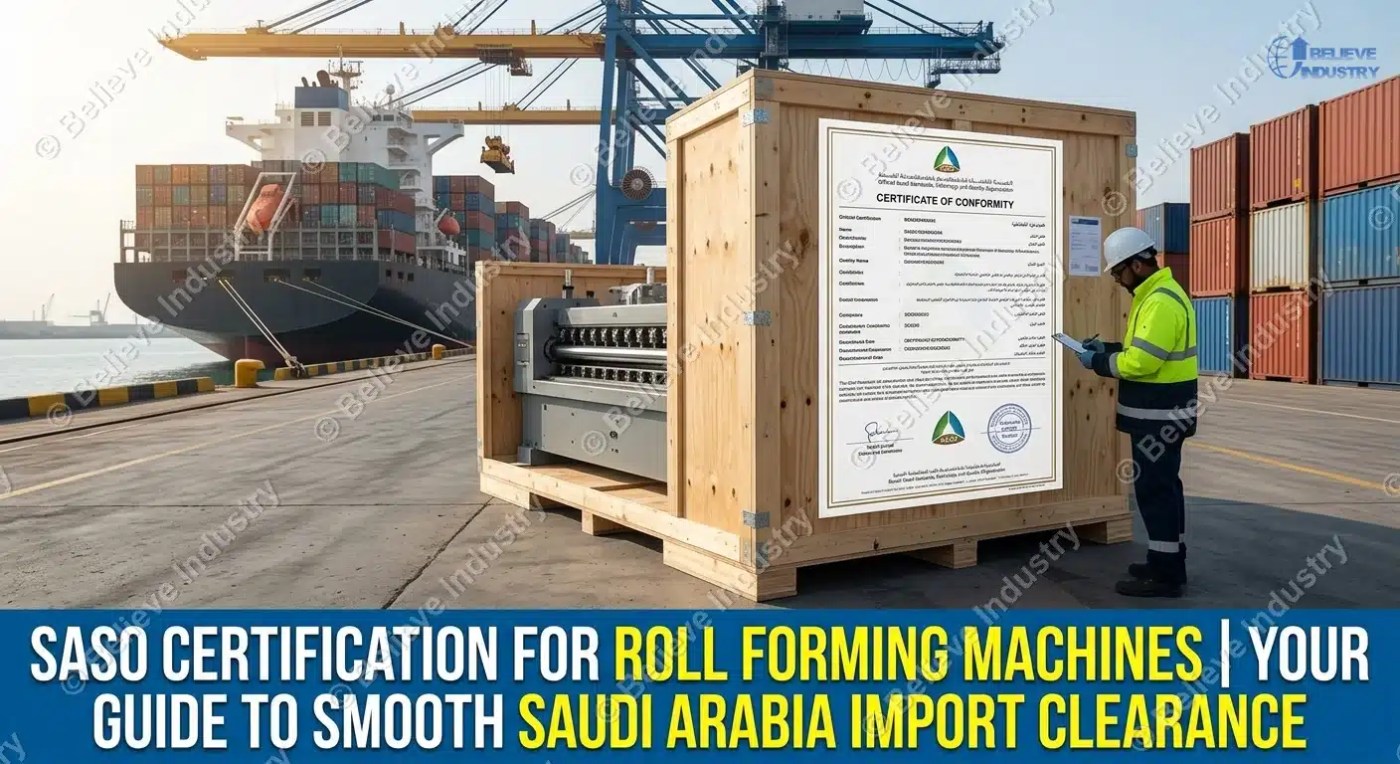
You shipped a container of roll forming machines to Dammam port. Customs holds it. The reason? No SASO certificate.
Saudi Arabia runs one of the strictest import compliance systems in the Gulf. Every industrial machine, including roll forming equipment, must pass SASO certification before it clears customs.
A SASO certificate for roll forming machines is the legal document that proves your equipment meets Saudi technical standards for safety, electromagnetic compatibility, and energy efficiency. Without it, your shipment stays in port. Demurrage fees pile up.
This guide walks through six practical steps to obtain your SASO certificate. The same compliance logic applies to any μηχανή σχηματισμού ρολού you plan to import. We also explain how a manufacturer with over 15 years of roll forming export experience handles SASO certification for buyers across 20+ χώρες.
What Is a SASO Certificate?
SASO stands for the Saudi Standards, Metrology and Quality Organization. It sets technical regulations for every product entering Saudi Arabia.
A SASO certificate is a Certificate of Conformity (CoC). It confirms your roll forming machine meets Saudi technical standards και Gulf Technical Regulations. It is mandatory for customs clearance at any Saudi port.
For roll forming machines, certification typically references IEC 60204-1 (electrical safety of machinery), IEC 61439 (low-voltage switchgear), and relevant GSO standards. Machines that form sheet metal through successive roller stations register as industrial machinery on the Saber platform.
Unlike CE marking, a European self-declaration, a SASO certificate requires third-party verification by an accredited certification body. You cannot self-certify.
SASO Certificate vs. Other Certifications
| Πιστοποίηση | Αγορά | Issuing Body | Key Requirement |
|---|---|---|---|
| SASO CoC | Σαουδική Αραβία | SASO-approved CB | Mandatory third-party testing |
| Σήμανση CE | EU/EEA | Manufacturer (self-declaration) | Technical file + DoC |
| Saber CoC | Σαουδική Αραβία | SASO via Saber platform | Online product registration |
| Gulf Conformity Mark | GCC countries | GSO | Unified GCC standard |
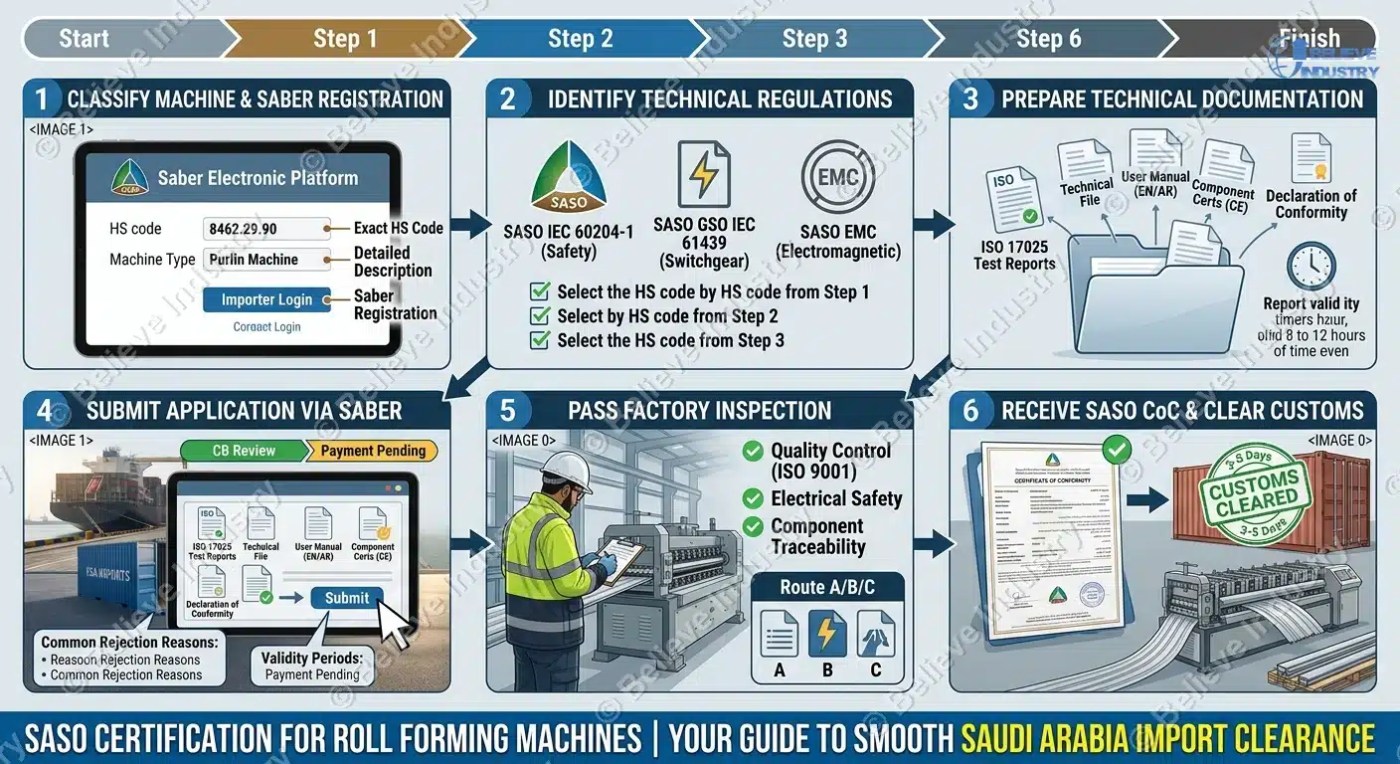
Step 1: Classify Your Machine Under HS Code and Saber
Every SASO certificate starts with correct product classification.
Saudi customs uses the Harmonized System (HS code). Roll forming machines typically fall under HS 8462 (machine tools for working metal) or related subheadings. A cable tray roll forming machine may classify differently from a Μηχανή σχηματισμού κυλίνδρων Z purlin.
Ο Saber electronic platform is where all SASO certification work happens. You register the product, upload documents, and receive your CoC online. There is no paper alternative.
For Saber classification you need:
- Exact HS code — confirmed with your freight forwarder or Saudi importer
- Product description — detailed enough to distinguish the machine type (cable tray, purlin, stud, etc.)
- Technical specifications — voltage, power rating, forming speed, material thickness range
- Intended use — which profiles the machine produces, and for which industry
The HS code determines which SASO technical regulation applies. An incorrect code gets rejected and costs you weeks. Common errors: a generic “8462” instead of the precise subheading, classifying the machine as “parts”, omitting auxiliary equipment ratings, and vague use descriptions like “metal machine”.
Step 2: Identify the Applicable SASO Technical Regulation
Not all SASO certificates are identical. The regulation depends on machine type, electrical specs, and end-use sector. Three commonly apply:
- SASO IEC 60204-1 — Safety of machinery, electrical equipment of machines. The primary standard. Covers wiring, earthing, electric shock protection, and control circuit safety.
- SASO GSO IEC 61439 — Low-voltage switchgear and control gear assemblies. Applies to the electrical cabinet and power distribution.
- SASO EMC Regulations — Electromagnetic compatibility. Ensures the machine does not emit interference that disrupts other equipment.
A μηχανή σχηματισμού ρολού δίσκου καλωδίων destined for Saudi electrical infrastructure projects may face additional scrutiny under construction product regulations.
To confirm your regulation: search your HS code on the Saber platform for linked regulations, consult your SASO-approved certification body (CB), and check the SASO official website for the latest mandatory standards. Regulations change, so check before every shipment.
Step 3: Prepare Technical Documentation and Test Reports
Documentation is the backbone of a successful SASO certificate application. Incomplete paperwork is the most common rejection reason.
You need:
- Αναφορές δοκιμών from an ISO/IEC 17025 accredited laboratory, covering IEC 60204-1 and applicable EMC tests
- Technical file with machine drawings, electrical schematics, bill of materials, and control system description
- Εγχειρίδιο χρήστη in English and Arabic (Arabic is strongly recommended)
- Εκτίμηση κινδύνου per ISO 12100 (safety of machinery)
- Component certificates — CE certificates for motors, PLCs, VFDs, and safety components
- Factory nameplate photo showing manufacturer, model, serial number, voltage, power, and year of manufacture
- Manufacturer’s Declaration of Conformity — signed statement of standards compliance
SASO does not accept internal factory test reports. Reports must come from a third-party lab accredited to ISO/IEC 17025.
If you have a CE marked machine, CE test reports may partially help, but SASO does not automatically accept them. Additional testing or gap analysis may be required.
Plan validity: IEC 60204-1 and EMC test reports stay valid for 3 years, the technical file is a living document, and the Declaration of Conformity applies per shipment or model.
Step 4: Submit Application Through Saber
With documents ready, submit your application through Saber:
- Register on Saber — your Saudi importer creates an account. Foreign manufacturers cannot register directly.
- Submit product details — HS code, specifications, documents
- CB reviews application — the certification body validates your submission
- Invoice issued — the CB quotes certification fees
- Payment made — typically by the Saudi importer
Most roll forming machines skip the full machine sample; these are large, customized machines. Instead, the certification body conducts a factory inspection or accepts third-party test reports with a factory audit. The inspection verifies production capability, consistency between tested and serial units, correct labeling, and shop-floor electrical safety.
For a standard model exported repeatedly, such as a γραμμή παραγωγής σχαρών καλωδίων, SASO certification follows Route B ή Route C: factory inspection plus periodic surveillance.
| Certification Route | Requirement | Ιδανικό για |
|---|---|---|
| Route A | One-time shipment inspection | One-off exports |
| Route B | Factory inspection + CoC per shipment | Regular exporters |
| Route C | Full factory audit + surveillance | High-volume exporters |
Step 5: Pass Factory Inspection and Surveillance Audit
If your certification route includes a factory inspection, this step is decisive.
The SASO-approved inspector visits your facility and evaluates:
- Quality management system — documented QMS, ISO 9001 certification helps
- Production process control — incoming inspection, in-process checks, final testing
- Electrical safety implementation — wiring practices, earthing, cable routing, protection devices
- Test equipment calibration — instruments calibrated by accredited labs
- Component traceability — can you trace motor, PLC, and VFD to their CE certificates?
A typical visit runs one to two days: opening meeting (30 min), factory tour (2 to 3 hours on production flow and electrical safety), QMS review (2 hours), nameplate and label inspection (2 hours), and a closing meeting on findings and corrective actions. The inspector reports to the certification body.
After initial certification, SASO requires surveillance audits every 12 to 18 months. Missing one invalidates your certificate. Set calendar reminders.
Step 6: Receive SASO CoC and Clear Saudi Customs
The final step, where the effort pays off.
After the certification body reviews all documents and inspection results, they issue the SASO Certificate of Conformity, valid for the specific machine model(s) listed. A new model requires a new or amended certificate.
For repeat shipments of the same model, you still need a Shipment Certificate of Conformity (SCoC), a per-shipment document confirming the consignment matches the certified model. It is issued through Saber with the commercial invoice and packing list.
With a valid CoC and SCoC, customs clearance at Dammam, Jeddah, or Riyadh Dry Port typically completes in 3 to 5 working days. Without them, expect weeks of delays and storage charges.
Common Rejection Reasons
- CoC expired — check the expiry date before shipping
- Model mismatch — machine model on invoice does not match the CoC
- Missing SCoC — each shipment needs its own SCoC, not just the main CoC
- Incomplete labeling — no SASO mark or missing nameplate on the machine
SASO Certificate Costs and Timeline
Cost depends on machine complexity and certification route.
| Cost Element | Estimated Range (USD) | Σημειώσεις |
|---|---|---|
| Test reports (IEC 60204-1) | $2,000 to $5,000 | Third-party accredited lab |
| EMC testing | $1,500 to $3,500 | If required |
| Saber registration fee | $500 to $1,000 | Paid by importer |
| CB certification fee | $2,000 to $4,000 | Certification body charges |
| Επιθεώρηση εργοστασίου | $2,500 to $5,000 | Travel + inspector fees |
| Annual surveillance | $1,500 to $3,000 | Per year per factory |
Total estimated cost: $8,000 to $18,000 for initial certification of one machine model.
Timeline: 8 to 16 weeks from application to CoC issuance. Some CBs offer expedited processing for an additional fee.
How Beli Rollforming Supports SASO Certification
Getting certified alone takes time. Working with a manufacturer that already understands the process cuts months off the timeline.
Beli Rollforming supplies SASO-compliant roll forming machines to buyers in Saudi Arabia, the UAE, Qatar, and 20+ other countries. Our machines are built to IEC 60204-1 standards with CE-certified electrical components.
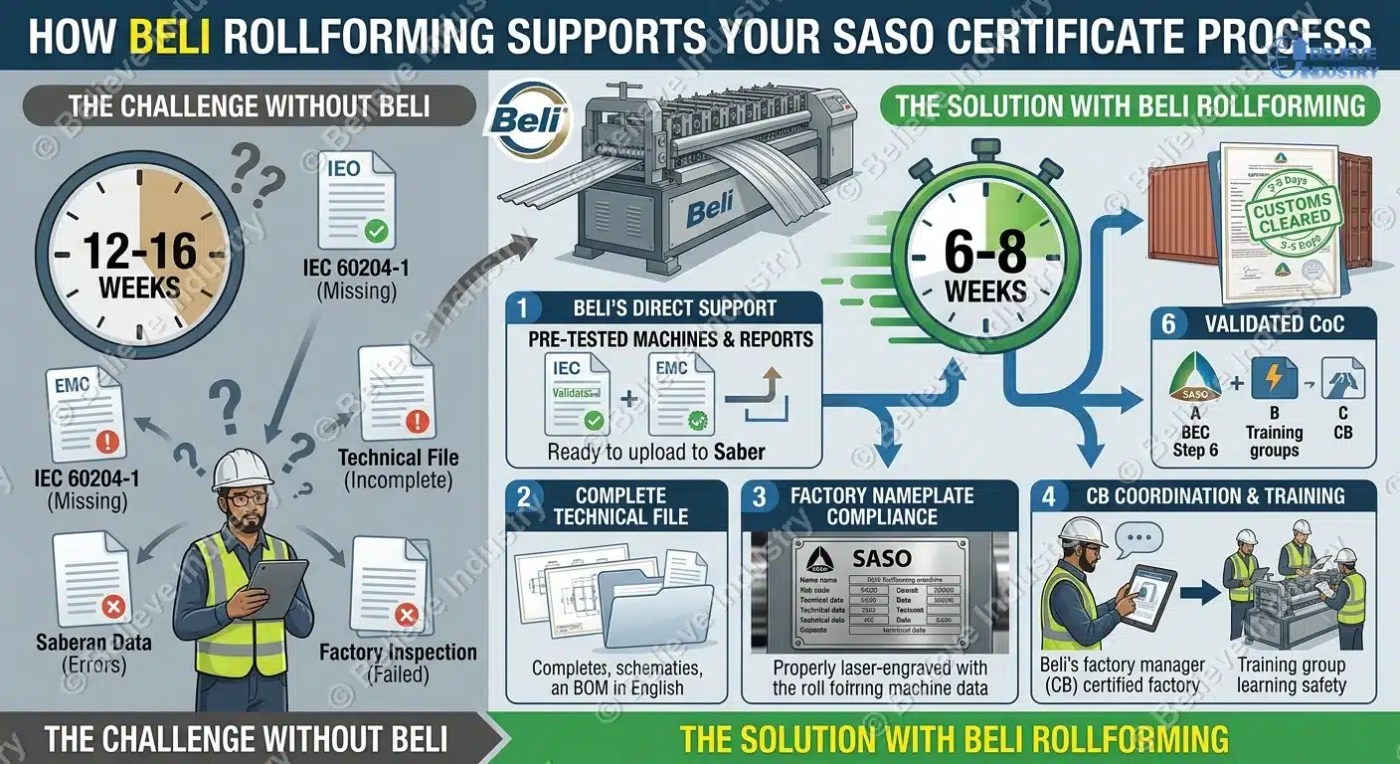
What Beli provides for your SASO certificate:
- Pre-tested machines — IEC 60204-1 and EMC test reports ready for standard models
- Complete technical file — drawings, schematics, BOM, risk assessments in English
- Component certificates — CE declarations for every motor, PLC, VFD, and sensor
- Factory nameplate compliance — all labels meet SASO marking requirements
- CB coordination — we work directly with your chosen certification body
- Εκπαίδευση χειριστών — Saudi-compliant programs satisfying SASO safety requirements
For standard models, this cuts SASO certificate processing from the typical 12 to 16 weeks down to 6 to 8 weeks.
Why a SASO Certificate Matters Beyond Customs
Saudi Vision 2030 is investing over $1 trillion in infrastructure, housing, and industrial development. From NEOM to the Red Sea Project, giga-projects demand certified equipment. A SASO-certified roll forming machine qualifies you to bid on these projects.
Many international machine suppliers skip SASO certification and avoid the Saudi market. Those who invest face less competition and command higher margins, because certification eliminates the buyer’s customs risk.
It also positions your equipment for the broader Gulf market. Kuwait, Bahrain, Oman, and other GCC states increasingly align import standards with Saudi regulations, so certification for Saudi Arabia often accelerates certification for neighboring markets.