









Εισαγωγή
A roll forming machine can produce thousands of meters of precision profiles per day. Without a properly trained operator, that same machine turns into a source of scrap, downtime, and safety hazards. Roll forming operator training is the foundation of profitable, safe, and consistent production. Skip it, and you pay for it every shift.
Every roll forming machine operator must develop specific competencies before running a production line solo. Whether you operate a cable tray roll forming line ή ένα Μηχανή τεγίδας Z, the core skills remain the same. Comprehensive roll forming operator training transforms a beginner into a confident, safe, and productive operator.
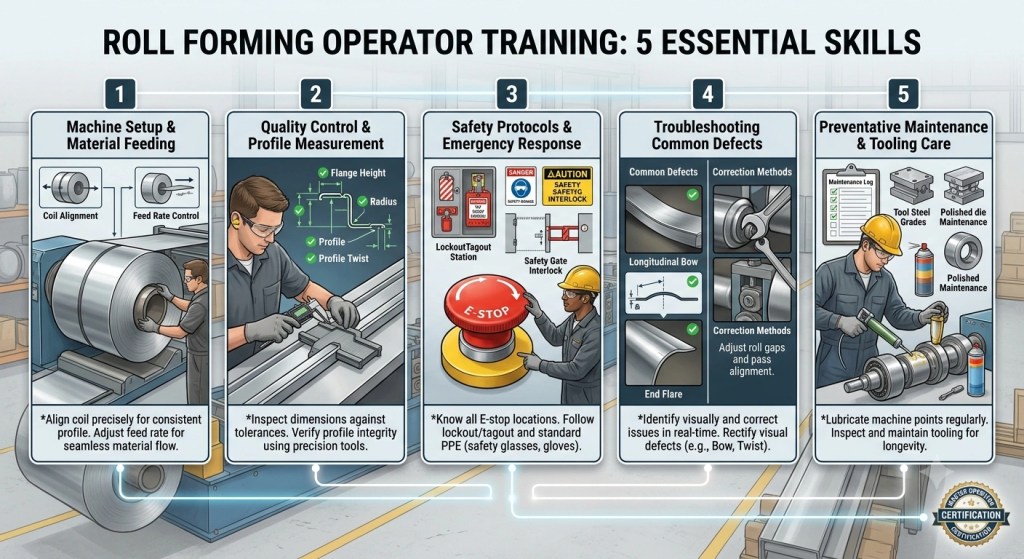
This guide covers the five skills every roll forming operator must master. Beli Rollforming, with over 15 years of experience exporting machines to 20+ countries across the US, Europe, and Australia, has trained operators worldwide. We distilled that experience into this practical reference.
Roll forming operator training by the numbers:
- Setup quality accounts for 80% of final profile accuracy
- Trained operators achieve 1–3% first-run scrap vs 10–25% for untrained
- Untrained operators cause 12–20 hours of downtime per month vs under 4 hours for trained
- Daily maintenance checks extend tooling life by 30–50%
- Basic operator competency requires 3–5 days of hands-on training
Skill 1: Machine Setup and Material Feeding
Why Setup Matters
Proper machine setup determines 80% of your output quality. A misaligned entry guide, an incorrect coil tension, or a wrong pass sequence creates defects that cascade through the entire γραμμή σχηματισμού ρολού. This is why roll forming operator training must begin with setup fundamentals. The machine operator who masters setup controls the quality of every profile that follows.
According to OSHA’s machine guarding guidelines, incorrect setup is among the top causes of both quality failures and operator injuries on metal forming equipment.
Core Setup Tasks
A trained roll forming machine operator must handle these setup steps confidently:
- Coil loading and uncoiler adjustment. Load the steel coil onto the uncoiler, set tension, and align the strip centerline with the entry guide.
- Entry guide positioning. Set the entry guide width and height to match the strip dimensions exactly.
- Roll station verification. Walk through each forming station to confirm roll positions match the flower diagram for the target profile.
- Pre-flight test run. Run 2–3 meters of strip at low speed to check for twist, bow, or dimensional drift before full production.
| Setup Task | Common Mistake | Consequence |
|---|---|---|
| Coil centering | Off-center coil | Strip wanders, edge cracks |
| Entry guide width | Too wide | Profile twists or bows |
| Roll alignment | Skipped station check | Dimensional errors downstream |
| Test run length | Skipping test run | Mass scrap on first batch |
Material Handling Tip
Always inspect the coil for edge damage, rust, or waviness before feeding. A damaged coil produces defects from the first meter. The ASTM A1008/A1008M standard defines acceptable surface quality for cold-rolled steel used in roll forming.

Skill 2: Quality Control and Profile Measurement
In-Line Quality Checks
A roll forming machine operator must verify profile dimensions continuously — not just at the end of the run. Roll forming operator training teaches operators to catch deviations early and adjust mid-run.
Key measurements to track:
- Cross-section dimensions. Width, height, and leg lengths against the drawing tolerance (typically ±0.5 mm).
- Straightness. Check for bow, twist, or camber using a straightedge on a 3-meter sample.
- Surface quality. Inspect for scratches, roll marks, or oil contamination.
- Hole patterns. If the line includes inline punching, verify hole position and diameter.
| Defect Type | Detection Method | Adjustment |
|---|---|---|
| Twist | Rotate sample on flat table | Adjust last 2–3 stations |
| Bow (up/down) | Straightedge check | Raise or lower top rolls |
| Camber (left/right) | Measure against straight line | Adjust side guides |
| Dimensional drift | Caliper measurement | Fine-tune station gaps |
| Surface marks | Visual inspection | Clean or replace rolls |
When to Stop the Line
If any measurement drifts beyond tolerance, the operator must stop the line immediately. Continuing to run out-of-spec material wastes coil stock and creates downstream rework costs. As The Fabricator magazine notes, early detection saves both material and machine time.

Skill 3: Safety Protocols and Emergency Response
Non-negotiable safety rules
Safety is not a separate module in roll forming operator training. It is woven into every skill. Every roll forming machine operator must understand and practice these protocols before touching the machine:
- Never reach into the forming area while the line is running. Pinch points between top and bottom rolls can crush fingers in milliseconds.
- Lock-out/tag-out before any adjustment. When adjusting rolls, cleaning the line, or clearing a jam, the machine must be fully de-energized and tagged.
- Wear required PPE. Safety glasses, steel-toe boots, and hearing protection are minimum requirements near a running μηχανή σχηματισμού ρολού.
- Know the emergency stop locations. Every operator must locate all E-stop buttons before starting the line. Test them during the daily pre-start checklist.
| Hazard | Risk Level | Required Response |
|---|---|---|
| Pinch point at roll stations | Ψηλά | Never approach while running |
| Flying shear blade | Ψηλά | Stand behind guard during cut |
| Coil end whipping | Μέσον | Secure coil tail before uncoiling |
| Hydraulic pressure release | Μέσον | Follow LOTO before servicing |
| Noise above 85 dB | Μέσον | Wear hearing protection |
Emergency Response Steps
If an injury or equipment failure occurs:
- Press the nearest E-stop button immediately.
- Call for first aid or medical response if anyone is injured.
- Do not restart the machine until the cause is identified and corrected.
- Document the incident per your facility’s reporting procedure.
OSHA standard 1910.147 governs lock-out/tag-out procedures for all machinery servicing. Compliance is mandatory in US facilities and represents best practice everywhere.

Skill 4: Troubleshooting Common Defects
The Operator as First Responder
When profile defects appear, the roll forming machine operator is the first person on the scene. Waiting for a maintenance engineer wastes production time. Quality roll forming operator training must equip operators to diagnose and fix the most common issues, turning every operator into a capable first responder on the line.
Top 5 Defects and Fixes
| # | Ελάττωμα | Likely Cause | Operator Fix |
|---|---|---|---|
| 1 | End flare | Over-forming at last station | Reduce pressure on final pass |
| 2 | Twist | Uneven side pressure | Adjust side rolls symmetrically |
| 3 | Γρατσουνιές στην επιφάνεια | Dirty or damaged rolls | Clean rolls; inspect for nicks |
| 4 | Wave or buckling | Excessive internal stress | Reduce forming angle per pass |
| 5 | Inconsistent length | Encoder or sensor fault | Check encoder alignment; recalibrate |
Systematic Troubleshooting Method
A trained roll forming operator should follow this sequence:
- Identify the defect clearly. Is it twist, bow, flare, surface damage, or dimensional drift?
- Locate the origin station. Run a short sample and check the profile at each station to find where the defect starts.
- Make one adjustment at a time. Change a single roll gap or guide position, then re-test. Multiple simultaneous changes make it impossible to identify what worked.
- Record the fix. Log the adjustment in the machine’s setup sheet so the next operator does not repeat the troubleshooting cycle.
Ο CEN standards for cold-formed steel profiles provide tolerance benchmarks that help operators determine whether an adjustment has brought the profile back into spec.

Skill 5: Preventative Maintenance and Tooling Care
Daily Maintenance Checklist
Roll forming operator training must include hands-on preventative maintenance. The operator who runs the machine daily is the best person to catch early wear signs. Skipping daily checks leads to gradual quality decline that goes unnoticed until scrap rates spike.
| Check | Συχνότητα | Τι να ψάξετε |
|---|---|---|
| Roll surface condition | Καθημερινά | Scratches, pitting, buildup |
| Θερμοκρασία ρουλεμάν | Καθημερινά | Excessive heat or vibration |
| Hydraulic oil level | Καθημερινά | Below minimum mark |
| Lubrication points | Καθημερινά | Grease at all marked fittings |
| Belt and chain tension | Εβδομαδιαίος | Slack, wear, misalignment |
| Electrical connections | Μηνιαίος | Loose wires, corrosion |
| Shear blade condition | Εβδομαδιαίος | Dulling, chipping |
Our detailed Οδηγός προληπτικής συντήρησης για τη διαμόρφωση με ρολό provides full daily, monthly, and yearly checklists with specific intervals for every component.

Tooling Care Essentials
Roll forming tooling is the heart of the machine. Damaged rolls produce defective profiles from the moment they are installed. Every roll forming machine operator must follow these tooling care rules:
- Never force rolls onto shafts. Rolls must slide onto the shaft smoothly. Forcing creates micro-damage that degrades the forming surface.
- Store rolls properly. When not in use, rolls should be stored on racks in a dry, clean environment. Stacking rolls on the floor invites surface damage.
- Clean rolls after every run. Remove oil, metal dust, and debris with a soft cloth. Never use abrasive pads that scratch the forming surface.
- Inspect rolls before installation. Check for nicks, corrosion, or dimensional wear. A damaged roll must be replaced or refurbished before use.
As the AISC Steel Construction Manual emphasizes, precision in cold-formed profiles starts with precision in the tooling that creates them.
Comparison: Trained vs Untrained Operators
| Μετρικός | Trained Operator | Untrained Operator |
|---|---|---|
| Χρόνος εγκατάστασης | 20–40 minutes | 60–120 minutes |
| First-run scrap rate | 1–3% | 10–25% |
| Defect detection speed | Minutes | Hours or missed entirely |
| Safety incidents per year | Near zero | 2–5 minor incidents |
| Machine downtime per month | <4 hours | 12–20 hours |
| Tooling lifespan | Full rated life | 30–50% reduced |
The difference is dramatic. A trained roll forming machine operator produces more, wastes less, and stays safe. Proper roll forming operator training pays for itself within the first month of production. The savings compound every month thereafter.
How Beli Rollforming Supports Operator Training
Beli Rollforming does not just ship machines. We help your team run them. Every machine we deliver includes:
- On-site commissioning and training. Our engineers visit your facility, set up the machine, and train your operators on all five skills covered in this guide.
- Video training library. We provide recorded walkthroughs for setup, adjustment, and maintenance procedures specific to your machine model.
- Setup documentation. Each machine ships with detailed setup sheets, flower diagrams, and tolerance specifications, customized for your profiles.
- Remote troubleshooting support. If an operator encounters a defect they cannot resolve, our engineers provide real-time guidance via video call.
With over 15 years in the roll forming industry and machines running across 20+ countries, primarily in the US, Europe, and Australia, Beli Rollforming understands that operator readiness is as important as machine quality. As αυτοματοποίηση διαμόρφωσης ρολού advances, the operator’s role shifts from manual control to system monitoring. But the foundational skills remain critical. A great machine with an untrained operator underperforms. That is why we invest in εκπαίδευση χειριστών διαμόρφωσης κυλίνδρων as part of every delivery.
Συχνές ερωτήσεις
Basic competency takes 3–5 days of hands-on training. Full proficiency, including troubleshooting and maintenance, develops over 2–3 months of daily production experience.
Ναι. Το πιο σύγχρονο. μηχανές διαμόρφωσης ρολού έχουν σχεδιαστεί για λειτουργία από έναν μόνο χειριστή. Ο χειριστής διαχειρίζεται την τροφοδοσία του πηνίου, παρακολουθεί την ποιότητα και χειρίζεται την αποκοπή σε στοίβαγμα από έναν σταθμό ελέγχου.
No formal degree is required. Mechanical aptitude, attention to detail, and willingness to follow safety protocols are the essential qualifications. Roll forming operator training provides the technical knowledge.
Calipers and gauges should be verified against master standards at least weekly. Production tolerances of ±0.5 mm require instruments that are themselves accurate to ±0.1 mm or better.
Skipping the test run. New operators often jump to full-speed production without running a short sample first. This is the single biggest source of first-batch scrap.
Yes. We provide training in English, and we can arrange support in other languages for major markets. Our engineers have valid work visas for the US, Australia, and several European and Middle Eastern countries.
OSHA 10-Hour General Industry certification is recommended for US facilities. In Europe, operators should be familiar with CE safety requirements per ΕΝ 60204-1 for electrical equipment safety on machines.
The operator pauses the line, secures the coil tail on the uncoiler, loads the new coil, aligns the strip to the entry guide centerline, and runs a 2-meter test sample before resuming full speed.
This is a serious safety violation. The machine must be de-energized and locked out before any physical adjustment. Adjusting rolls while the machine is powered, even if stopped, risks accidental startup and injury.
Absolutely. Daily cleaning and inspection extends roll life by 30–50%. Dirty or neglected rolls wear faster, produce poorer profiles, and require earlier replacement. This directly cuts into your profitability.
Αρχείο αλλαγών άρθρου
| Ημερομηνία | Εκδοχή | Αλλαγή |
|---|---|---|
| 2026-07-02 | 1.0 | Αρχική δημοσίευση |
Επόμενοι ενεργοποιητές αξιολόγησης
- OSHA updates to machine guarding or LOTO standards
- New ASTM or CEN tolerance standards for cold-formed profiles
- Beli Rollforming training program updates or new machine models added
- Reader feedback indicating missing operator skill areas
- Significant changes in roll forming automation technology affecting operator responsibilities