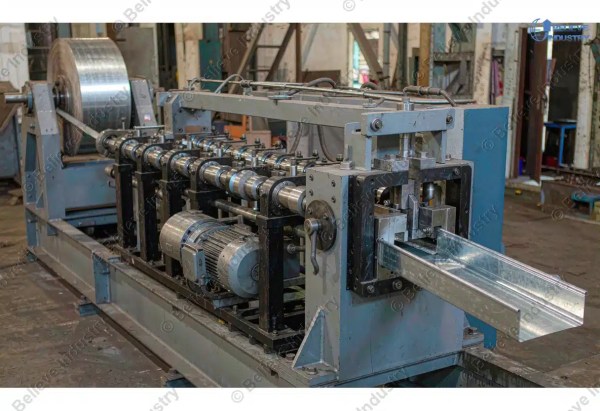




The global demand for high-density storage has positioned the آلة تشكيل الأسطوانات العمودية عالية السرعة as a critical asset in industrial manufacturing. To achieve high productivity, these machines traditionally operate at sheet speeds ranging from 5 to 150 m/min. However, maintaining tight manufacturing tolerances at such velocities requires advanced engineering to manage the massive forming forces that occur during the bending process.
The Architecture of Precision: 9 Critical Specifications
To dominate the market, a آلة تشكيل الأسطوانات العمودية عالية السرعة must meet these nine technical benchmarks derived from established industry standards:
Machine Stiffness Rating: A high stiffness (often targeted near 83,100 N/mm in experimental models) is vital to minimize the “roll gap increase” during high-pressure forming.
Force-Based Shaft Selection: Shafts must be selected based on rigorous force calculations to handle both torque and the significant bending moments produced during production.
Shoulder Alignment Precision: Baseline alignment for all rolls and spacers must be verified on a granite plate to ensure the vertical and horizontal guide planes are perfectly synchronized.
Constant Bend Allowance (Arc) Method: Flower pattern design should utilize this analytical solution to find precise 2D die dimensions, including web and flange lengths.
التعويض عن الارتداد المرن: Specialized stations are required to counteract the elastic recovery of the material, as unmodeled deflection can lead to higher-than-predicted springback angles.
Edge Stress Optimization: Pass designs must be simulated (using tools like ملف تعريف Ubeco) to ensure longitudinal membrane strain at the strip edges does not exceed yield limits, which prevents edge waviness.
Surface Preservation for Coated Steels: For zinc or aluminum-coated materials, the roll designer must minimize the speed differential between the rolls and the material to reduce “pick-up” and surface scratches.
Rafted Construction for Utilization: To achieve a line utilization of up to 80%, rafted construction should be used to drastically reduce tool changeover times.
Relocated Weld Lines: In structural uprights, the foresight to relocate weld lines away from prepunched holes is critical for maintaining overall part quality.
Managing Deflection and Profile Stability
One of the most significant challenges in operating a آلة تشكيل الأسطوانات العمودية عالية السرعة is “machine deflection”. This phenomenon, occurring when the sheet is being bent, can lead to part distortions and accelerated tool wear if not properly accounted for. Advanced manufacturers now use numerical simulations with deformable tooling to improve the prediction of forming loads and ensure geometric stability.
For a deeper dive into these mechanical interactions, explore our تحليل شامل لآلة تشكيل اللفة.
Innovative Tooling Integration
Efficiency is also dictated by how the آلة تشكيل الأسطوانات العمودية عالية السرعة interacts with auxiliary equipment. For example, servo technology in flying shear systems allows for accurate length cutting at high speeds without stopping the line. Furthermore, when processing specialized profiles, engineers can refer to the دليل تشكيل اللفائف (External) for best practices on roll design and material selection.
Industry Resource Links:
Precision Metalforming Association (PMA): Guidelines for Tolerances and Cost-Effective Design
Ubeco GmbH: Technical data on Rollform Design Software and Flower Patterning
ASTM International: Standards for Cold-Formed Steel Structural Members
Engineering Tool: Precision Upright Strip Width Calculator
Eliminate the guesswork in your warehouse racking design. Our interactive calculator utilizes the Constant Bend Allowance (Arc) Method and localized K-Factor logic to provide the exact unfold length required for your high-speed upright roll former. Whether you are working with high-yield steel or standard structural profiles, use this tool to ensure ±0.5mm manufacturing tolerances from the first station to the flying shear.
Upright Unfold Length Calculator
Based on Constant Bend Allowance (K-Factor) Method
o provide a comprehensive reference for your engineering and sales teams, I have compiled a Static Bend Allowance Reference Table. This table serves as a secondary “validation tool” alongside the interactive calculator, allowing for quick checks during the design phase of a آلة تشكيل الأسطوانات العمودية عالية السرعة.
Bend Allowance Reference Table (90° Bends)
Calculated using the Constant Bend Allowance (Arc) Method with a K-Factor of 0.448.
| Material Thickness (T) | Inside Radius (R) | Bend Allowance (BA) | Setback (Per Bend) |
| 1.5 ملم | 1.5 ملم | 3.41 mm | 3.00 mm |
| 2.0 ملم | 2.0 ملم | 4.55 mm | 4.00 mm |
| 2.5 ملم | 2.5 ملم | 5.68 mm | 5.00 mm |
| 3.0 ملم | 3.0 ملم | 6.82 mm | 6.00 mm |
| 3.5 mm | 3.5 mm | 7.96 mm | 7.00 mm |
| 4.0 ملم | 4.0 ملم | 9.09 mm | 8.00 mm |
الطاقة الشمسية العائمة قطاع ناشئ ولكنه سريع النمو، خاصةً في الدول ذات الأراضي المحدودة مثل كوريا الجنوبية وهولندا. تعتمد هذه التقنية على عوامات وإطارات على المسطحات المائية.
فرصة: على الرغم من استخدام عوامات بلاستيكية (البولي إيثيلين عالي الكثافة أو HDPE) في كثير من الأحيان، إلا أن أنظمة الإرساء والتثبيت والممرات المرتبطة بها لا تزال تتطلب هياكل معدنية مقاومة للتآكل. آلة تركيب هيكل الألواح الشمسية يمكننا إنتاج مقاطع الألمنيوم أو البوليمر المقوى بالألياف (FRP) المصممة خصيصًا والفريدة من نوعها واللازمة لهذه التطبيقات المتخصصة للغاية.
حافة الابتكار: يمثل هذا المجال المتخصص مجالًا يتطلع إلى المستقبل حيث يكون الدخول المبكر مع متخصص آلة تركيب هيكل الألواح الشمسية يمكنها تأمين مكانة مهيمن في السوق.
الخطوة التالية: هل أنت مستعد للاستفادة من هذه المشاريع ذات العائد المرتفع على الاستثمار باستخدام حل تشكيل اللفة المصمم خصيصًا؟ اتصل بنا قم بزيارة RollForming اليوم لمناقشة مواصفات جهازك.
يوفر هذا الفيديو نظرة عامة على خيارات تركيب الألواح الشمسية المختلفة، بما في ذلك الأنظمة الأرضية والسطحية، مما يساعد في توضيح الأنواع المختلفة من المكونات التي تحتاجها آلة تركيب هيكل الألواح الشمسية يمكن أن تنتج.
Frequenced Asked Quentions
While traditional ranges are 5–150 m/min, high-performance lines typically target a consistent 30m/min for heavy-duty racking
It is determined through analytical methods like the K-factor and bend allowance calculations to ensure 2D strip accuracy.
Low stiffness leads to an increased roll gap, which causes the profile to deviate from its intended cross-sectional dimensions.
Yes, provided the line is equipped with robust shafts and rolls made of hardened tool steel to resist accelerated wear.
They allow for “off-line” setup, meaning the machine can be reconfigured for a new profile in minutes rather than hours.
By optimizing the number of stations so that the transition of longitudinal strain is gradual and stays within elastic limits.
الخلاصة
Developing a high-performance آلة تشكيل الأسطوانات العمودية عالية السرعة requires balancing high-volume productivity with the physical realities of material strain and machine deflection. To stay competitive, manufacturers must integrate these 9 critical specs into their design phase. For more on optimizing your production, read our analysis on Roll Forming Market Risks or see our guide on Roll Forming Software Simulation.
Ready to engineer your next racking line? Contact Believe Industry Company today for a technical review.