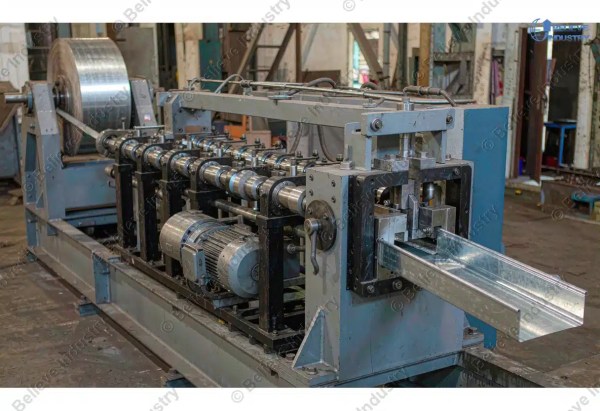



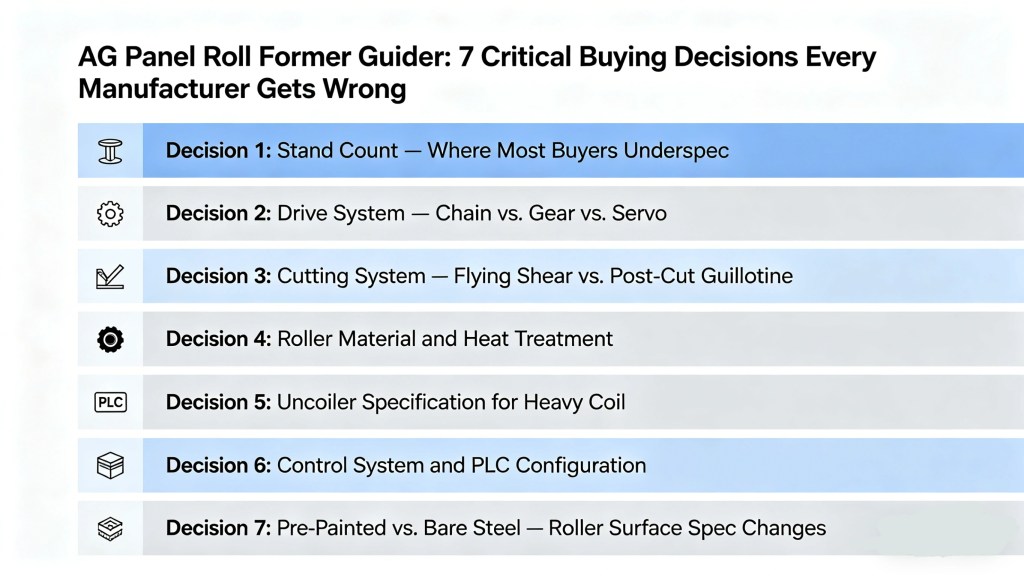
Bir AG panel profil oluşturma makinesinin is one of the most requested machines in the US agricultural and residential metal roofing market — yet it’s also one of the most misunderstood purchases in the industry. Buyers confuse stand count with actual forming quality. They treat material thickness ranges as afterthoughts. And they often discover hidden capability gaps only after the machine arrives on site.
This guide cuts through the noise. Whether you’re sourcing your first AG panel profil oluşturma makinesinin or replacing an aging line, the seven decisions below determine whether your investment pays off in 18 months or drags your margins for years.
What Is an AG Panel, Exactly?
The AG panel — Agricultural Panel, sometimes called “farm panel” — is a corrugated metal roofing profile that dominates rural and semi-commercial construction across the United States. Its defining geometry is a 1.25-inch-tall rib with a 9-inch major coverage width and a 2.67-inch minor rib spacing pattern, though exact dimensions vary by regional preference.

AG panel is not the same as R panel or PBR panel. The profile is softer in geometry, making it faster to produce, cheaper to install, and well-suited for agricultural buildings, storage sheds, carports, and light residential roofing. If you need a direct side-by-side comparison, our article on R Panel vs AG Panel: 7 Critical Factors breaks down the structural and production differences in detail.
A proper AG panel profil oluşturma makinesinin must reproduce the full profile geometry within ±0.5mm tolerance across the entire panel width — because AG panels are stacked and installed with overlapping side ribs, and any deviation compounds across a row.
Decision 1: Stand Count — Where Most Buyers Underspec
The forming stands are where the metal actually gets shaped. Each stand adds a small incremental bend, gradually walking the flat coil strip into the final profile geometry.
Most entry-level ag panel roll forming machines run 15 to 18 stands. That’s adequate for 26-gauge mild steel (0.55mm). Push beyond that — into 24-gauge (0.70mm) or 22-gauge (0.85mm) — and you’re asking each stand to do more bending work than it was designed for.
The result: springback, edge waves, and bow defects that no downstream straightening process can fully correct.
What to specify:
- 26-gauge to 24-gauge primary material: 16–20 stands is workable
- 24-gauge to 22-gauge high-tensile: request 20–24 stands minimum
- ASTM A792 Grade 80 steel: discuss with your manufacturer — some profiles need 24+ stands
Our dedicated page on the AG Panel Roll Forming Machine for US Market details the 15+ stand configuration we use for North American customers.
Decision 2: Drive System — Chain vs. Gear vs. Servo
Three drive architectures dominate the market. They are not equivalent.
| Sürücü Tipi | Speed Range | Maintenance Interval | Gürültü Seviyesi | En Uygun Olduğu Alan |
|---|---|---|---|---|
| Chain drive | 10–25 m/min | Every 500 hours | Yüksek | Budget entry lines |
| Gear drive | 15–35 m/min | Every 2,000 hours | Orta | Mid-volume production |
| Servo drive | 20–45 m/min | Every 5,000 hours | Düşük | High-volume, precision |
Chain-driven ag panel roll formers are cheaper upfront. The hidden cost is chain stretch. As the chain elongates over time, the timing between stands drifts — and you get inconsistent panel geometry in long production runs.
Gear-driven systems remove the chain entirely. Drive torque transfers directly from the gearbox to each stand shaft, eliminating stretch as a failure mode. Most serious production operations run gear boxes.
Servo-driven lines add closed-loop speed control. The machine measures actual shaft position 1,000 times per second and corrects deviations in real time. This matters most when you’re running thin high-tensile alloy coatings where even a 2% speed variation causes surface micro-cracking. For more context on why servo technology became standard in modern lines, see our analysis of Roll Forming Automation: 5 Ways to Slash Operating Costs.
Decision 3: Cutting System — Flying Shear vs. Post-Cut Guillotine
The cut quality on AG panel affects installation speed at the jobsite. Rough cuts mean installers spend time with grinders. Poor length accuracy means wasted material.
Flying shear (servo-synchronized): The cutting die accelerates to match strip speed, cuts, then returns. The material never stops moving. Production speed stays at maximum. Length tolerance is typically ±2mm.
Post-cut guillotine: The strip stops at a measured length, a hydraulic blade drops, and the strip moves again. Easier to calibrate. Length tolerance can reach ±1mm. But the stop-start cycle limits throughput to roughly 60–70% of the line’s theoretical maximum.
For a full technical breakdown of flying shear technology and why Believe Industry standardizes on servo-driven cutting, read Flying Shear: 4 Reasons Beli RollForming Uses Servo Technology.
Decision 4: Roller Material and Heat Treatment
This is the specification that separates a machine that lasts 15 years from one that needs roller replacement after 18 months.
AG panels have wide, flat-section ribs with frequent sharp transitions. Those transition zones apply concentrated stress to the roller surfaces at high contact pressure. Soft rollers deform. Deformed rollers produce panels with inconsistent rib height — a defect that’s invisible in individual panels but shows up immediately when panels are lapped at the ridge or eave.
Roller specifications to request:
- Malzeme: GCr15 bearing steel (AISI 52100 equivalent) for forming rolls; 40Cr for shaft and mandrel
- Hardness: HRC 58–62 after vacuum quench and double temper
- Surface finish: Ra ≤ 0.8 μm on contact faces (mirror-polished for prepainted coil)
- Chrome plating: Optional but recommended for lines running galvalume or PVDF-coated material
A dedicated deep-dive on roll material selection is available in Shaft for Roll Former: 6 Powerful Material Choices for Ultimate Longevity.
Decision 5: Uncoiler Specification for Heavy Coil
US agricultural roofing typically uses coils in the 15,000–20,000 lb range. The uncoiler is what separates a line that runs continuously from one that forces operators to stop every 90 minutes for a rethread.
A 5-ton or 7-ton single-head hydraulic uncoiler is the standard for mid-volume AG panel production. For operations running two shifts or more, a double-head uncoiler with hydraulic coil car allows the next coil to be loaded while the current coil still feeds — eliminating the changeover stop entirely.
What to check:
- Coil OD capacity: most production coils reach 1,500mm OD
- Coil ID range: 508mm (20″) is the US standard; 610mm (24″) is common in Mexico
- Expansion range: confirm the mandrel expands to hold the actual ID tolerance of your coil supplier
Our guide on Üretkenliği Hızla Artırın: 5 Tonluk Hidrolik Rulo Açıcı Rulo Şekillendirme Hatlarını Nasıl Dönüştürüyor? covers coil capacity planning in detail.
Decision 6: Control System and PLC Configuration
Entry-level ag panel roll formers ship with relay logic or basic PLC control. That means manual length adjustment, operator-dependent speed changes, and no production data logging.
A production-grade line needs:
- Siemens S7 or Allen-Bradley MicroLogix PLC (common spare parts globally)
- 7-inch or 10-inch color touchscreen HMI with recipe storage
- Encoder-based length measurement (±2mm over 10m)
- Auto-count with batch stop function
- Remote diagnostics capability via Ethernet/Modbus
The recipe storage function alone recovers its cost in three months. A line that runs 12 SKUs — different lengths, different order quantities — would otherwise require an operator to manually re-enter settings every time. With stored recipes, that’s a 30-second touchscreen call.
For perspective on how PLC control translates to operational efficiency, PLC Control for Roll Forming Efficiency: 7 Essential Reasons to Invest provides a detailed ROI breakdown.
Decision 7: Pre-Painted vs. Bare Steel — Roller Surface Spec Changes
This is where buyers who run prepainted Galvalume coil damage their tooling — and don’t know why until it’s too late.
Prepainted coil has a PVDF or SMP topcoat that is harder than the zinc base and softer than the steel substrate. When a forming roll with a rough surface finish contacts that coating at forming pressure, it microscopically abrades the paint. You get hairline scratches at every rib transition — invisible in the forming area, visible to end customers under UV light.
The fix is simple at the machine specification stage: request mirror-polished roller contact faces (Ra ≤ 0.4 μm) and chrome-plated rollers for all prepainted material lines. The cost delta is modest. The post-delivery cost of re-polishing or replacing rollers is not.
For more on material compatibility across steel types, see Roll Forming Material: Steel vs Aluminum — 8 Key Differences.
AG Panel Roll Former Technical Specification Reference
This table summarizes the key parameters buyers should confirm before placing an order for a North American market AG panel profil oluşturma makinesinin.
| Parametre | Giriş Seviyesi | Mid-Volume | High-Volume |
|---|---|---|---|
| Forming stands | 18 | 20 | 24 |
| Üretim hızı | 10–20 m/min | 20–35 m/min | 35–45 m/min |
| Malzeme kalınlığı | 0.40–0.55mm | 0.40–0.80mm | 0.40–0.95mm |
| Malzeme akma mukavemeti | up to 230 MPa | up to 345 MPa | up to 550 MPa |
| Drive system | Chain | Vites kutusu | Gear Box or Gear |
| Cut system | Guillotine | Flying shear | Servo uçan makas |
| PLC markası | Generic | Siemens/Delta | Siemens S7 |
| Roller hardness | HRC 52–55 | HRC 58–60 | HRC 60–62 |
| Roller surface | Standart | Polished | Mirror + Chrome |
| Uncoiler capacity | 3T | 5T | 7T hydraulic |
| Line footprint | ~15 m | ~18 m | ~30m |
AG Panel vs. PBR Panel vs. R Panel: Production Comparison
If you’re evaluating whether an AG panel profil oluşturma makinesinin doğru makine olup olmadığını veya bir PBR makinesinin daha fazla pazar talebini karşılayıp karşılamayacağını değerlendiriyorsanız, bu karşılaştırma başlangıç noktasıdır.
| Faktör | AG Panel | PBR Panel | R Panel |
|---|---|---|---|
| Rib height | 1.25″ | 1.25″ | 1.125″ |
| Coverage width | 36″ | 36″ | 36″ |
| Stant sayısı (tipik) | 18-20 | 16–20 | 16-18 |
| Primary market | Tarımsal, konut | Ticari, endüstriyel | Ticari çatı kaplaması |
| Montaj yöntemi | Vidalı sabitleme | Vidalı sabitleme | Vidalı sabitleme |
| Panel sertliği | Orta | Yüksek | Orta |
| Makine maliyeti (yaklaşık) | 45K–90K | 55K–110K | 50K–95K |
| Profil karmaşıklığı | Daha düşük | Yüksek | Orta |
PBR paneli, yapısal kaburga geometrisi bina kodlarında belirtildiği için daha sıkı şekillendirme toleransları gerektirir. AG paneli daha toleranslıdır — bu nedenle, metal çatı kaplama pazarına ilk kez giren işletmeler için önerilen başlangıç noktası budur.
Şu PBR panel profil oluşturma makinesi ve R Panel Profil Oluşturma Makinesi ürün sayfaları, doğrudan karşılaştırma yapmanız gerekiyorsa konfigürasyon farklılıklarını detaylandırır.
Common Defects from a Misspecified AG Panel Line (And How to Fix Them)
Edge wave: Usually caused by insufficient forming stands or excessive material tension from the uncoiler. Solution: add a leveling pass, reduce coil brake tension, and confirm roller diameter consistency across all stands.
Bow (lengthwise camber): The panel arcs from end to end. Primary cause is unequal roll penetration depth across the strip width. Check that left and right forming rolls are set to identical depth using feeler gauges or digital depth sensors. Our maintenance guide Roll Forming Preventative Maintenance: Maximize Uptime includes depth-setting procedures.
Springback at ribs: The formed angle partially opens after the rolls release the material. This is a material yield strength issue, not a machine fault. High-tensile steel needs additional over-bend compensation built into the roller geometry. If you’re seeing springback consistently, share your coil spec data sheet with your roll forming tooling team. Springback in Roll Forming: 4 Key Techniques covers the engineering fix.
Paint abrasion on prepainted coil: See Decision 7 above. If it’s happening post-delivery, immediate remediation is to reduce line speed by 20–30% and apply a light anti-static film to roller contact surfaces as a temporary measure while permanent roller re-finishing is arranged.
Length variation (±5mm+): Points to encoder drift or encoder wheel slip. Check encoder wheel contact pressure against the strip surface. Replace the wheel if the surface is worn flat. Recalibrate the PLC length parameter using a certified 10-meter reference bar.
Auxiliary Equipment That Determines Line Performance
Şu AG panel profil oluşturma makinesinin itself is only the center unit. The line’s actual output capacity depends on upstream and downstream equipment working in sync.
Coil car / coil handling: Without a hydraulic coil loading car, a 20,000 lb coil change takes two workers and 20 minutes. With a car, it’s one worker and four minutes.
Servo feeder / loop control: Maintains consistent tension between the uncoiler and the first forming stand. Eliminates the strip tension spikes that cause width variation on thin material. See the Servo Besleyici page for specifications.
Leveling machine: A 5- to 7-roll leveler between the uncoiler and the forming mill removes coil set — the natural curvature the strip develops during storage on the coil. Without it, the strip enters the forming stands at a slight arc, which introduces width variation and bow in the finished panel. For leveling unit selection criteria, Leveling Machine: 3 Essential Keys for Flat Perfection is the right starting point.
Stacking / bundling: Manual stacking at the discharge end limits the line speed to roughly 15–20 m/min because operators can’t handle panels faster. An automated conveyor-and-stacker system removes the human bottleneck and allows the line to run at its mechanical limit.
The full picture of what connects an AG panel profil oluşturma makinesinin to a complete production line is covered in Roll Forming Machine Auxiliary Equipment: 2025 Key Supplier.
Believe Industry AG Panel Roll Former: Key Specifications
Believe Industry Company has been manufacturing roll forming equipment since 2005 and has supplied metal roofing lines to customers in 40+ countries. The AG panel line built for the US market follows this configuration:
- Profile: Standard 36″ coverage AG panel, customizable to buyer’s profile drawing
- Forming stands: 18 standard, 22 or 24 available on request
- Malzeme: Galvalume, galvanized, or prepainted steel, 0.40–0.80mm (expandable to 0.95mm with tooling upgrade)
- Üretim hızı: 20–40 m/min depending on configuration
- Drive: Chain drive standard; servo drive option available
- Kesme: Hydraulic servo flying shear, ±2mm length tolerance
- PLC: Siemens S7-200 Smart or S7-1200 with 10″ color touchscreen HMI
- Roller material: GCr15, HRC 58–62, chrome-plated for prepainted applications
- Rulo açıcı: 5T single head hydraulic; 7T double head optional
- Electrical: 380V/50Hz standard; 480V/60Hz (US spec) available
- Certification: CE, ISO 9001:2015
We’ve installed AG panel lines in partnership with roofing manufacturers across the US, Canada, and Australia. For Australian-specific configurations, Roll Forming Machine Australia: 7 Powerful Reasons to Choose Believe Industry covers regional electrical and compliance requirements.
How to Evaluate Suppliers for an AG Panel Roll Former
The machine specification is only part of the evaluation. After shortlisting machines on technical merit, the supplier variables that actually determine project success are:
Fabrika denetimi: Request a test run at the factory using your coil spec (or a representative sample). Any manufacturer unwilling to run material before shipment is a risk.
On-site installation and commissioning: Şu AG panel profil oluşturma makinesinin installation process involves precise stand alignment, roller depth setting, and speed calibration that cannot be done correctly by a general contractor following a manual. Insist on factory-trained installation engineers. Rulo Şekillendirme Makinesi Kurulum Servisi describes what proper commissioning looks like.
Spare parts inventory: Ask specifically about spare forming rolls, drive gears, and PLC components. A line that stops for three weeks waiting for a drive gear from overseas is a $50,000+ downtime event.
Documented training: Operators need to understand stand depth adjustment, encoder calibration, and cutting die maintenance. Training should be documented, not verbal.
For a comprehensive supplier evaluation framework, Rulo Şekillendirme Makinesi Nasıl Satın Alınır: 2026 İçin Eksiksiz Alıcı Rehberi walks through the full sourcing process from RFQ to final acceptance.
AG Panel Roll Former: Frequently Asked Questions
Entry-level lines from Chinese manufacturers start at approximately 45,000–45,000–60,000 for a 15-stand gear-drive configuration. A complete production-ready line with uncoiler, leveler, and stacker runs 75,000–75,000–120,000. High-volume servo lines with full automation reach 150,000–150,000–250,000. For a detailed cost breakdown, Rulo Şekillendirme Makinesi Fiyatı: 2026 İçin En İyi 7 Nihai Sır covers the full price spectrum.
Production lead time at Believe Industry is 45–60 days after order confirmation and deposit receipt. Ocean freight from Shanghai to US West Coast ports adds 18–22 days. East Coast ports add 25–30 days. Plan for 75–90 days total from order to delivery at your facility.
Technically possible with a full tooling change, but not economical for dual-market operations. The profile geometry difference requires replacing all forming rolls (15–22 pieces), which takes 8–12 hours of skilled labor. Operations running both profiles in significant volume should budget for two separate machines.
Most flying shear configurations handle 1,000mm to 20,000mm (1 foot to 65 feet). Longer panels require a longer discharge support table — typically 1.5× the maximum panel length. Custom lengths beyond 20,000mm are possible with extended outfeed systems.
The machine frame and forming geometry are the same. The differences are in roller surface finish (mirror polish vs. standard), roller plating (chrome vs. bare), and discharge conveyor design (padded vs. standard). Specify your intended material at the RFQ stage.
CE certification covers the machine’s electrical and mechanical safety compliance with European standards, which US import authorities recognize. ISO 9001 covers manufacturing quality management. For US-specific electrical compliance, request machines built to NEMA/NEC standards for 480V/60Hz operation.
Start with your current panel purchase price from a service center vs. your coil cost plus machine amortization. For most operations running 5,000+ panels per month, in-house production achieves payback in 18–30 months. The ABD Çatı Kaplama Kar Hesaplayıcısı is a useful starting point for the numbers.
The 22-stand machine adds four additional forming passes between the major geometry stations. This reduces per-stand forming stress, extends roller life by approximately 40%, and allows the machine to run harder materials (higher yield strength steels) without springback. For most standard Galvalume coil, 15 stands is sufficient. For high-tensile applications, 18 is the better choice.
External Reference Sources
The following sources provide technical and market context for AG panel profil oluşturma makinesinin buyers evaluating production requirements and material standards:
- MBMA Metal Building Systems Manual — Roofing Panel Specifications: The Metal Building Manufacturers Association publishes dimensional standards for AG, R, and PBR panel profiles used in US construction projects.
- ASTM A792 / A792M Standard Specification for Steel Sheet, 55% Aluminum-Zinc Alloy-Coated: The primary material standard for Galvalume coil used in AG panel production.
- SMACNA Architectural Sheet Metal Manual: Industry standard for sheet metal installation, including standing seam and exposed fastener roofing panel installation requirements.
- Metal Construction Association Technical Resources: MCA publishes application guides and product testing data for metal roofing profiles, including load span tables and installation guidance for AG panel systems.
- Rollforming Magazine — Industry Technical Articles: Industry publication covering roll forming process engineering, tooling design, and equipment selection for North American manufacturers.
Summary
Bir AG panel profil oluşturma makinesinin is a profitable investment when specified correctly and a persistent maintenance problem when it’s not. The seven decisions above — stand count, drive system, cutting method, roller material, uncoiler capacity, PLC configuration, and surface finish for coated materials — determine which outcome you get.
Believe Industry Company builds AG panel lines for the North American market from our Wuxi facility. We’ve shipped to customers in over 40 countries since 2005, and our US-specification lines run at 480V/60Hz with Siemens PLC and servo flying shear as standard. Factory inspection before shipment is available for every order.
If you’re evaluating a purchase, the Roll Forming Machine Components: 10 Must-Have Parts for Zero-Waste Fabrication article gives you a technical checklist to bring to any supplier conversation. And if you want to understand the full line architecture before committing to a configuration, Buy a Roll Forming Machine walks through the procurement decision from the beginning.
Değişiklik Günlüğü
| Sürüm | Tarih | Yazar | Değişiklikler |
|---|---|---|---|
| 1.0 | 2026-05-06 | Believe Industry | Initial publication. 13 sections, 7 buyer decision framework, 3 comparison tables, 8 FAQs, defect troubleshooting guide, 15 internal links, 5 external authority links. |
Next review date: 2026-08-06