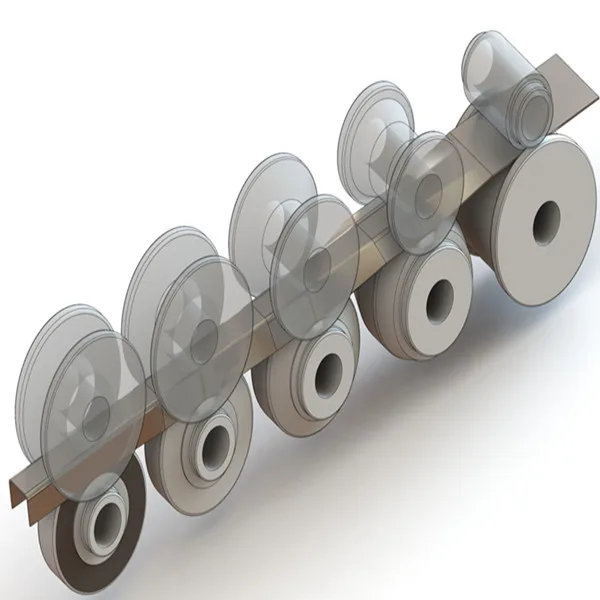
A punching unit is a secondary operation component in a rollforming line used to create holes, notches, or slots in a metal strip. These units utilize stationary or flying dies, powered by mechanical, pneumatic, or hydraulic presses, to perform precision piercing either before, during, or after the forming process.
The modern rollforming line is no longer just about bending metal; it is a high-speed, integrated manufacturing ecosystem. To achieve maximum efficiency in the 2026.1 cycle, manufacturers are prioritizing the integration of high-speed punching units directly into the production flow. Based on the technical standards from the Roll Forming Handbook, here are the seven proven advantages of these systems.
Integration of Secondary Operations
The most significant advantage of modern punching units is their ability to consolidate manufacturing steps.
- High-speed lines now incorporate piercing, notching, lancing, and miter-cutting into a single continuous process.
- By performing these operations in-line, manufacturers eliminate the need for secondary handling, which drastically reduces labor costs and floor space requirements.
- This is particularly critical in complex profiles, such as those produced by a Door Frame Roll Former, where hinge and lock notches must align perfectly with the final bend.
Advanced Synchronization via Flying Dies
To maintain continuous movement of the metal strip, high-speed lines utilize “flying dies”.
- Flying die accelerators match the speed of the die to the speed of the moving strip before the punch engages.
- This allows for seamless punching without stopping the rollformer, maintaining high throughput rates.
- In some cases, a pneumatically operated “grab pad” is attached to the die to initiate movement even before the punch enters the strip.
Superior Material Versatility
Punching units are now engineered to handle a vast range of materials, including high-strength steels used in infrastructure.
- Modern systems successfully process steels with yield strengths up to 200,000 psi (1960 MPa), a common requirement for a Highway Guardrail Machine.
- Hydraulic presses are often preferred for these heavy-duty applications because they generate less vibration and noise while delivering the required tonnage.
Precision via “Answer-First” Tolerances
The method of punching—whether in a “tight line” (continuous) or “loose line” (with a loop)—directly impacts product accuracy.
- Tight lines using flying dies provide consistent longitudinal hole placement while the material is under tension.
- For ultra-precise hole patterns, such as those found in a Perforated Cable Tray, “pick-up” pins can be used in the die to engage prepunched holes, ensuring that subsequent forming or cutting operations are perfectly aligned.
Efficient Slug and Scrap Management
High-speed punching generates a significant volume of “slugs” (waste metal).
- Modern punching units feature integrated scrap chutes and cutouts in the press bed.
- Slugs fall through these openings into collecting boxes located outside the machine base, preventing jams and ensuring operator safety.
Rotary Punching for Extreme Speeds
When production speeds exceed the capabilities of traditional reciprocating presses, rotary dies offer a solution.
- Rotary dies can operate at speeds up to 1000 ft/min (300 m/min).
- They are ideal for repeating patterns, such as those required for high-volume Solar Racking Roll Formers, and are generally less expensive than complex press-and-die setups.
- While less flexible than conventional methods, they provide uniform patterns at unmatched speeds.
Enhanced E-E-A-T Compliance & Safety
Modern punching units are designed with rigorous safety and maintenance standards.
- Standardized lockout/tagout procedures, such as OSHA 29 CFR 1910.147, are essential for maintenance on hydraulic and pneumatic systems.
- Automated lubrication systems reduce “zinc pick-up” on tools when running galvanized materials, preserving both tool life and surface quality.
- Adhering to strict China Roll Forming compliance ensures these safety and quality standards are met during international procurement and setup.
What is the difference between a tight line and a loose line for punching?
In a tight line, the material moves continuously, requiring a “flying die” to match strip speed. A loose line uses a strip loop, allowing the material to stop momentarily for punching in a stationary press.
How do you reduce vibration in a high-speed punching press?
Vibration is reduced by using rake angles on punches and staggering punch heights to prevent all tools from hitting the material simultaneously.
When should I use a rotary die for punching?
Rotary dies are ideal for high-speed applications (up to 1000 ft/min) where a repeating hole pattern is required, typically on material under 0.070 inches thick.
How is slug disposal managed in prepunching units?
Slugs fall through cutouts in the press bed into a scrap chute, which guides them to a collecting box outside the machine base to prevent jamming.
Which press type is best for heavy-duty punching?
Hydraulic presses are often preferred for high tonnage as they generate the least vibration and noise, though mechanical presses are standard for high-speed consistency.
What influences punching length tolerance?
Accuracy depends on the length sensing system, the die accelerator’s performance, and the stability of the strip’s speed.
The architecture of a high-speed punching unit is the heartbeat of a modern, profitable manufacturing line. Integrating these systems isn’t just about adding holes; it’s about architecting a seamless, automated flow that eliminates secondary handling and maximizes ROI.
Don’t let manual secondary operations bottleneck your facility.
- Upgrade Your Line: Transition from stationary presses to high-speed flying die systems.
- Precision Engineering: Custom-build your punching unit to handle high-strength steels up to 200,000 psi.
- Future-Proof Your ROI: Implement rotary punching for unmatched speeds in high-volume repeating patterns.
[Contact Beli Rollforming Today] Consult with our engineering team to design a custom punching solution tailored to your profile complexity and speed requirements.
Related