






The MFMA-4 standard shows up on almost every strut channel datasheet. Buyers see the line and assume the channel is strength certified. It is not. MFMA-4 controls shape and fit, not how much load the channel carries.
That difference decides real projects. A channel can meet MFMA-4 dimensional rules and still fail a span check. Another channel can carry the load but accept no standard fitting. This guide separates the two so you can specify with confidence.
If you are new to the product itself, read our คู่มือรางเหล็กสำหรับงานโครง first. It defines the profile and the accessories. This article goes deeper on the standard printed in the spec.
What the MFMA-4 standard actually covers
MFMA-4 is Metal Framing Standards Publication No. 4, issued by the Metal Framing Manufacturers Association. It sets the dimensions and tolerances for cold formed metal channel and its fittings. The goal is interchangeability. A 41 mm spring nut from one maker should slide into a 41 mm channel from another.
The standard does three things. It fixes the nominal cross section, it limits how far a made channel may drift from that section, and it gives the test basis that load tables rely on. It does not rate a channel for a given load. That job belongs to AISI S100-2016, the American Iron and Steel Institute specification for cold formed steel structural members.
Here is the clean split buyers should keep in mind.
| เอกสาร | What it controls | What it does not |
|---|---|---|
| MFMA-4 | Channel dimensions, tolerances, fitting interface | ความจุโหลด |
| AISI S100-2016 | Design of cold formed steel members, section properties | Fitting interchangeability |
| ASTM A653 / A123 | Steel grade and zinc coating | Shape or strength design |
A spec that says only “complies with MFMA-4” is incomplete for a load bearing support. It tells you the channel will fit standard hardware. It says nothing about whether it holds your pipe run. Ask for the load table and the design standard behind it.
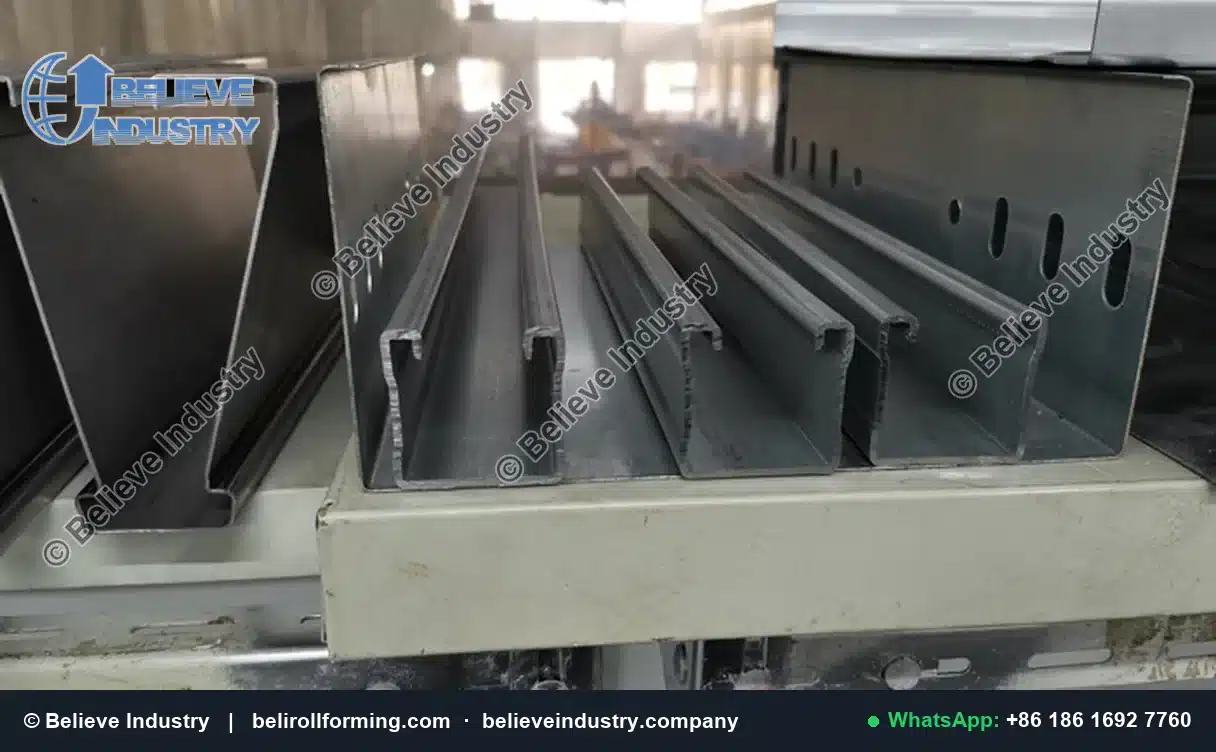
Sample sections are checked against MFMA-4 dimensional limits before bulk order.
The dimensions MFMA-4 standard fixes
North American metal framing grew around a 41 mm, or 1-5/8 inch, base width. Accessory makers tooled their nuts and brackets to that number, so it became the default. Depth is the variable engineers change to buy stiffness.
| Property | ค่าที่พบบ่อย | Why it matters |
|---|---|---|
| Base width | 41 mm / 1-5/8 in | Controls fitting compatibility |
| ความลึกของราง | 21, 41, 52, 62, 82 mm | Deeper section carries more load |
| ความยาวสต็อก | 3 m และ 6 m หรือ 10 ft และ 20 ft | Longer stock means fewer joints |
| Slot type | ร่องยาว, รูกลม, แบบทึบ | กำหนดความยืดหยุ่นในการยึดติด |
| Section form | เดี่ยว, ประกบหลัง, คู่ | Built up pairs raise stiffness |
Depth does most of the work in bending. A 41 x 21 mm shallow channel suits a wall mounted cable run. A 41 x 82 mm section handles longer spans and heavier pipe. Our คู่มือเปรียบเทียบรางเหล็ก strut เกจ 12 กับเกจ 14 covers what gauge changes once the depth is fixed.
Metric and imperial sizes are close but not identical. A 41 mm channel is slightly wider than a true 1-5/8 inch section. Confirm the actual lip opening before mixing fittings from different regions on one job.
The 6 fit rules behind the MFMA-4 standard
Tolerances are where a compliant datasheet meets a real installation. These six numbers decide whether a channel fits the hardware you ordered.
- Base width holds at 41 mm. Spring nuts are tooled to this width. Drift beyond the tolerance and the nut either drops through or binds.
- Length tolerance is about plus or minus 1/16 in. Two channels meet at a splice. If both run long, the joint misses the bolt holes.
- Lip inturn is controlled. The lip angle sets how far a nut can rotate and grip. Too open and the nut spins. Too closed and it will not seat.
- 12 ga base metal sits near 2.66 mm. A US electrical specification sets 12 gage at 0.1046 inch minimum for MFMA-4 channel. Thinner stock will not meet that spec.
- Slotted channel keeps about 85 percent of solid capacity. Slots remove steel from the back face. Published slotted tables already include this, so never derate twice. Our คู่มือเปรียบเทียบรางเหล็ก strut แบบเจาะร่องกับแบบทึบ shows the calculation.
- Built up sections are spot welded about 2 to 3 in on center. Pairing two channels only acts as one section if the weld connects them along the length.
These rules matter most on mixed supplier jobs. When the channel, nut and bracket all come from one maker, small drift hides. When they come from three, it shows up as a fitting that will not slide. Our strut channel manufacturers in the USA guide lists the plant checks that catch this before shipment.

A slotted section keeps about 85 percent of the solid channel load capacity.
MFMA-4 standard and the load table are different questions
MFMA-4 gives the section its shape and the test basis. AISI S100-2016 turns that section into a load number. Most manufacturer tables use a maximum bending stress of 25,000 psi. That figure comes from a virgin steel minimum yield of 33,000 psi, cold worked to an average yield around 42,000 psi.
Deflection often governs before strength does. General framing is commonly held to a span divided by 240. A pipe run can be strong enough and still sag enough to fail the alignment check. Read both the load column and the deflection column.
One more detail separates a useful table from a decorative one. Lateral bracing reduces allowable load on long spans. A 41 x 41 mm, 12 ga solid channel rated near 1,740 lb at a 24 in span drops sharply by 120 in once bracing is accounted for. The table should show that reduction, not just the short span number.
Steel grade and coating belong in the same sentence. Pre galvanized channel is formed from sheet to ASTM A653, often with G90 or Z275 coating. Hot dip galvanizing after fabrication follows ASTM A123, which the American Galvanizers Association documents. The coating process changes tolerance behavior, so state which one the project calls for.
How to specify the MFMA-4 standard on a real project
A short, complete spec line saves a round of quote revisions. Write it in this order.
- State the standard: channel and fittings comply with MFMA-4.
- State the section: base width, depth, gauge and slot pattern.
- State the design basis: AISI S100-2016, with the load table attached.
- State the steel: grade and coating, ASTM A653 pre galvanized or ASTM A123 hot dip.
- State the deflection limit: L/240 for general framing, tighter for brittle services.
- State the fit check: sample channel accepts the specified nut and bracket before bulk order.
The last line is the one most often skipped. Ask a supplier for a short sample and fit your actual fittings. It takes a day and prevents a container of channel that no bracket will accept. Our คู่มือเครื่องขึ้นรูปรางเหล็ก explains how the profile is made, which helps when a tolerance problem traces back to the tooling. Both the guide and this standard sit inside the wider หมวดเครื่องขึ้นรูปด้วยลูกกลิ้ง.
Beli Rollforming has built roll forming equipment since 2005 and delivered 500+ machines to 50+ countries. Our team includes 80+ engineers and technicians working from a 15,000 m² facility. Every complete machine ships with a 24-month warranty on the complete machine, covering mechanical, hydraulic and electrical systems, with wear parts excluded.
คำถามที่พบบ่อย
1. What is the MFMA-4 standard?
MFMA-4 is Metal Framing Standards Publication No. 4 from the Metal Framing Manufacturers Association. It sets dimensions and tolerances for cold formed strut channel and fittings so parts from different makers interchange.
2. Does MFMA-4 rate load capacity?
No. MFMA-4 controls shape, dimensions and fit. Load capacity comes from a separate design standard, AISI S100-2016, and from the manufacturer’s published load table.
3. What base width does MFMA-4 use?
The North American default is 41 mm, or 1-5/8 inch. Accessories are tooled to this width, which is why a 41 mm nut fits channel from most suppliers.
4. How thick is 12 ga strut channel?
About 2.66 mm, or 0.1046 inch minimum base metal thickness in a US electrical specification. 14 ga is about 1.9 mm and suits lighter conduit and cable support.
5. What length tolerance applies to MFMA-4 channel?
Roughly plus or minus 1/16 inch. At a splice, two long pieces can miss the bolt holes, so this number matters on multi piece runs.
6. Why does slotted channel carry less load?
Slots remove steel from the back face. A slotted section keeps about 85 percent of the solid section capacity, and published slotted tables already include the reduction.
7. Which standard governs the load table?
AISI S100-2016 governs the design of cold formed steel structural members. Many channel tables use a maximum bending stress of 25,000 psi derived from cold worked steel yield around 42,000 psi.
8. What deflection limit is typical for strut channel?
General framing is commonly limited to L/240, meaning span divided by 240. Brittle services such as glass pipe or plaster need a tighter limit.
9. Does galvanizing change MFMA-4 compliance?
The coating does not change the dimensional standard, but pre galvanized ASTM A653 and hot dip ASTM A123 channel behave differently in tolerance and fit. State the coating in the spec.
10. Can I mix fittings from different MFMA-4 suppliers?
Usually yes on nominal 41 mm parts, but metric and imperial sizes are close, not identical. Fit a sample nut and bracket before placing a bulk order.
อัปเดตล่าสุด: 2026-11-25
บันทึกการเปลี่ยนแปลงบทความ
- 2026-11-25: Published. MFMA-4 scope, dimension table, 6 fit rules, load table basis and project spec checklist, 10 FAQs.
ตัวกระตุ้นการทบทวนครั้งต่อไป
- MFMA-4 revision or new Metal Framing Manufacturers Association publication.
- AISI S100 edition change affecting cold formed design stress.
- New ASTM coating specification adopted in strut channel procurement.




 ไทย