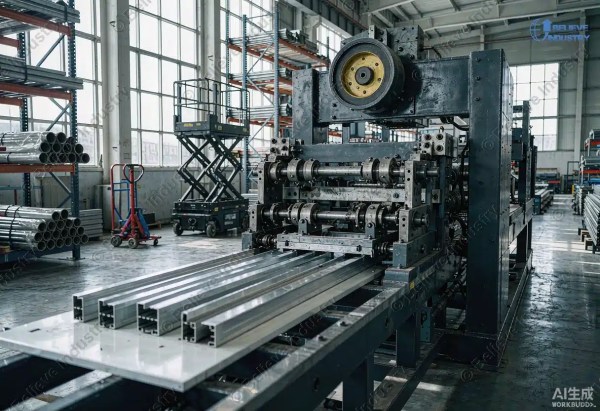










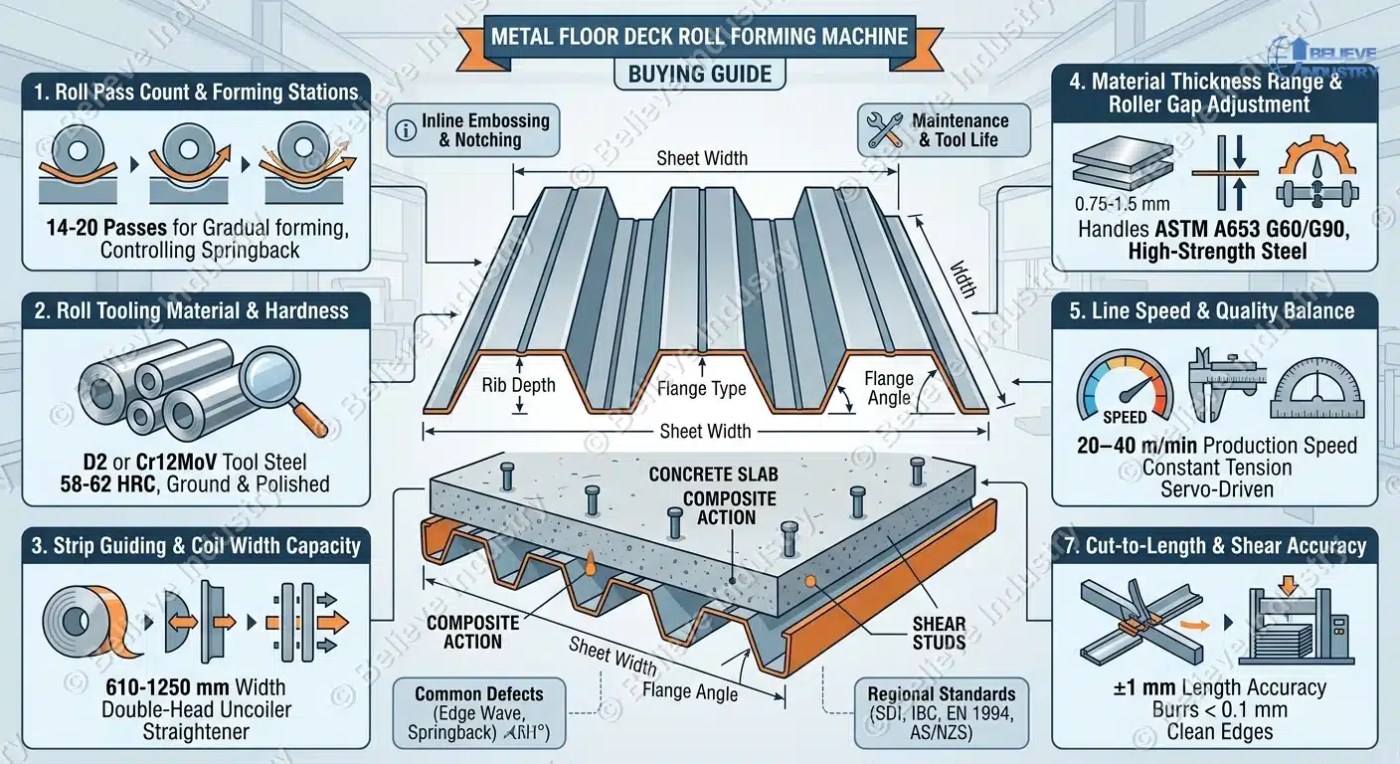
A metal floor deck roll forming machine turns galvanized coil into the ribbed steel sheets that carry concrete slabs in commercial buildings. The profile it produces is not decorative. Rib depth, sheet width, and dimensional accuracy directly control how much load the deck can carry and how it performs in a composite slab. This metal floor deck roll forming machine buying guide breaks down the 7 specs that decide profile quality, so you can compare lines on data instead of brochures.
Floor deck is a cold-formed steel sheet with trapezoidal ribs that supports poured concrete and acts as the working platform during construction. Builders lay it, weld or screw it to beams, pour concrete on top, and the two materials work together as a composite slab. When the profile geometry drifts, the slab loads shift, the panels stop nesting, and the project loses time on site.
Most buyers focus on line speed and price. Both matter, but neither explains why one machine holds a ±0.5 mm profile and another drifts after a week of production. The answer sits in roll pass count, tooling steel, strip guiding, and shear accuracy. This floor deck machine guide covers each spec with the target values that good deck lines hold, and it ends with a checklist you can take to any supplier meeting.
Floor deck demand now comes from more than high-rise towers. Data centers, warehouses, hospitals, and parking structures all specify composite floor deck, and each project buys by profile spec, not by brand. That is why dimensional consistency across a whole production shift is worth more than a slightly higher line speed.
The 7 specs below are listed in the order they affect the profile on the line. Work through them top to bottom, and you will see where a cheap machine hides its compromises.
1. Roll Pass Count and Forming Stations
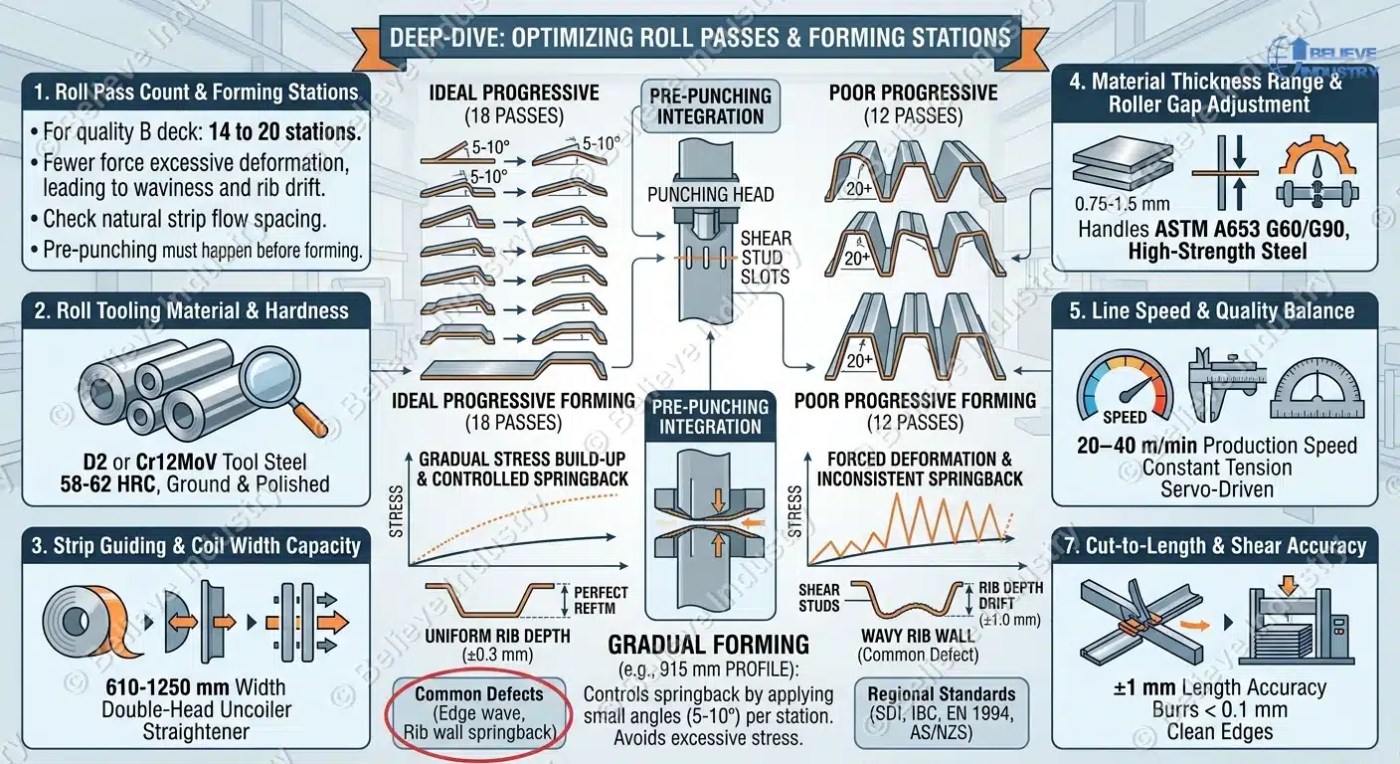
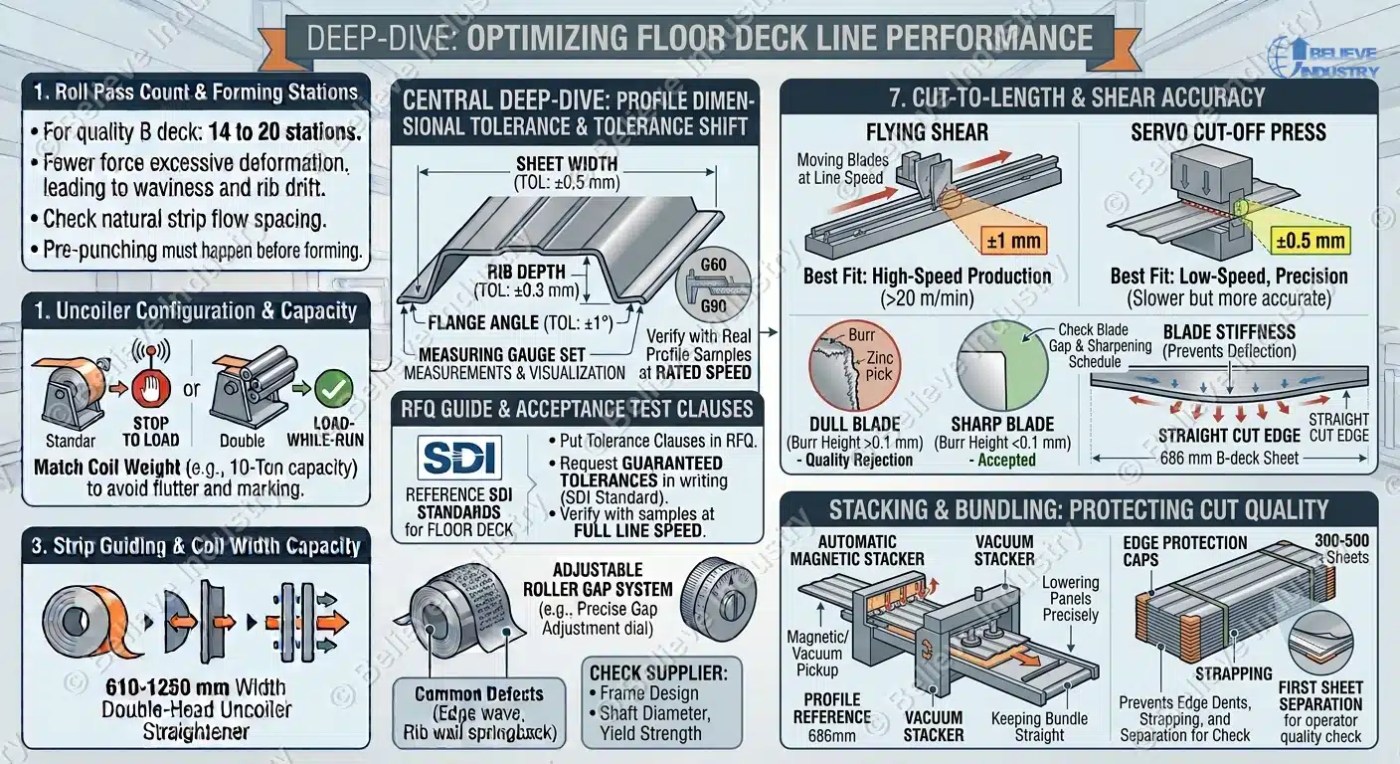
Roll pass count is the first spec that decides profile quality on a floor deck roll forming machine. A floor deck profile like B deck needs 14 to 20 forming passes to bend the strip gradually from flat coil into the final ribbed shape.
Each pass bends the material by a small angle, usually 5 to 15 degrees per station. Gradual forming controls springback, which is the tendency of steel to partially return to its flat shape after bending. Springback is the main reason thin deck profiles get wavy rib walls. A machine with 12 passes or fewer forces more deformation per station, and the result shows up as inconsistent rib depth across the sheet.
Check the station layout on the machine drawing, not just the number of stands. Stations should be spaced to allow natural strip flow, with no tight 90 degree bends in a single pass. Also check where pre-punching happens. Deck sheets often need notches or slots for shear studs, and punching must occur before forming while the strip is still flat. The Профилегибочная машина для производства настилов пола 915 uses a full 18-pass sequence for the 915 mm modular profile, which is typical for a quality deck line. When a supplier quotes a floor deck machine with fewer stations, ask for measured profile samples at rated speed before you commit.
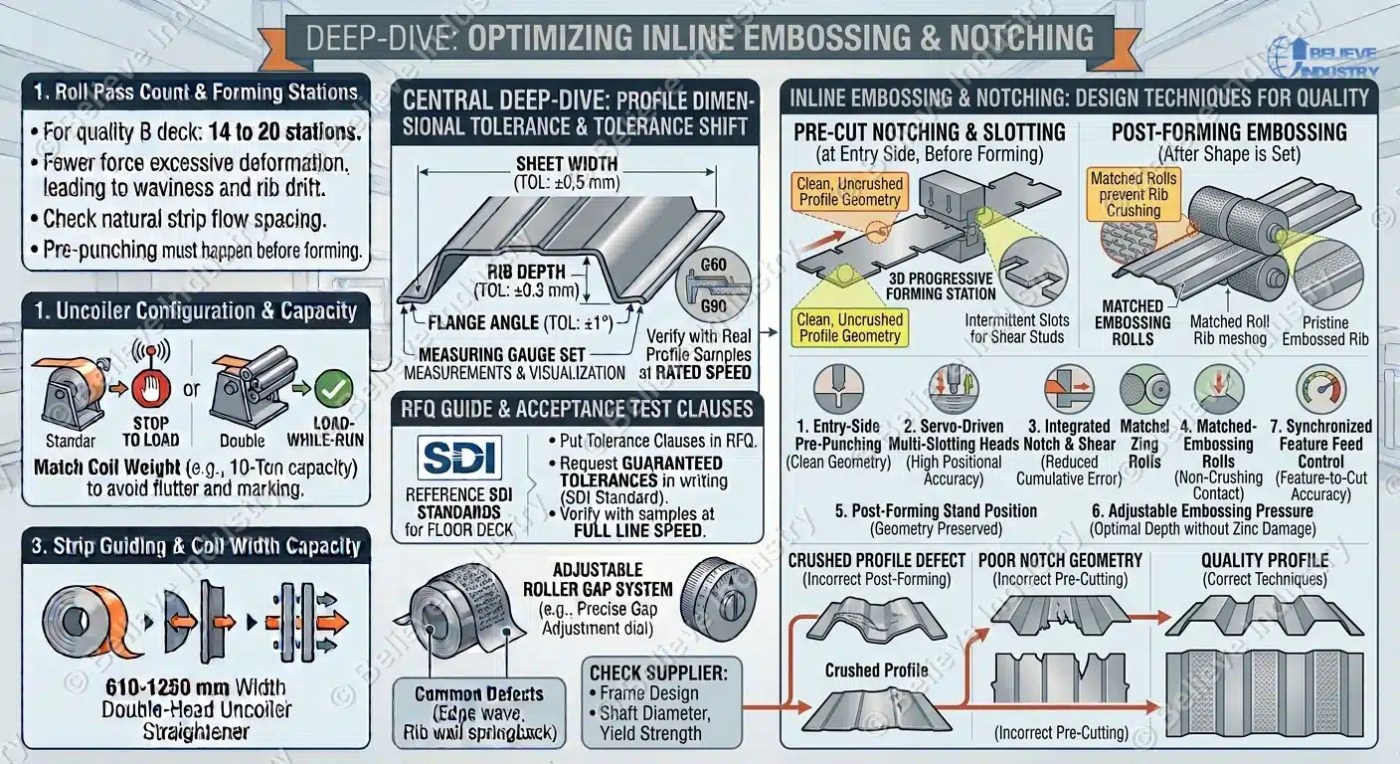
Punching and notching deserve a separate check on the drawing. If the line uses a pre-punch station, confirm the punch clearance for your material thickness. A punch with too much clearance produces a torn edge that can initiate cracks when the rib is formed over it. For deck profiles with intermittent slots, servo-driven punching heads hold slot position within ±0.5 mm along the sheet length.
2. Roll Tooling Material and Hardness
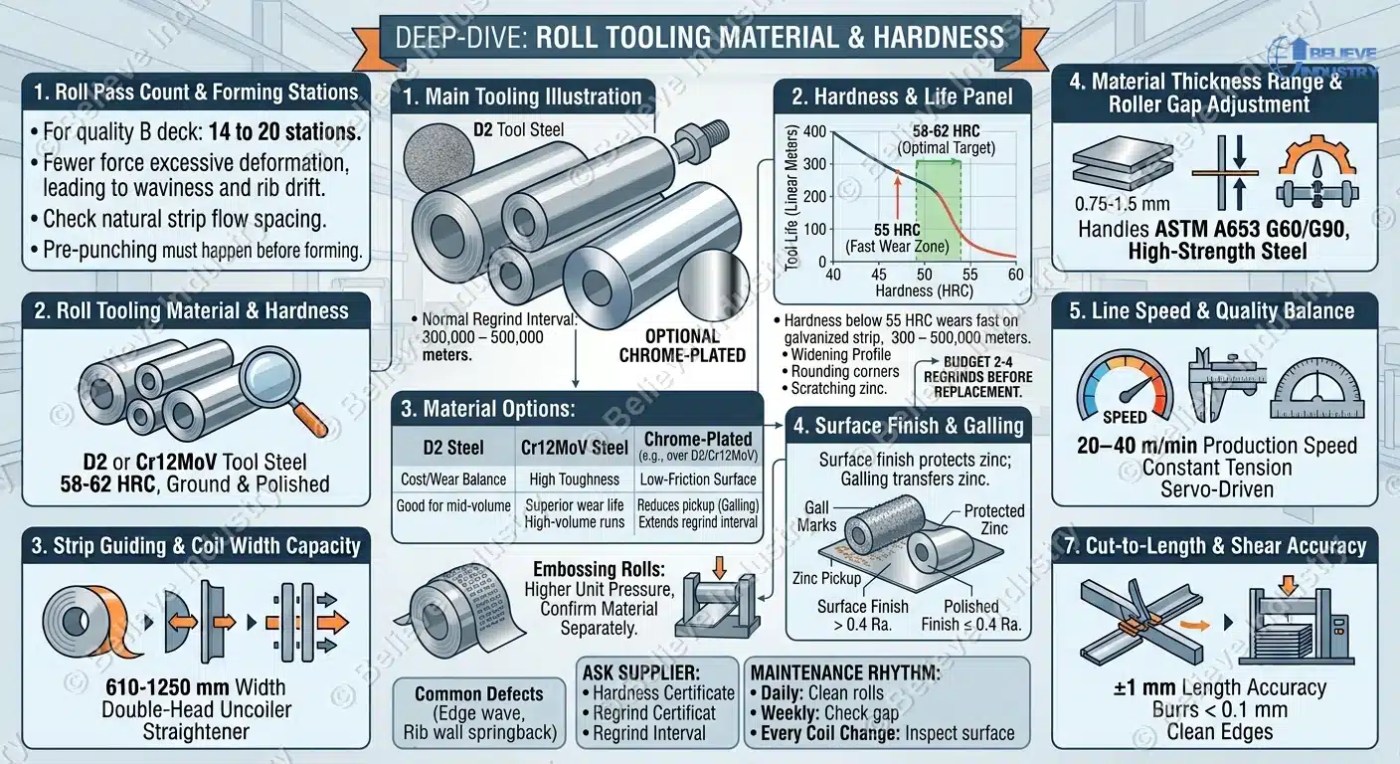
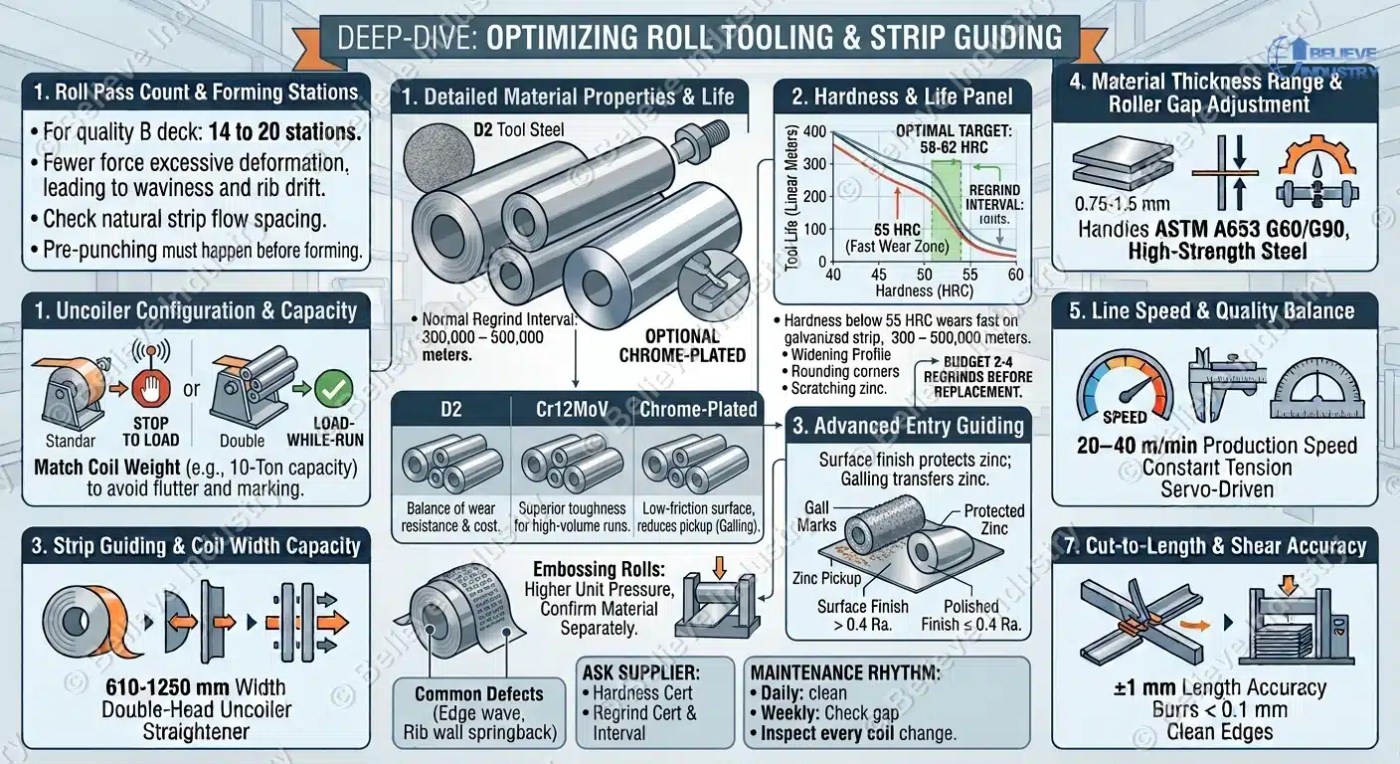
Roll tooling material decides how long a metal floor deck roll forming machine holds its profile tolerances. Deck tooling is typically machined from D2 or Cr12MoV tool steel, hardened to 58 to 62 HRC, then ground and polished.
Hardness below 55 HRC wears fast on galvanized strip. Worn rolls widen the profile, round off rib corners, and scratch the zinc coating. Three tooling options dominate the market. D2 steel balances wear resistance and cost, Cr12MoV adds toughness for high-volume runs, and chrome-plated rolls add a low-friction surface that reduces pickup and extends tool life between regrinds. Ask the supplier for the tooling hardness certificate and the expected regrind interval, normally 300,000 to 500,000 linear meters for a deck profile.
Surface finish on the rolls matters as much as hardness. A polished finish of 0.4 Ra or better protects the galvanized surface and reduces galling, which is the transfer of zinc onto the roll face. Galling leaves marks on every sheet it touches until the roll is cleaned. If you plan to run embossed or textured deck, confirm the texture roll material separately, because embossing rolls carry higher unit pressure than plain forming rolls. For related guidance on tooling for other profiles, see our surface scratch and mark defect guide.
3. Strip Guiding and Coil Width Capacity
Strip guiding controls the material before it reaches the first pass, and it decides edge quality on the finished profile. A floor deck line needs an entry system that accepts coil widths from 610 mm to 1250 mm with side guides and a straightener.
Poor guiding lets the strip wander sideways. Wandering shows up as uneven rib depth, edge wave, and misaligned locking edges on the deck sheet. Edge wave is the most common deck quality defect, and it almost always traces back to strip tension or entry alignment. The explains how coil conditioning affects the whole line.
Check the uncoiler configuration. A single-head uncoiler needs a stop to load the next coil, which interrupts production. A double-head uncoiler loads the next coil while the line runs, cutting changeover to 2 to 5 minutes. Match the uncoiler to your coil weight. A 10-ton coil needs a mandrel that holds it without vibration at line speed. Light-duty uncoilers let the strip flutter, which marks the profile and produces inconsistent rib height across the sheet width.
The straightener is just as important. Deck strip under 1.0 mm thick tends to have coil set, and a 5-roll straightener corrects it before the strip enters the first forming station.
An entry loop or accumulator between the uncoiler and the forming mill absorbs speed differences when the line accelerates and decelerates. Without it, tension spikes at every speed change and the profile distorts at exactly the point where the operator needs it stable. For deck lines running above 25 m/min, plan for a loop pit or a horizontal loop at the entry side.
4. Material Thickness Range and Roller Gap Adjustment
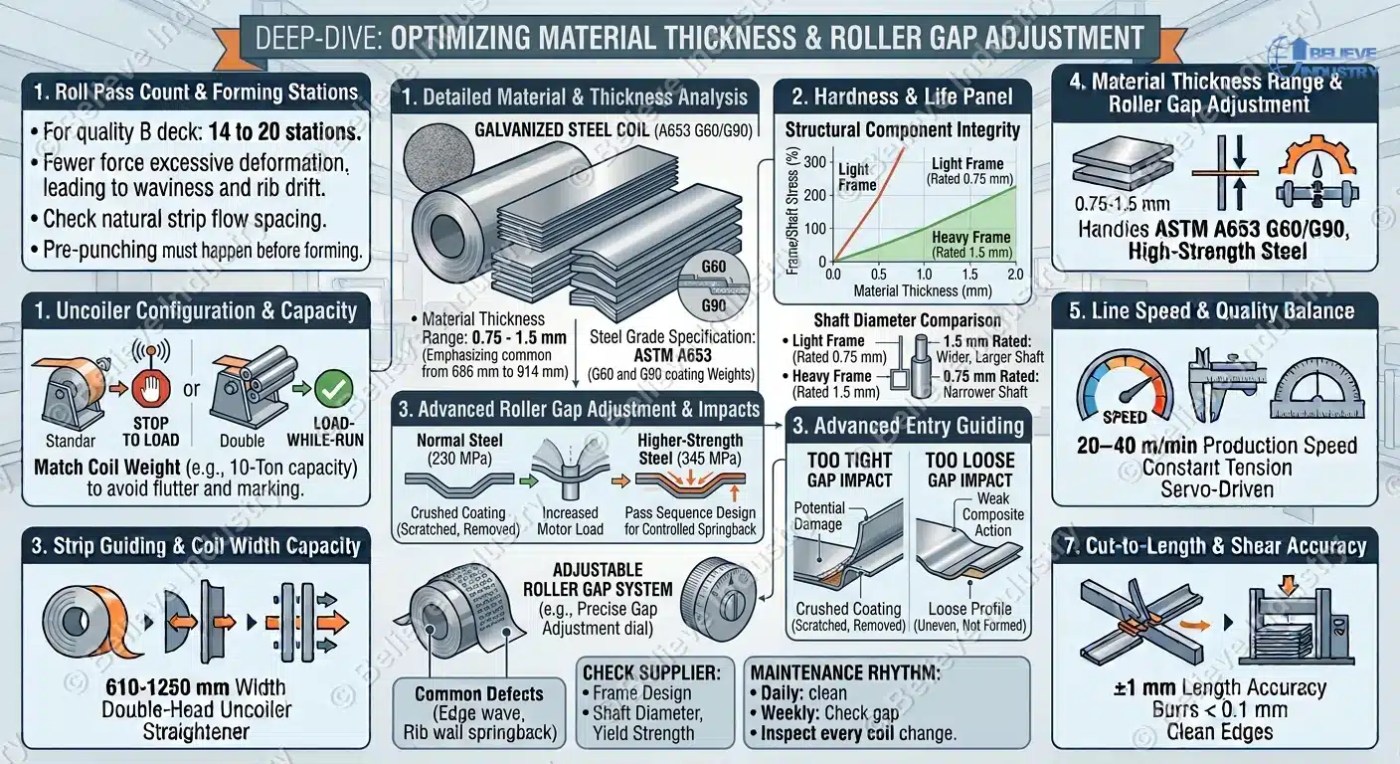
Material thickness range defines which floor deck specs a machine can run. Most deck profiles use 0.75 mm to 1.5 mm galvanized steel, with sheet width from 686 mm to 914 mm after forming.
Thicker strip demands stronger frames and larger shafts. A machine built for 1.5 mm material runs 0.75 mm without issue, but a light-frame machine rated for 0.75 mm will flex under 1.2 mm strip. Compare the frame thickness and shaft diameter, not just the brochure range. Roller gap must be adjustable to match the material thickness, because running the wrong gap crushes the coating or leaves the profile loose. Our roller gap clearance guide covers the 6 thickness rules for gap setting.
Steel grade matters too. ASTM A653 galvanized steel in G60 or G90 coating is the standard for floor deck, and the specification defines the coating weights and steel grades. The line must handle the yield strength of the grade you buy, typically 230 MPa to 345 MPa. Higher-strength steel springs back more, so the pass sequence must be designed for it. A композитный вальцовочный станок built for higher-strength steel keeps more margin for future material changes.
5. Profile Dimensional Tolerance
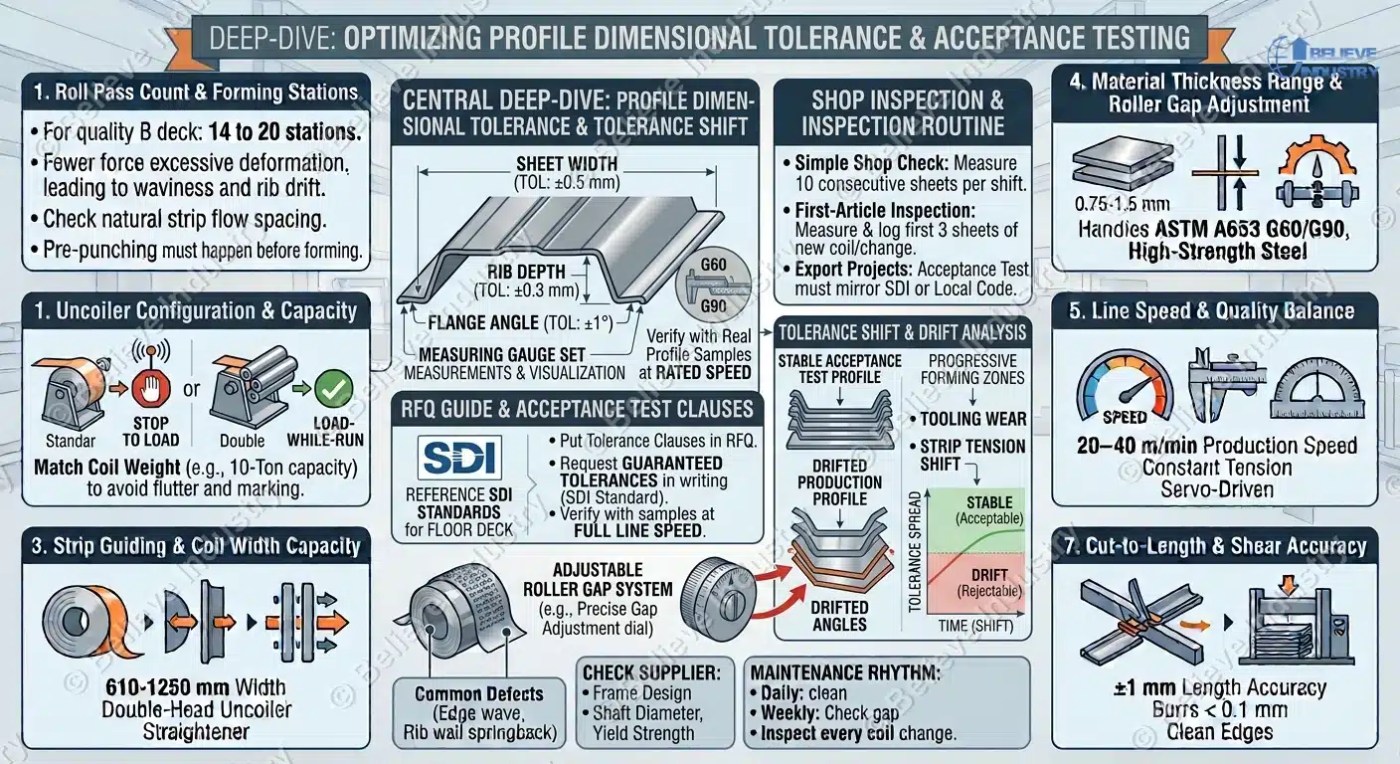
Dimensional tolerance is the spec that decides profile quality on a floor deck roll forming machine. A quality deck line holds sheet width within ±0.5 mm, rib depth within ±0.3 mm, and flange angles within ±1 degree at full line speed.
These numbers matter because deck panels must nest at the locking edges and match the shear stud layout on site. The Steel Deck Institute (SDI) publishes dimensional and performance standards for steel floor deck, and their SDI standards page is the reference buyers should quote when writing an RFQ. Ask the supplier which tolerance they guarantee on the acceptance test, in writing.
Verify tolerances with a real profile sample at rated speed, not a hand-formed sample. A floor deck machine that holds tolerance at 5 m/min can fail at 30 m/min when vibration and strip tension change. Set up a simple shop check: measure width with a caliper, rib depth with a depth gauge, and flange angle with a protractor on 10 consecutive sheets per shift. Record the readings. If the spread grows during the shift, the tooling or the strip tension is drifting. The roll forming machine RFQ guide lists the 6 technical specs to put in your inquiry, including tolerance clauses and acceptance test terms.
Set a first-article inspection routine before the line ships. The first 3 sheets of every new coil and every profile change should be measured and logged. That habit catches coil-to-coil variation before it becomes a customer complaint. For export projects, the acceptance test should mirror the standard your customer will check against, usually SDI or the local building code.
6. Line Speed and Quality Balance
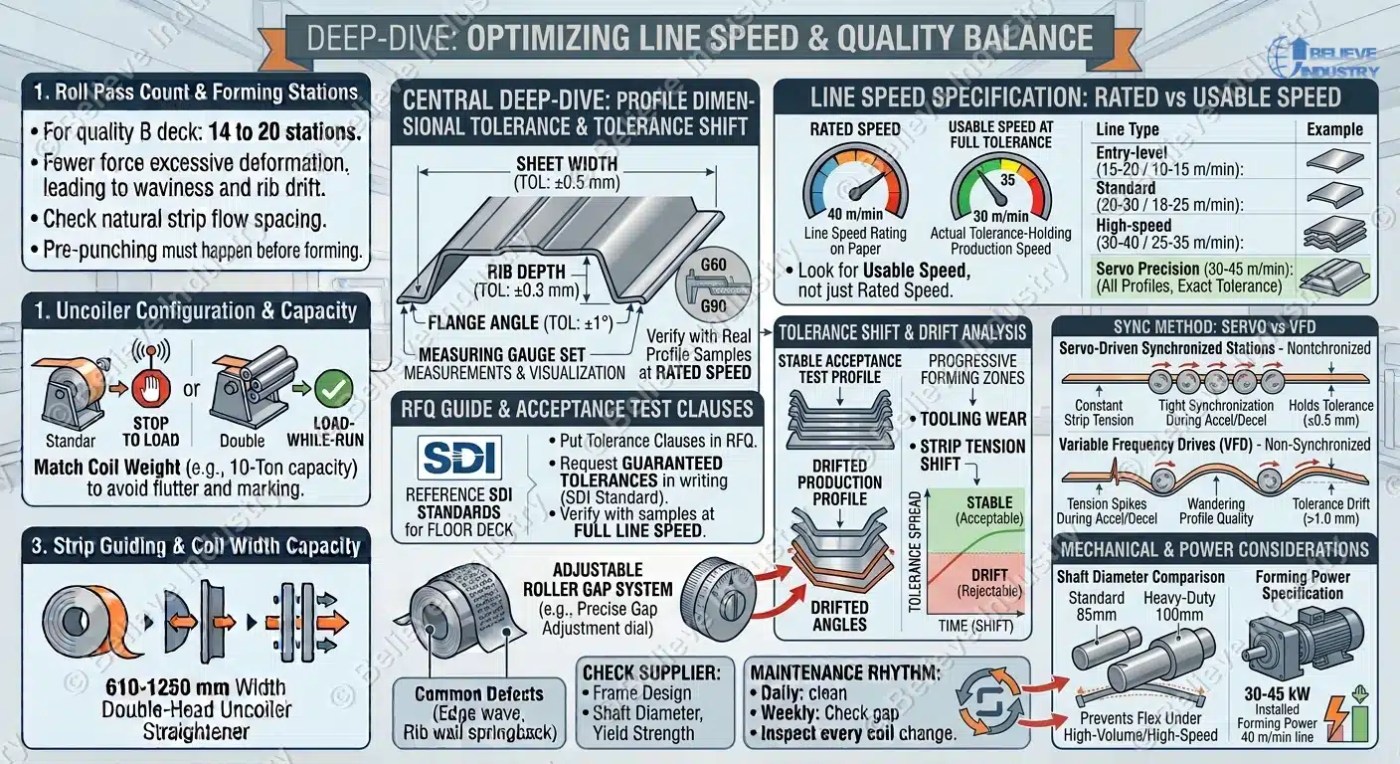
Line speed is the spec where budget machines cut corners. A metal floor deck roll forming machine runs at 20 to 40 m/min in production, and that speed must be achievable without losing tolerance.
Faster forming generates heat, increases springback, and adds vibration. A line rated at 40 m/min that only holds tolerance at 15 m/min is a 15 m/min machine in practice. Look for servo-driven lines where each station is synchronized, so strip tension stays constant across speed changes. Constant tension is what keeps rib depth uniform from the first sheet to the last coil. Variable-frequency lines can run at speed, but they lack the station-to-station synchronization that holds profile quality during acceleration and deceleration.
Speed also interacts with profile changeover. A deck line that handles B deck and N deck should switch profiles in 15 to 30 minutes with interchangeable tooling carts. Our profile changeover guide shows the 6-step quick swap method that keeps changeover time out of your quality window.
Motor power and frame rigidity are the hidden half of the speed question. A 40 m/min deck line needs roughly 30 to 45 kW of installed forming power depending on material thickness, and the frame must be rigid enough that the stations do not flex under load. Ask for the forming power and the shaft diameter. Thin shafts and undersized motors are the classic signs of a speed rating that only exists on paper.
| Line Type | Rated Speed (m/min) | Usable Speed at Full Tolerance | Typical Profile | Best Fit |
|---|---|---|---|---|
| Entry-level floor deck line | 15-20 | 10-15 | B deck only | Low volume, single profile |
| Standard deck line | 20-30 | 18-25 | B deck, N deck | Mid volume, 2-3 profiles |
| High-speed deck line | 30-40 | 25-35 | B deck, N deck, composite | High volume, multi-profile |
| Servo precision line | 30-45 | 30-40 | All deck profiles | Exacting tolerance, export specs |
7. Cut-to-Length and Shear Accuracy
Cut-to-length accuracy decides whether the profile quality survives the last step. A deck sheet cut 2 mm short at the shear is scrap, no matter how good the ribs are.
Two systems dominate: flying shears and servo cut-off presses. A flying shear cuts on the move at line speed, holding length within ±1 mm on deck panels. A servo cut-off press stops the strip, cuts, and restarts, which is more accurate but slower. For deck production above 20 m/min, a flying shear is the standard choice. Check the shear blade gap and sharpening schedule, because a dull blade produces burrs that catch on the locking edge.
The shear must also handle the full sheet width without deflection. A B deck roll forming machine cutting 686 mm wide sheets needs a blade stiff enough to hold a straight edge across the whole width. Burr height above 0.1 mm is a quality rejection on most deck jobs. After the shear, an automatic stacker keeps sheets aligned so the edges do not get dented during packing. Commissioning procedures for shears and stackers are covered in our 7-day startup checklist.
Stacking is part of cut quality in practice. A magnetic or vacuum stacker lowers each sheet onto the stack, keeping the bundle straight so panels arrive at the jobsite flat. Bundles are usually strapped at 300 to 500 sheets, depending on thickness, and protected with edge caps. A good stacking system also separates the first sheet of each bundle for the operator’s quality check.
| Profile | Sheet Width (mm) | Rib Depth (mm) | Typical Steel | Приложение |
|---|---|---|---|---|
| Палуба B | 686 | 38 | 0.75-1.2 mm A653 G60/G90 | Roof and floor deck, light composite |
| N deck | 914 | 76 | 0.9-1.5 mm A653 G60/G90 | Floor deck, heavier composite slabs |
| Composite deck | 914 | 50-76 | 1.0-1.5 mm A653 G90 | Composite slabs with shear studs |
| 915 modular deck | 915 | 38-76 | 0.9-1.5 mm A653 G90 | Multi-purpose floor deck lines |
Inline Embossing and Notching
Profile quality is not only shape. Many floor deck buyers need embossing, notching, or slotting done inline, and that work can damage the profile if the machine design is wrong. Pre-cut notching at the entry side, before forming, keeps the profile geometry clean. Embossing after forming requires matched rolls that do not crush the rib. Our guide on inline embossing and notching techniques details the 7 design techniques for adding these features without quality loss.
Maintenance and Tool Life
Tool life is the operating cost that never appears on the quote. A metal floor deck roll forming machine with hardened tooling needs a simple maintenance rhythm: clean the rolls daily, check the gap weekly, and inspect the surface for pickup after every coil change.
Plan for 300,000 to 500,000 linear meters between regrinds, and budget 2 to 4 regrinds per tooling set before replacement. Regrinding removes 0.1 to 0.2 mm from the roll face, so the gap must be reset afterward. Keep a spare set of the first and last forming rolls in stock, because those stations wear first. Ask the supplier for the tooling drawing and the regrind procedure in the documentation pack. A machine without a documented maintenance plan is a machine that loses its profile silently.
Common Deck Quality Defects and Their Root Causes
Buyers should know the defects before the machine arrives, because each one traces to a specific spec in this guide.
| Defect | Visible Sign | Root Cause | Исправить |
|---|---|---|---|
| Крайняя волна | Wavy edge along the sheet length | Strip tension or guiding fault | Fix uncoiler, straightener, side guides |
| Rib wall springback | Rib walls lean outward | Too few passes or wrong angle sequence | Add forming stations |
| Zinc scratching | Grey marks on the ribs | Worn or rough tooling | Regrind or chrome-plate rolls |
| Width drift | Sheet width grows during a shift | Tooling wear or gap too tight | Check hardness, adjust gap |
| Burred cut edge | Sharp lip at the shear | Dull blade or wrong gap | Resharpen, adjust blade gap |
Most defects are correctable on the line, but correction costs production time. A machine that scores well on the 7 specs avoids most of them by design.
7-Spec Checklist Before You Buy
Use this table when you compare quotes. A supplier that answers all 7 rows with measured numbers, not adjectives, is a supplier who understands deck profile quality.
| Спецификация | What to Check | Target Value |
|---|---|---|
| 1. Forming passes | Station count on the machine drawing | 14-20 passes |
| 2. Tooling | Hardness certificate, finish, regrind interval | 58-62 HRC, 0.4 Ra |
| 3. Strip guiding | Uncoiler type, straightener, side guides | 610-1250 mm, double-head option |
| 4. Thickness range | Frame strength, shaft size, gap adjustment | 0.75-1.5 mm, A653 G60/G90 |
| 5. Tolerance | Acceptance test clause in writing | ±0.5 mm width, ±0.3 mm rib |
| 6. Line speed | Usable speed at full tolerance | 20-40 m/min production |
| 7. Cut accuracy | Shear type, blade gap, burr limit | ±1 mm length, burr under 0.1 mm |
Factory Acceptance Test
A factory acceptance test (FAT) is the only reliable way to verify the 7 specs before shipment. Plan it around your own coil and your own profile. Bring material that matches your production mix, run at rated speed, and measure 10 consecutive sheets. Check width, rib depth, cut length, and burr height on each sheet, and record the readings in a log you keep.
Watch one full profile changeover during the FAT to confirm the 15 to 30 minute claim. Ask the supplier to demonstrate each checklist row at rated speed with your coil, then compare the measured values to the targets. Sign off only after 10 consecutive sheets meet all 7 rows. The FAT protects both sides. The supplier proves the machine, and you prove that your material and expectations are compatible with it.
Regional Standards and Building Codes
Deck profiles are sold into different code environments, and the machine must produce what the code checks. In the US, projects reference the International Building Code (IBC) and SDI standards for steel floor deck. In Europe, composite slab design follows EN 1994, and deck manufacturers certify their profiles to a European Technical Assessment (ETA) where required. In Australia and New Zealand, AS/NZS 4600 covers cold-formed steel structures.
Check which code applies to your export market before you fix the tooling. Rib depth, sheet width, and emboss pattern are not interchangeable between code regions. Buyers selling into the US market should review the current International Code Council publications for deck provisions, while European buyers work with EN 1994 and their national annexes. Match the machine spec to the code, not the other way around.