









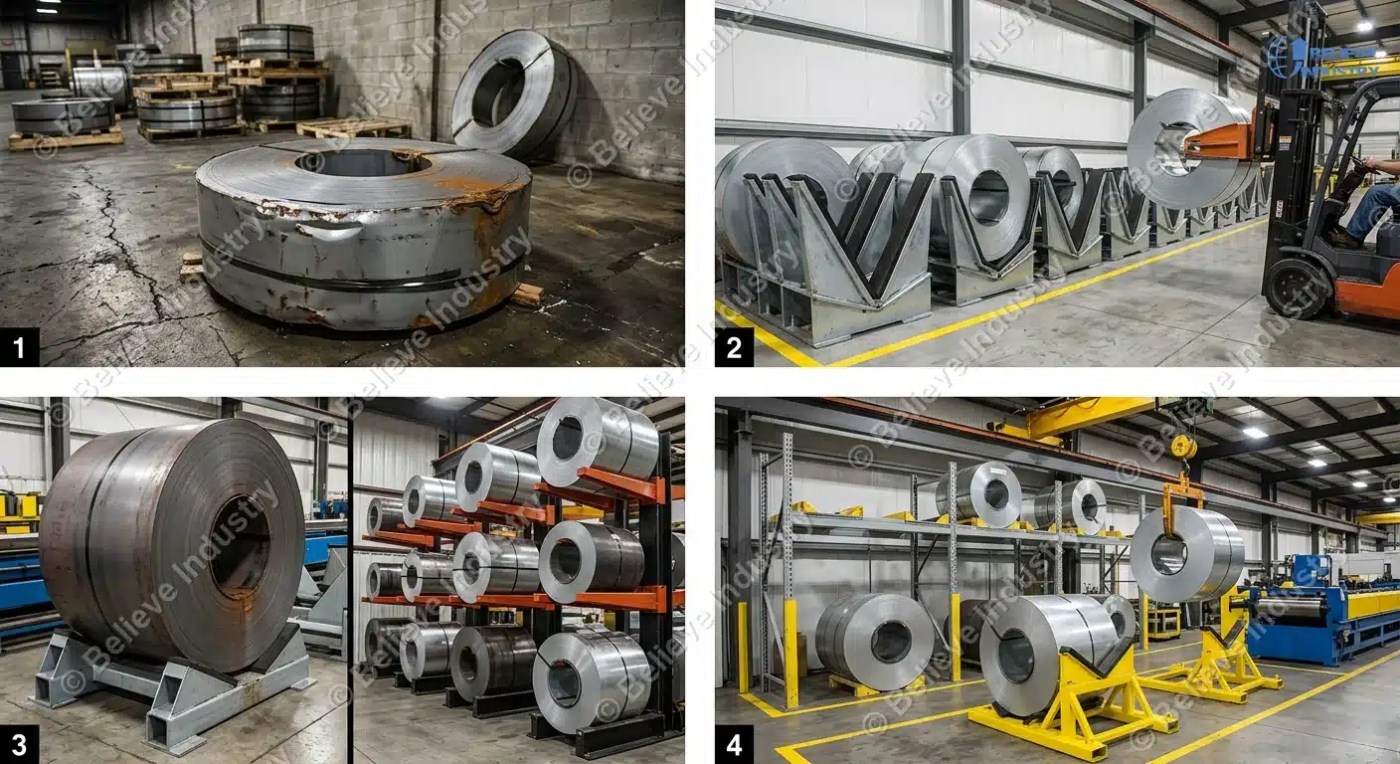
A single damaged steel coil can cost $2,000 to $15,000 depending on the material grade and coil weight. Yet many roll forming facilities treat roll forming coil storage as an afterthought. Coils sit on concrete floors, lean against walls, or stack on makeshift pallets. The result is edge damage, surface scratches, rust formation, and safety hazards.
Proper coil handling best practices protect both material quality and worker safety. The Occupational Safety and Health Administration (OSHA) standard 29 CFR 1910.176 requires that all stored materials be stable, secure, and accessible without creating fall or crush hazards. This guide covers 7 rack systems designed to prevent coil damage and keep your roll forming line running smoothly.
Whether you store hot rolled steel, cold rolled steel, galvanized coils, or aluminum, the right coil storage rack systems make a measurable difference. You can explore our complete coil processing and material handling guide for broader context on how storage fits into the full production flow.
Why Roll Forming Coil Storage Matters
Improper coil storage causes edge damage in 15 to 30 percent of received coils, according to industry surveys by O Fabricante magazine. Edge damage is not a cosmetic issue. When the coil edge gets dented, bent, or nicked, the strip will not feed cleanly into the desenrolador de máquina de perfilagem. This causes strip wandering, telescoping, and line stoppages.
Coil damage falls into four main categories. Edge damage occurs when coils are dropped or bumped. Surface scratching happens when coils rub against rough floors or each other. Rust forms when moisture collects between coil wraps without air circulation. Telescoping damage occurs when horizontal coils are stored on their side without proper support and the wraps shift laterally.
The financial impact goes beyond the coil itself. A damaged coil feeds unevenly into the roll forming line. This causes profile defects, tooling wear, and scrap rates that can jump from 1 percent to 5 percent or more. You also risk damaging downstream equipment like the nivelador de conformação de rolos when dented strip passes through straightening rollers.
Good roll forming coil storage also extends material shelf life. Galvanized coils stored per ASTM A653 guidelines should remain in usable condition for 6 to 12 months. Without proper ventilation and support, white rust can form on the zinc coating within 30 days.
7 Rack Systems to Prevent Coil Damage
Each rack system below serves a specific coil type, weight range, and plant layout. Compare them carefully before investing.
1. Vertical Coil Storage Racks
Vertical coil storage racks hold coils upright on their eye. The coil eye faces forward, allowing an overhead crane or forklift to insert a mandrel or C-hook directly into the bore. These racks typically support 5 to 30 ton coils and are the most common storage method in roll forming plants.
Vertical storage works best for coils with inner diameters of 508 mm or 610 mm. The rack base distributes weight evenly across a wide footprint, preventing the coil from tipping. Most vertical racks feature a steel cradle with a V-shaped or U-shaped saddle lined with rubber or polyurethane to protect the coil edge.
The main advantage is space efficiency. You can place vertical racks side by side with only 100 to 150 mm of clearance between coils. This makes them ideal for facilities with limited floor space. The disadvantage is that vertical storage does not work well for very thin gauge coils (under 0.3 mm) because the coil may collapse under its own weight.
2. Horizontal Coil Storage Cradles
Horizontal coil storage cradles hold coils on their side, with the coil axis parallel to the floor. The coil rests in a cradle that supports the outer diameter along two contact lines. These cradles accommodate coils up to 40 tons and are standard in facilities handling heavy gauge steel.
Horizontal storage prevents telescoping because the coil weight presses evenly against the cradle surface. This is critical for soft materials like aluminum and thin gauge galvanized steel. The cradle design allows air to circulate between coil wraps, which reduces moisture buildup and rust formation.
The tradeoff is floor space. Horizontal cradles require 1.5 to 2 times the floor area of vertical racks for the same number of coils. They also require wider aisles for forklift access since the coil must be loaded from the side.
3. Cantilever Coil Racks
Cantilever coil racks use horizontal arms extending from a vertical column to support coils. Each arm typically handles 3 to 15 tons, and a single column can support 2 to 4 arms at different heights. This creates a multi-tier storage system that maximizes vertical space.
Cantilever racks work well for máquinas de perfilagem de rolos para a indústria de movimentação de materiais where multiple coil grades and sizes must be stored in the same area. You can adjust arm spacing to accommodate different coil widths without modifying the rack structure.
The key safety consideration is load balance. Each arm must carry an equal share of the coil weight. Uneven loading can cause arm deflection and rack failure. Always verify that the coil center of gravity sits directly over the arm midpoint.
4. Coil Saddle Stands
Coil saddle stands are low-profile supports that hold coils in the horizontal position. Unlike full cradles, saddle stands use a simple V-shaped or curved support block. They support 2 to 20 ton coils and are often used as temporary staging near the roll forming line.
Saddle stands are portable and inexpensive. You can move them with a forklift and position them wherever coil staging is needed. This makes them ideal for facilities that reconfigure their production layout frequently.
The limitation is that saddle stands do not provide the same level of protection as full cradles. They support the coil at only two points, which can cause localized deformation on soft materials. Use rubber padding on the contact surface to minimize this risk.
5. V-Block Coil Holders
V-block coil holders are precision-machined blocks with a V-shaped groove that cradles the coil outer diameter. They accommodate coils from 1 to 10 tons and are most commonly used for aluminum and stainless steel coils where surface protection is critical.
The V-shaped design distributes contact pressure across a wider area than a flat surface. This prevents surface indentation and scratching on polished or pre-painted materials. V-blocks are often made from hardwood, ultra-high-molecular-weight polyethylene (UHMWPE), or nylon to eliminate metal-to-metal contact.
V-block holders are typically used in pairs, spaced 60 to 70 percent of the coil width apart. This spacing ensures that the coil weight is distributed evenly without creating bending stress across the coil width.
6. Overhead Crane Compatible Storage Racks
Overhead crane compatible storage racks are designed with clear lift paths above each coil position. These racks support coils from 5 to 30 tons and feature integrated lifting points or C-hook access channels that allow a crane operator to pick up a coil without repositioning other stored coils.
This rack type is essential for high-volume roll forming facilities where coil changeover happens 2 to 4 times per shift. The design eliminates the need to move adjacent coils to access the one you need, which reduces handling damage and cuts changeover time. The Associação dos Fabricantes de Guindastes da América (CMAA) sets specifications for crane-compatible storage that ensure safe lift paths and load ratings.
O Desbobinador hidráulico de 5 toneladas commonly used on roll forming lines works best when coils are staged on crane-compatible racks within 3 to 5 meters of the uncoiler. This minimizes travel distance and reduces the risk of dropping a coil during transport.
7. Mobile Coil Storage Carts
Mobile coil storage carts are wheeled platforms that hold 1 to 5 ton coils. They allow operators to move coils from storage to the roll forming line without a crane or forklift. Most carts feature a V-shaped cradle, locking casters, and a hand brake for safety.
Mobile carts are ideal for lighter coils and for facilities where overhead crane access is limited. They also serve as a buffer between the storage area and the production line. You can stage a coil on a cart near the componentes de máquinas de perfilagem de rolos staging area and wheel it into position when the previous coil runs out.
Never exceed the rated capacity of a mobile cart. A cart loaded beyond its limit can tip when moved, causing severe injury and coil damage. Always lock the casters before loading or unloading.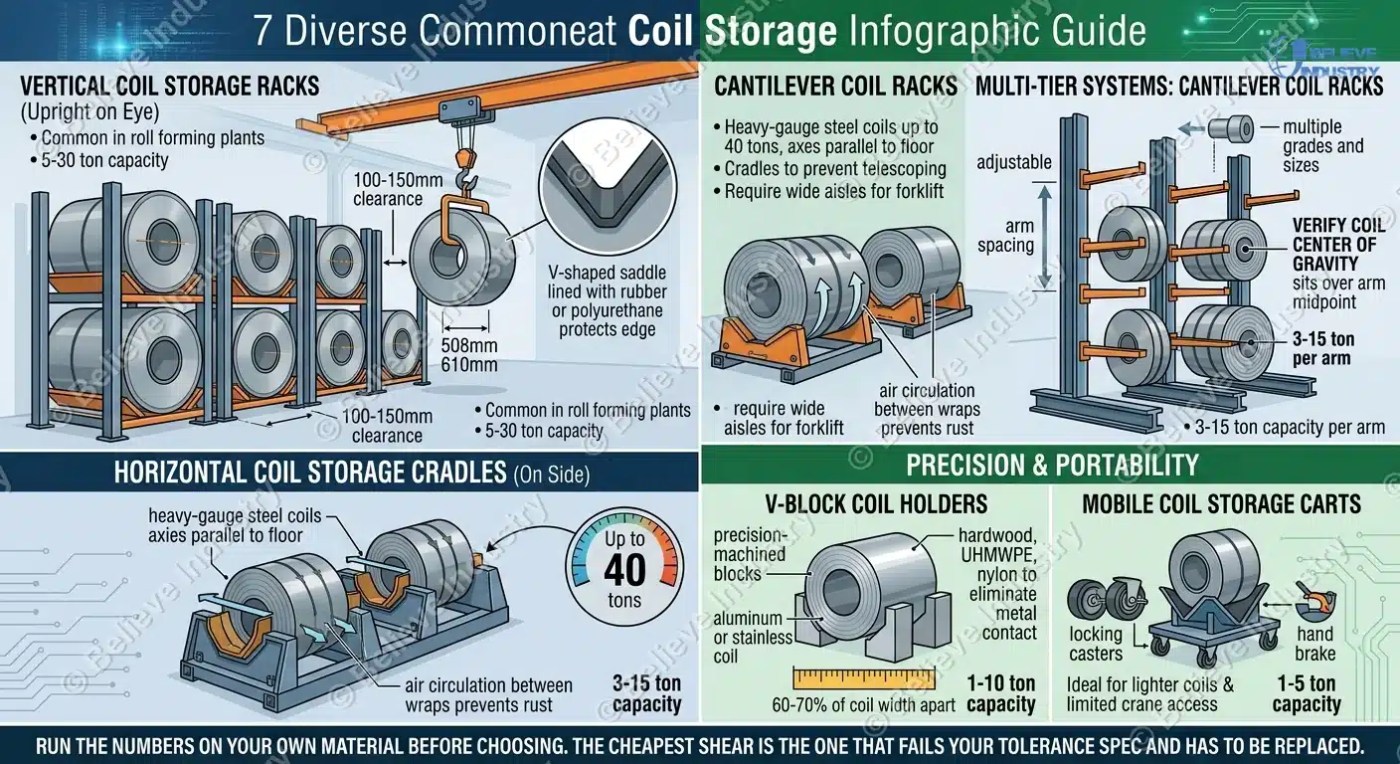
Comparison of 7 Coil Storage Rack Systems
The table below compares all 7 rack systems by capacity, best use case, floor space, and approximate cost range.
| Rack System | Capacity (Tons) | Best Use Case | Floor Space | Cost Range |
|---|---|---|---|---|
| Vertical Coil Storage Rack | 5 to 30 | General steel coil storage | Baixo | $2,000 to $8,000 |
| Horizontal Coil Cradle | Up to 40 | Heavy gauge steel, aluminum | Alto | $3,000 to $12,000 |
| Cantilever Coil Rack | 3 to 15 per arm | Multi-grade, multi-size storage | Médio | $4,000 to $15,000 |
| Coil Saddle Stand | 2 to 20 | Temporary staging near line | Baixo | $500 to $2,500 |
| V-Block Coil Holder | 1 to 10 | Aluminum, stainless, pre-painted | Médio | $300 to $1,500 |
| Overhead Crane Compatible Rack | 5 to 30 | High-volume, fast changeover | Médio | $5,000 to $20,000 |
| Mobile Coil Storage Cart | 1 to 5 | Light coils, limited crane access | Baixo | $800 to $3,500 |
Coil Handling Best Practices Beyond Racking
Proper rack systems are only half the equation. How you handle coils between storage and the roll forming line matters equally. Here are essential coil handling best practices.
Acclimatize coils before unwinding. Cold coils moved from outdoor storage to a heated plant will produce condensation. Let coils acclimatize for 4 to 8 hours before unwinding. This prevents moisture from entering the coil wraps and causing rust.
Use the correct lifting attachment. C-hooks work for vertical coils. Eye hooks work for horizontal coils. Never use chains or wire rope directly on the coil surface. Always use fabric slings or rubber-padded lifting forks to prevent surface damage. The American National Standards Institute (ANSI) provides standards for below-the-hook lifting devices that specify safe load ratings.
Inspect every coil on receipt. Check for edge damage, telescoping, water stains, and banding integrity before moving the coil to storage. Document any damage with photos and notify the supplier within 24 hours. Use our calculadora de bobina to verify coil weight and dimensions match the packing list.
Store coils by grade and age. Practice first-in-first-out (FIFO) rotation. Place newly received coils behind older stock. This prevents coils from sitting in storage beyond their recommended shelf life.
Maintain clear aisles. OSHA 29 CFR 1910.176 requires that passageways and aisles be kept clear of obstructions. Ensure at least 1 meter of clearance around all stored coils for safe lifting and emergency access.
Common Coil Damage Types and Prevention
| Damage Type | Cause | Prevention Method | Cost Impact |
|---|---|---|---|
| Edge Damage | Dropping, bumping, improper lifting | Use rubber-padded racks, correct lifting attachments | $200 to $2,000 per coil |
| Surface Scratching | Contact with rough floors or other coils | Use V-blocks, UHMWPE padding, avoid stacking | $100 to $1,500 per coil |
| White Rust (Galvanized) | Moisture between wraps, poor ventilation | Store horizontally with air circulation, keep dry | $300 to $3,000 per coil |
| Telescoping | Horizontal storage without support, vibration | Use full cradles, secure with banding | $500 to $5,000 per coil |
| Core Collapse | Vertical storage of thin gauge coils | Store thin coils horizontally | $1,000 to $5,000 per coil |
Roll Forming Coil Storage Safety Checklist
Use this checklist to audit your storage area regularly.
- All coils rest on approved rack systems, not on bare concrete
- Rack capacity labels are visible and coils do not exceed rated loads
- Rubber or polyurethane padding covers all coil contact surfaces
- Aisles are clear with minimum 1 meter clearance
- Coils are banded and secured against rolling or tipping
- Storage area is dry, ventilated, and protected from direct rain
- Coils are arranged for FIFO rotation by grade and date
- No coil is stacked more than 3 tiers high
- Lifting equipment is rated for the heaviest coil in storage
- All operators have completed Treinamento para operador de perfiladeira including material handling safety