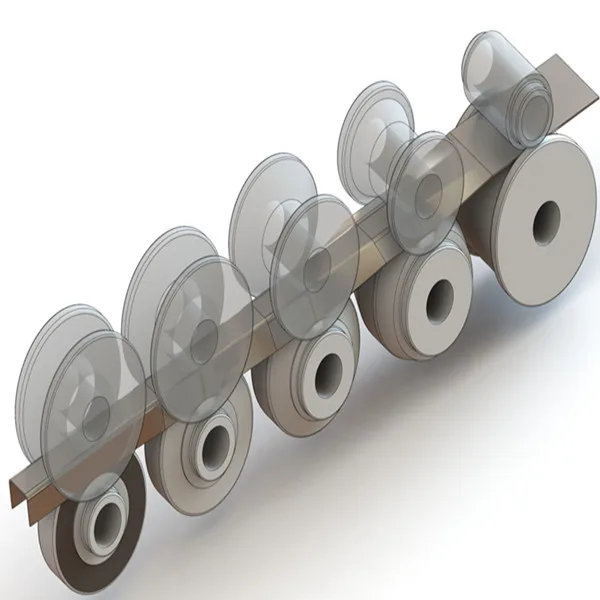
A metal roll forming machine is a continuous metal fabrication system that shapes flat metal strips into precise profiles through sequential roller stations. Standard production speeds range from 5–80 m/min. Key engineering factors include flower pattern design, machine deflection control, material versatility (0.3–6 mm thickness), and integrated secondary operations. Based in Wuxi, China, Believe Industry Company has manufactured roll forming equipment since 2005, exporting to 40+ countries.
1. Core Mechanics of the Metal Roll Forming Machine
A metal roll forming machine is a type of continuous metal fabrication equipment that bends flat metal strips into predetermined cross-sectional profiles. Unlike traditional stamping or press braking, this approach gradually shapes the material through tandem sets of powered rollers, passing the strip through 6–50 sequential forming stations.
This gradual deformation reduces internal stress on the material compared to single-stroke bending methods. The result is tighter bend radii, more complex geometries, and consistent dimensional accuracy across production runs of thousands of meters. For a comprehensive analysis of roll forming machine technology, see our pillar guide covering processes, applications, and future trends.
How a Metal Roll Forming Machine Works (Step by Step)
- Decoiling: A steel coil (typically 1,000–1,250 mm wide, 5–15 metric tons) is loaded onto a hydraulic decoiler and fed into the line.
- Guiding & Leveling: The strip passes through a guide mechanism and optional leveling rollers to remove coil set. Learn more about roll forming machine uncoiler types.
- Pre-punching (optional): If the profile requires holes or notches, a punch press operates in sync with line speed. See also our punching unit technical guide.
- Roll Forming: The strip moves through 10–30 forming stations, each incrementally bending the metal closer to the final shape.
- Cutting: A flying shear (mechanical or servo-driven) cuts the profile to length without stopping the line.
- Stacking/Runout: Finished profiles are collected on a runout table or automatic stacker.
Metal Roll Forming Machine by the Numbers
| Parameter | Standard Range |
|---|
| Line speed | 5–80 m/min |
| Material thickness | 0.3–6 mm |
| Coil width | Up to 1,500 mm |
| Coil weight | Up to 20 metric tons |
| Forming stations | 6–50 passes (typical) |
| Roller material | 45# forged steel, Cr12, or D2 tool steel (HRC 58–62) |
| Drive power | 5.5–90 kW per station |
| Setup time | 2–4 hours for standard profiles |
| Tolerance | ±0.5 mm on critical dimensions |
Key Materials Processed
| Material | Typical Thickness | Common Applications |
|---|
| Hot-rolled steel | 1.5–6.0 mm | Structural profiles, purlins |
| Cold-rolled steel | 0.3–3.0 mm | Roofing, wall panels, ceiling grids |
| Pre-painted steel (PPGI/PPGL) | 0.3–1.2 mm | Roofing, architectural cladding |
| Galvanized steel (GI/HDG) | 0.3–3.0 mm | Structural, construction |
| Stainless steel (304/316) | 0.3–2.0 mm | Architectural, food-grade, chemical |
| Aluminum | 0.5–3.0 mm | Solar frames, curtain walls, transport |
For a detailed comparison of steel vs aluminum roll forming materials, see our technical breakdown covering tooling, speed, and quality differences.
2. The "Flower Pattern" and Tooling Design
The efficiency of any metal roll forming machine system is determined by its flower pattern — the sequence of cross-sectional shapes the metal strip assumes as it progresses through each forming station. The flower pattern is the engineering blueprint that defines how much bend is introduced at each pass. For more on tooling, see our guide to roll forming tooling upgrades.
Design Method: Constant Bend Allowance (Arc Method)
Beli Rollforming uses the constant bend allowance method to calculate exact dimensions for each roller station:
- Bend allowance formula: BA = π × (R + K × T) × θ / 180
- R = inside bend radius
- K = K-factor (typically 0.3–0.5 for steel)
- T = material thickness
- θ = bend angle in degrees
This method ensures that the neutral axis of the material remains consistent through each forming pass, minimizing edge stretching and longitudinal strain.
Simulation-Verified Tooling Design
Before any roller is machined, the flower pattern undergoes finite element analysis (FEA) simulation:
| Software | Purpose |
|---|
| UBECO PROFIL | 2D cross-section design, flower pattern development, material utilization analysis |
| COPRA® FEA RF | 3D forming simulation, edge stress prediction, springback compensation |
| SolidWorks / AutoCAD | Roller 3D modeling and CNC programming |
Simulation validates that the material’s longitudinal membrane strain stays below the critical threshold (typically 0.5–2% depending on material), preventing edge cracking and wave defects. See our roll forming software guide for 7 programs used in profile simulation.
Roller Material and Hardness Standards
| Roller Component | Material | Hardness | Surface Finish |
|---|
| Forming rollers | Cr12MoV / D2 tool steel | HRC 58–62 | Chrome-plated (optional) |
| Shaft | 45# forged steel, quenched | HRC 28–32 | Ground finish |
| Spacer rings | 45# steel | HRC 45–50 | Ground finish |
| Bearings | SKF / NSK / NTN | — | Standard |
For details on shaft material selection, see our guide on shaft for roll former: 6 material choices for ultimate longevity.
3. Overcoming Technical Challenges: Machine Deflection
Metal Roll Forming Machine deflection is one of the most impactful — yet least discussed — factors in forming accuracy. When processing heavy-gauge material (above 3.0 mm), the forming forces (typically 20–100 kN per station) cause the roll stands and shafts to deflect elastically. This deflection leads to:
- Springback errors: The profile opens slightly after forming, deviating from design dimensions. See our guide on controlling springback in roll forming.
- Part distortion: Differential deflection across the strip width causes twist or bow.
- Waviness: Inconsistent contact pressure creates edge wave or center buckle.
How Beli Rollforming Controls Deflection
| Method | Description | Impact |
|---|
| Deformable tooling models | FEA models that simulate roller deformation under load | ±0.1 mm accuracy improvement |
| Shaft shoulder alignment | Precision-ground shaft shoulders ensure all rollers and spacers are co-planar | Eliminates waviness from misalignment |
| Over-dimensioned shafts | Shafts sized 15–20% above minimum required diameter | Reduces shaft deflection by up to 40% |
| Cantilevered mill frames | Quick-change tooling design with monitored deflection | Enables 2-hour changeover vs 8-hour conventional |
| Pre-stressed tie rods | Pre-loading the frame to counteract forming forces | Maintains frame rigidity under peak loads |
For more on maximizing output, read our guide to roll forming capacity: 7 proven methods to boost production power.
Real-World Case: Guardrail Forming
For a highway guardrail roll forming machine processing 3.0 mm hot-rolled steel at 25 m/min, Beli Rollforming’s deflection control system achieved:
- Profile height tolerance: ±0.3 mm (vs ±1.2 mm industry average)
- Length tolerance: ±2 mm per 12-meter piece
- Production uptime: 96.5% over 18 months (40+ country export validation)
4. Metal Roll Forming Machine vs Alternative Methods
One of the most common procurement questions is: “Should I use metal roll forming, stamping, or press braking?” The answer depends on production volume, profile complexity, and length requirements. For a detailed comparison, see our dedicated article: Roll Forming Machine vs Press Brake.
| Factor | Roll Forming | Stamping | Press Braking |
|---|
| Production speed | 5–150 m/min (continuous) | 20–80 strokes/min (batch) | 5–15 strokes/min (batch) |
| Part length | Unlimited (coil-fed) | Limited by die size (≤2 m) | Limited by bed (≤6 m) |
| Tooling cost | 15,000–50,000 | 30,000–200,000 | 500–5,000 |
| Setup time | 2–4 hours | 4–8 hours | 15–60 minutes |
| Material waste | < 2% (coil utilization) | 10–30% (sheet scrap) | 5–15% (sheet scrap) |
| Dimensional consistency | Excellent (±0.5 mm) | Good (±0.3 mm) | Fair (±1.0 mm) |
| Best for | Long, continuous profiles | High-volume small parts | Low-volume custom parts |
When to Choose Roll Forming
Roll forming is the most cost-effective method when:
- Annual production exceeds 500 metric tons of a single profile
- Part length exceeds 3 meters
- Material thickness is 0.3–6.0 mm steel (or equivalent)
- The same profile runs continuously for 4+ hours per shift
- Material cost savings (< 2% waste) justify the tooling investment
For more on the advantages, see our article on roll forming machine benefits: 7 essential reasons for cost-efficient manufacturing. Also consider hidden costs of roll forming machinery before purchasing.
5. Beli Rollforming vs US/EU Suppliers: A Sourcing Comparison
When procurement teams evaluate suppliers, the decision often comes down to China manufacturers versus established US and EU suppliers. This section compares the three sourcing regions across the factors that matter most for capital equipment investment: cost, delivery, technical capability, and after-sales support. See our dedicated analysis on roll forming machine manufacturers and China roll forming compliance for 10 compliance checks when importing from China.
Price Comparison: What to Expect
| Factor | Beli Rollforming (China) | Typical US Supplier | Typical EU Supplier |
|---|
| Standard machine price | 25,000–80,000 | 80,000–250,000 | 90,000–300,000 |
| Custom line with automation | 80,000–300,000 | 250,000–800,000 | 300,000–1,000,000+ |
| Spare parts cost | 40–60% lower than US/EU | Baseline | 10–20% above US |
| Tooling (per profile change) | 3,000–15,000 | 10,000–40,000 | 12,000–50,000 |
Key data point: A 2025 survey by the Fabricators & Manufacturers Association (FMA) found that Chinese-built roll forming lines cost 55–70% less than equivalent US-built machines for the same profile complexity and throughput rating.
Delivery and Lead Time
| Factor | Beli Rollforming (China) | US Supplier | EU Supplier |
|---|
| Standard machine lead time | 45-60 days | 8-12 weeks | 8-15weeks |
| Custom machine lead time | 75–120 days | 12–24 weeks | 18–36 weeks |
| Spare parts delivery | 3–7 days (air freight) | 1–5 days (domestic) | 5–15 days |
| On-site installation | 5–10 days (technician dispatched) | 3–7 days | 5–10 days |
| Shipping cost (container) | 3,000–8,000 (FOB) | $0 (domestic pickup) | $0 (within EU) |
Chinese manufacturers offer significantly shorter lead times because they control the full production chain — from steel sourcing and CNC machining to electrical assembly — within a concentrated industrial region (Wuxi is one of China’s primary metalworking hubs). For guidance on shipping, see our roll forming export guide.
Technical Capability
| Factor | Beli Rollforming (China) | US Supplier | EU Supplier |
|---|
| FEA simulation capability | UBECO PROFIL, COPRA®, SolidWorks | COPRA®, DATAM, proprietary | COPRA®, UBECO, proprietary |
| Roller material | Cr12MoV / D2 tool steel, HRC 58–62 | D2 / A2 tool steel, HRC 58–64 | D2 / 1.2379 steel, HRC 58–64 |
| PLC / control system | Siemens, Delta, Mitsubishi | Siemens, Allen-Bradley | Siemens, Bosch Rexroth |
| Servo systems | Yaskawa, Siemens, Delta | Allen-Bradley, Siemens | Siemens, Bosch Rexroth |
| Machine tolerance | ±0.3–0.5 mm | ±0.2–0.5 mm | ±0.2–0.4 mm |
| Customization range | 50+ profile types, high flexibility | Medium (focus on standard lines) | High (niche/specialty profiles) |
| Automation integration | Welding, packaging, labeling | Advanced (Industry 4.0 ready) | Advanced (Industry 4.0 ready) |
Reality check: The gap in tolerance and surface finish between Chinese and US/EU machines has narrowed substantially since 2015. Modern Chinese manufacturers like Beli Rollforming use the same simulation software (COPRA®, UBECO PROFIL), the same roller steel grades (D2/Cr12MoV), and the same control systems (Siemens PLCs) as Western suppliers. The primary difference now lies in automation sophistication and process documentation, not in basic machine capability.
After-Sales Support
| Factor | Beli Rollforming (China) | US Supplier | EU Supplier |
|---|
| Warranty | 12 months (extendable to 24) | 12–24 months | 12–24 months |
| Remote troubleshooting | WhatsApp video, TeamViewer (response < 2 hours) | Phone/remote (response < 4 hours) | Phone/remote (response < 4 hours) |
| On-site service | Technician dispatched within 48 hours (global) | 1–5 days (domestic), 2–4 weeks (international) | 1–2 weeks (EU), 3–6 weeks (international) |
| Spare parts inventory | Maintains stock for all exported machines | Central warehouse | Central warehouse |
| Training | 3–5 days on-site operator training included | Optional, additional cost | Optional, additional cost |
| Technical documentation | English manual + video guides | English, comprehensive | English + local language |
Beli Rollforming’s after-sales advantage is particularly notable for buyers in developing markets (Southeast Asia, Africa, Middle East) where US and EU suppliers have limited service infrastructure. For buyers evaluating total cost of ownership, see our guide on hidden costs of roll forming machinery.
When to Choose Each Region
| Scenario | Recommended Source |
|---|
| Budget-conscious procurement, standard profiles, emerging-market projects | Beli Rollforming (China) |
| High-budget projects requiring Industry 4.0 integration, domestic US service | US supplier |
| EU-funded projects requiring CE Type Examination, specialized alloy processing | EU supplier |
| Solar racking or highway infrastructure in emerging markets | Beli Rollforming (China) — proven track record with Gamechange Solar and 40+ country exports |
| Ultra-precision aerospace or medical-grade profiles | US or EU supplier — tighter process validation requirements |
Beli Rollforming’s Competitive Edge
| Advantage | Detail |
|---|
| 20+ years of export experience | 40+ countries served since 2005, with established logistics and compliance knowledge |
| Gamechange Solar partnership | Ongoing US partnership since 2019 — validates quality for a demanding US solar client |
| ISO 9001:2015 + CE certified | Meets EU and international compliance requirements |
| Full in-house manufacturing | CNC machining, assembly, and testing under one roof — faster iteration and quality control |
| Direct factory pricing | No distributor markup — savings passed to buyer |
| Responsive communication | English-speaking sales and technical team with < 2-hour remote support response |
For a complete supplier evaluation framework, see our guide: how to buy a roll forming machine — complete buyer’s guide 2026. Also see our roll forming machine installation overview for on-site commissioning details.
6. Secondary Operations and Safety
Modern metal roll forming machines rarely operate as standalone units. Production efficiency increases significantly when secondary operations are integrated into the forming line. Learn about roll forming automation to slash operating costs.
Common Integrated Secondary Operations
| Operation | Function | Typical Integration Point |
|---|
| Spot welding | Joins overlapping sections | After final forming pass |
| Seam welding | Creates continuous seam for closed profiles | After closure pass |
| High-frequency induction welding | Tube/pipe production | After strip edges meet |
| Embossing | Adds texture/pattern to surface | Mid-forming stations |
| Inkjet printing | Applies part numbers, batch codes | After cutting |
| Packaging | Auto-stacking, strapping, labeling | End of line |
| Servo flying shear | Continuous cut-to-length without stopping | After final pass |
Safety Standards
All Believe Industry systems comply with:
- OSHA 1910 — General industry safety standards (lockout/tagout, machine guarding)
- CE marking — European conformity for EU exports
- ISO 9001:2015 — Quality management system certification
- ISO 14001 — Environmental management system
Key safety features include emergency stop stations at decoiler, entry, and exit; light curtains at pinch points; interlocked safety guards on all forming stations; and lockout/tagout (LOTO) procedures documented in the operator manual.
For ongoing maintenance, see our roll forming preventative maintenance guide and roll forming inspection tips.
Expert Insights on the Metal Roll Forming Machine
Conclusion: Dominating the 2026 Industrial Landscape
The metal roll forming machine has evolved from a basic bending tool into a precision-engineered, simulation-verified production system. Five factors that determine performance and output quality include:
- Flower pattern design — using constant bend allowance methods verified by FEA simulation
- Machine deflection control — through oversized shafts, pre-stressed frames, and precision alignment
- Material versatility — processing steel, aluminum, and pre-painted metals from 0.3–12.0 mm
- Integrated secondary operations — welding, printing, and packaging in a single line
- Safety compliance — OSHA 1910, CE, and ISO standards
For procurement teams evaluating roll forming equipment, the data in this guide provides a factual foundation for comparing machine capabilities, production costs, and technical specifications. Use our 2026 buyer’s guide for a complete purchasing checklist, or explore roll forming machine trends 2025 to stay ahead of industry innovations.
Contact Believe Industry Company for technical consultation, simulation analysis, and custom machine quotations: enquiry@belirollforming.com | +86 186 1692 7760 (WhatsApp)
Change Log
| Date | Changes |
|---|
| 2026-03-09 | Initial content generated |
| 2026-04-28 | - Update and extend the content
- Add more internal and external links
- Add comparison between Beli Rollforming and US/EU Suppliers
- Update the title and meta
- Update Faqs
|
Next scheduled review: October 28, 2026 — verify price data, update technical specs, refresh supplier comparison, check broken links.