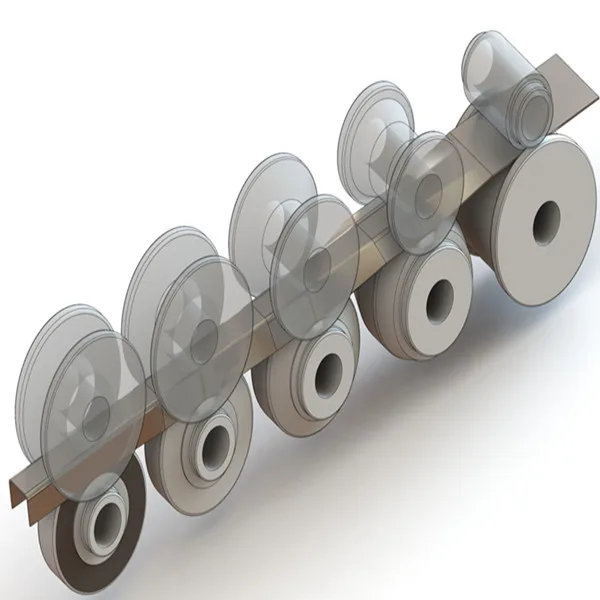
What Is a Cassette Type Roll Forming Machine?
A cassette type roll forming machine uses pre-assembled tooling cassettes that slide in and out of the main frame. You don’t adjust individual rollers. You swap the whole cassette.
This makes profile changeovers fast, clean, and repeatable.
Traditional machines bolt each roller station to the frame. One profile change takes hours. A cassette type roll forming machine cuts that time to under 15 minutes.
Why This Matters in 2026
Buyers now demand smaller runs and faster delivery. Running one profile all day is no longer the norm.
If your factory changes profiles often, this type of machine pays for itself through saved labor alone.
Key drivers in 2026:
- Labor costs are rising. Changeover time is expensive.
- Order sizes are shrinking. Flexibility beats raw speed.
- Customization is a selling point. More profiles = more clients.
Cassette vs. Standard vs. Double Layer: Quick Comparison
This table shows the three most common roll forming machine types side by side.
| Feature | Cassette Type | Standard Type | Double Layer Type |
|---|
| Profile changeover time | 10–15 minutes | 2–4 hours | N/A (fixed 2 profiles) |
| Number of profiles | Unlimited (add cassettes) | 1 per machine | 2 (fixed) |
| Upfront cost | High | Low | Medium |
| Best for | Multi-profile, small-batch | High-volume, single profile | Two fixed profiles, mid-volume |
| Tooling investment | Per cassette | Per machine | Built-in |
| Floor space | Single footprint | One machine per profile | One machine, two profiles |
| Skill required for changeover | Low (plug-and-play) | High (manual alignment) | Low (lever switch) |
| ROI payback | 12–24 months | 6–18 months | 10–20 months |
| Ideal industries | Construction, solar, racking | Roofing, decking | Light residential roofing |
Bottom line:
- Choose cassette type when you run 3+ profiles and changeover speed matters.
- Choose standard when you run one profile in very high volumes.
- Choose double layer when you need exactly two profiles and budget is tight.
5 Reasons to Choose a Cassette Type Roll Forming Machine
1. Changeover in Under 15 Minutes
The cassette slides out on guide rails. The new one slides in. You lock it, calibrate once, and run.
No re-shimming. No re-aligning. No calling a technician.
This alone saves 2–3 hours per changeover compared to a standard line.
2. One Machine, Many Profiles
One cassette type roll forming machine frame holds all your profiles. Each profile gets its own cassette.
You buy one machine. You add cassettes as your product range grows. That’s one set of electrical controls, one PLC, one operator.
3. Consistent Quality Every Run
Manual changeovers drift. Operators set spacers slightly differently each time.
Cassettes are precision-machined. Every insert returns to the same position. Profiles come out identical run after run.
This is critical for industries like:
- Solar mounting — tight hole tolerances
- Pallet racking — load-bearing uprights must be exact
- Drywall framing — clip-fit profiles need precision
4. Lower Long-Term Labor Cost
A standard changeover needs 2 workers for 3–4 hours. That’s 6–8 labor hours per change.
A cassette changeover needs 1 worker for 15 minutes.
If you change profiles 5 times per week, that’s 30+ hours of labor saved weekly.
5. Scalable Production
Start with 3 cassettes. Add more as your order book grows. The machine frame never changes.
This gives small manufacturers enterprise-level flexibility without enterprise-level investment.
How the Cassette System Works
The cassette is a self-contained rolling unit. It holds all the forming rollers for one profile, pre-set at the factory.
Step-by-step changeover:
- Stop the line — takes 1 minute
- Unlock the current cassette — loosen all bolts or use a quick-lock system
- Move out the cassette — on guide rails, 2–3 minutes
- Move in the new cassette — reverse the process
- Lock and verify — check alignment against fixed reference points
- Run 3 test pieces — confirm profile dimensions
- Full production — total time: 10–15 minutes
The PLC stores each profile’s settings. You select the profile on the touchscreen. The machine self-adjusts speed, cut length, and hole punch parameters.
Key Technical Specifications
Key Technical Specifications
When buying a cassette type roll forming machine, compare these specs against your material requirements. For material grade standards, refer to the AISI Steel Design Manual:
| Spec | Entry-Level | Industrial Grade |
|---|
| Material thickness | 0.3–1.5 mm | 0.3–3.0 mm |
| Material width | Up to 300 mm | Up to 600 mm |
| Line speed | 10–20 m/min | 25–60 m/min |
| Cassette change time | 15–30 min | 8–15 min |
| PLC brand | Generic | Siemens / Mitsubishi |
| Roller material | 45# steel | GCr15 bearing steel, HRC 58–62 |
| Drive type | Chain | Gear box or servo |
| Punching unit | Optional hydraulic | Inline servo / hydraulic flying die |
Roller material matters. GCr15 bearing steel lasts 5–10× longer than standard 45# steel. Ask your supplier what grade they use before you buy. Industry guidance from Rollforming Magazine confirms that roller hardness directly affects profile tolerances in high-speed cassette lines.
What Industries Use Cassette Type Roll Forming Machines?
Construction & Steel Framing
Drywall stud, track, and ceiling channel producers need fast changeovers. A single cassette type roll forming machine can cover C-stud, U-track, and ceiling tee in one shift.
→ See how we approach Construction and Steel Structure roll forming
Pallet Racking
Upright columns, step beams, box beams — racking manufacturers run multiple profiles. The cassette system is standard on modern racking lines.
→ Learn more about Step Beam Roll Forming Machines → Explore Upright Rack Roll Forming Machines
Solar Mounting
Solar projects use C-channels, Sigma profiles, and strut channels. Many of these share one frame size. This machine handles all of them.
→ Related: Solar Panel Mounting Structure Machine → Also see: Solar Mounting Bracket Roll Forming Machine
Roofing & Cladding
Metal roofing manufacturers producing IBR, R-panel, or AG panel in small runs use cassette machines to switch between profile types quickly.
→ Explore: IBR Roofing Sheet Roll Forming Machine
Cable Tray & Strut Channel
Electrical support system makers produce multiple tray widths and strut channel sizes. The cassette system eliminates the need for a separate machine per size.
→ Related: Strut Channel Roll Forming Machine → Also see: Cable Tray Production Line
How to Choose the Right Cassette Type Roll Forming Machine
Use this checklist before you buy:
- List your profiles first. How many do you need? How often do you switch?
- Check material thickness. Match the machine frame rating to your thickest material.
- Ask about roller material. GCr15 is the standard for serious production.
- Verify PLC brand. Siemens and Mitsubishi have global support networks.
- Request a changeover demo. Time it yourself. Don’t trust a number on a spec sheet.
- Ask about spare cassettes. Lead time matters. If a cassette breaks, how fast can you get a replacement?
- Check after-sales support. Can the supplier send a technician to your country?
→ More buying guidance: How to Buy a Roll Forming Machine – 2026 Buyer’s Guide → Also useful: Roll Forming Machine Components Guide
Price Range
A cassette type roll forming machine costs more upfront than a standard machine. Budget accordingly:
| Configuration | Approximate Price Range |
|---|
| Entry-level (3 cassettes, thin gauge) | USD 25,000 – 45,000 |
| Mid-range (5 cassettes, industrial grade) | USD 55,000 – 90,000 |
| Full production line (8+ cassettes, servo flying shear) | USD 100,000 – 300,000+ |
Prices vary by profile complexity, roller material, punching unit type, and automation level.
→ For a complete pricing breakdown: Roll Forming Machine Price Guide 2026
Frequently Asked Questions
Conclusion
A cassette type roll forming machine is built for factories that need to switch profiles fast without sacrificing quality. The math is straightforward — if you change over more than twice a week, the labor savings cover the higher upfront cost in under two years.
The key benefits in short:
- 15-minute changeovers vs. hours on a standard machine
- Unlimited profiles on one machine frame
- Consistent quality from precision-machined cassettes
- Lower long-term labor cost with one-person operation
- Scalable investment — add cassettes as your order book grows
Whether you produce pallet racking uprights, solar mounting brackets, drywall studs, or roof rails — the cassette system adapts. You run what the order demands, not what fits your machine.
Believe Industry has been building cassette type roll forming machines since 2005. Every machine ships with full documentation, PLC programs, and on-site commissioning support.
Ready to see what a cassette system can do for your production?
→ Request a Quote — Believe Industry → View All Roll Forming Machines → Read the 2026 Buyer’s Guide & Next Review
| Date |
Change |
Author |
| April 30, 2026 |
Initial publish — full article with comparison table, FAQ |
Darren Mao |
Next scheduled review: October 30, 2026 Review checklist:
- Update price ranges if market shifts
- Add new internal links for any new product pages
- Check keyword rankings and update FAQ based on new buyer questions
- Verify all external links are active