Solution 1: Implement Proactive Material Stress Equalization
High-strength steel coils inherently carry residual stress. If this stress is not equalized before forming, it releases unevenly, resulting in profile distortion.
The solution is to utilize a dedicated leveler (or tension-leveling module) on the line. While a typical decoiler only flattens the strip, a true leveling unit subjects the strip to controlled bending and reverse bending, distributing internal stresses uniformly across the width. This ensures the Metal Stud Roll Former receives perfectly flat, stress-neutral input material.
Solution 2: Apply Advanced Tooling Design and Pass Reduction
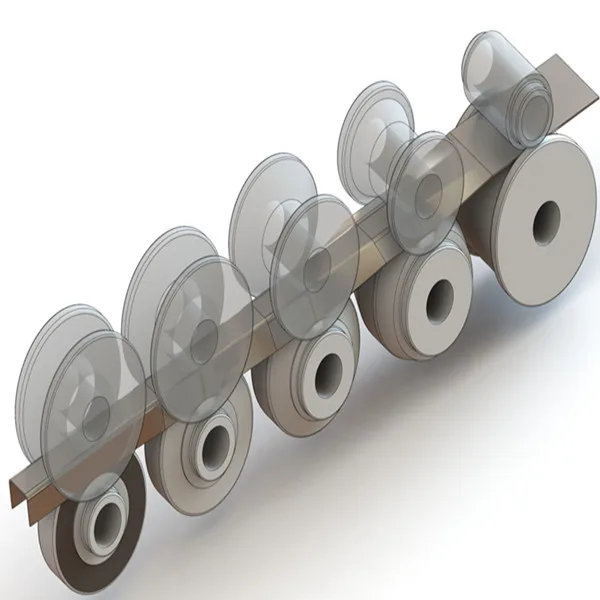
The number of forming stands (passes) and the complexity of the tooling design directly impact warping. Aggressive forming—trying to achieve the final shape in too few passes—induces severe stress and guarantees spring-back and twist.
The Fix: Use a gradual, multi-pass approach (often 12-16 stands for stud profiles) with specialized flower patterns that progressively bend the flanges and web. We constantly iterate our tooling designs for our Product: C Stud Roll Forming Machine to ensure the angular change at each station is minimal, preserving the material’s integrity.
Solution 3: Optimize Raft and Stand Alignment Precision
Misalignment is the silent killer of profile straightness. Even minor axial or vertical deviations in the forming shafts can cause one side of the profile to be overworked compared to the other.
A rigorous, systematic approach to checking and correcting this alignment is mandatory. A detailed pre-production roll forming machine inspection ritual should confirm all stands are parallel and level, typically using laser alignment tools on high-end Metal Stud Roll Former systems. This preventative step saves hours of debugging later.
Solution 4: Leverage Automated Exit Guide and Straightener Technology
Warping issues often become most visible at the exit of the forming section, just before the cutting stage. High-precision roll forming automation is the key here.
Modern Metal Stud Roll Former lines utilize automated hydraulic or servo-driven straightening units equipped with non-marring rolls or bushings. This exit guide applies a final, controlled, corrective force to the profile immediately before cutting. This final step neutralizes any residual twist and maintains the product’s straightness until the fly-cut saw completes the separation.
Solution 5: Address Differential Elongation (Edge vs. Center)
When forming sections with wide webs and deep flanges (common in stud profiles), the material at the edges elongates more than the material at the center, leading to edge wave and camber.
The Fix: High-performance Metal Stud Roll Former tooling must compensate for this differential elongation. This is achieved using specialized convex/concave roller designs or by employing specific side rolls to manage the flow of material, effectively forcing the edges to stretch and match the center’s length. This critical setup must be continually maintained; failure to do so will severely degrade product quality. For maintenance best practices, review our comprehensive guide on roll forming machine maintenance.
Solution 6: Integrating External Structural Standards Knowledge
Warping prevention extends to understanding the material’s cold-working properties and final application requirements. For example, cold-formed steel gains strength during the forming process—a phenomenon known as work hardening. This added stiffness can increase spring-back if the tooling does not account for it.
Producers should align their material usage with recognized industry standards. For instance, the American Iron and Steel Institute (AISI) provides technical specifications for the structural application of these products, which dictates the minimum straightness requirements that your Metal Stud Roll Former must meet. Applying this external knowledge ensures compliance and quality.
At Beli RollForming, our philosophy centers on engineering quality out of the box, drastically reducing the need for costly post-production adjustments. We design our Metal Stud Roll Former lines with built-in features to address these six critical warping challenges, from advanced leveling to automated exit controls.
By choosing Beli RollForming, you are investing in a machine that is engineered for consistent, accurate production, allowing you to focus on volume and delivery, not defect troubleshooting.