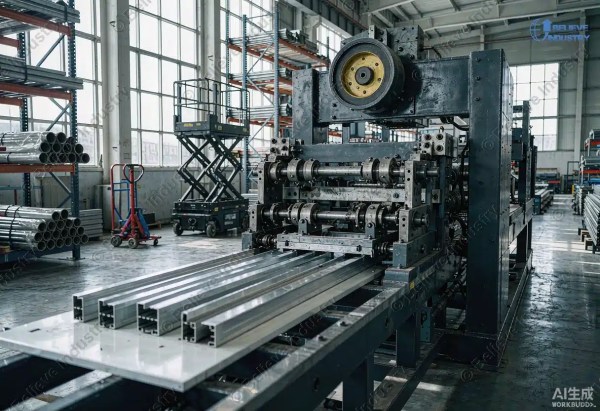










In the precision world of metal forming, the quality of the final product—whether it’s a Cee Purlin or a specialized strut channel—is determined long before the strip hits the first forming stand. It begins with the coil’s flatness. The μηχανή ισοπέδωσης, also known as a leveler or stretcher leveler, is the unsung hero of the μηχανή σχηματισμού ρολού production line. It is the critical gatekeeper that removes defects like coil set, edge wave, and oil-canning, which are inherent to coiled steel.
Ignoring these initial material flaws places immense, unnecessary stress on the entire roll former setup, leading to compromised profile quality and premature machine wear. At Beli RollForming, we emphasize the μηχανή ισοπέδωσης as a non-negotiable component for achieving peak performance.
This guide reveals the 3 essential keys to optimizing your μηχανή ισοπέδωσης operation, ensuring absolute flatness and maximizing your entire production output.

The Foundation of Quality: The Leveling Machine’s Critical Role
The primary function of the μηχανή ισοπέδωσης is to subject the metal strip to repeated, controlled elastic and plastic deformations. This bending and reverse bending action neutralizes the internal stresses locked into the material during the hot and cold rolling processes at the steel mill (known as “coil memory”).
If these stresses are not meticulously removed, they will release spontaneously during the roll forming process, resulting in defects like:
Camber: The strip bends horizontally.
Twist/Warping: The final profile twists upon cutting.
Spring-Back: The profile does not hold its intended angle.
This pre-processing step is so vital that a comprehensive analysis of roll forming machine performance often traces major quality issues back to a malfunctioning or improperly set μηχανή ισοπέδωσης.
3 Essential Keys to Leveling Machine Optimization
Lorem ipsum dolor sit amet, consectetur adipiscing elit. Ut elit tellus, luctus nec ullamcorper mattis, pulvinar dapibus leo.
Achieving “flat perfection” isn’t about running the machine; it’s about setting three specific, highly technical parameters correctly.
Key 1: Mastering the Work Roll Overlap (The “Wedge” Effect)
The effectiveness of any μηχανή ισοπέδωσης is primarily determined by how much the top and bottom work rolls are intentionally offset, creating a converging gap often referred to as the “wedge.”
The overlap is strongest at the entry side of the μηχανή ισοπέδωσης (applying maximum plastic deformation) and gradually reduces towards the exit side (applying minimum elastic deformation). The objective is to stretch the shorter, compressed fibers within the metal strip to match the length of the longer fibers (such as those at the center of the coil that may have “crowned”).To fully grasp the complex mechanics of plastic deformation and stress relief in coil processing, we recommend reviewing the latest technical data provided by the Precision Metalforming Association (PMA).
Optimization Tip: Precise, localized adjustment of the intermediate backup rolls allows the operator to control the degree of stretching across the strip’s width (edge-to-center). This is complex, and mastering it requires deep technical knowledge of your machine’s mechanics. These adjustments are managed within the main control system, linking directly to other εξαρτήματα μηχανής διαμόρφωσης κυλίνδρων for synchronization.
Key 2: Speed Synchronization with the Roll Former
Ο μηχανή ισοπέδωσης is only effective if its output speed perfectly matches the input speed of the roll forming mill. A misalignment in speed synchronization can reintroduce new stresses or cause the strip to buckle between the two components.
Lagging Leveler: If the leveler is slower than the roll former, the strip will pull taut, causing uncontrolled stretching and profiling errors.
Leading Leveler: If the leveler is too fast, the strip will slacken and snake, risking entry alignment issues at the first forming stand.
Optimization Tip: High-end μηχανή ισοπέδωσης systems, such as those supplied by Beli RollForming, use advanced servo-motor and encoder feedback systems. Ensure your PLC is programmed for dynamic speed matching based on real-time feedback. If you are operating a μηχανή διαμόρφωσης ρολού κατά παραγγελία designed for specific, non-standard speeds, this synchronization protocol must be custom-developed and tested rigorously before commissioning.
Key 3: Regular Gauge Calibration and Roll Inspection
The work rolls within the μηχανή ισοπέδωσης are subject to immense pressure and friction. Over time, these rolls will inevitably wear, reducing their diameter and altering the precise gap settings. Using worn rolls is equivalent to not using a leveler at all.
Mistake: Many operators only calibrate the μηχανή ισοπέδωσης when changing material thickness. The correct procedure requires regular inspection, regardless of material change, to check for signs of roll crowning or localized wear.
Optimization Tip: Implement a daily visual check for scoring, pitting, or material residue on the rolls. Use specialized contact gauges to verify the roll diameters and gaps weekly. Failure to perform this maintenance will compromise the initial material state, undermining the downstream precision.
Investing in a High-Performance Leveling Machine
The cost of material scrap and machine downtime caused by poor material flatness far outweighs the investment in a top-tier μηχανή ισοπέδωσης. When evaluating options, prioritize machines with:
Optimal Roll Count: Typically 5-Hi or 6-Hi roll configurations (referring to the number of passes) for maximum effectiveness.
Backup Roll System: Must feature independent adjustability to correct localized flatness defects across the width of the strip.
Quick-Change Cassette: Look for a design that simplifies roll changes for easier maintenance and reduced downtime, directly improving efficiency.
For detailed technical specifications and to explore our range of precision coil processing equipment, please visit our dedicated Product Page: Ρολοειδής ισοπεδωτής.
Σύναψη
Ο μηχανή ισοπέδωσης is not an optional extra—it is the indispensable foundation for quality. By focusing on these 3 essential keys—mastering roll overlap, ensuring perfect speed synchronization, and adhering to strict calibration schedules—you transform coiled material into perfectly flat stock, minimizing operational risk, extending the life of your expensive roll forming dies, and guaranteeing the flawless perfection of every final profile.
Επικοινωνήστε με την Beli RollForming σήμερα to learn how our integrated μηχανή ισοπέδωσης technology can revolutionize your material input and optimize your entire production line.