Einführung
A standing seam roof panel roll forming machine is a decade-long investment. The wrong machine means panel rejection and lost contracts. The right one delivers clean seams and strong margins.
Standing seam roofing is the top choice across the US, Europe, Australia, and the Middle East — hidden fasteners, weather resistance, clean lines. But producing consistent panels at speed is tough: tight tolerances, clean cuts, and zero alignment drift are non-negotiable. This guide walks through the main profile families — snap-lock, mechanical seam, BEMO, tapered — then covers eight must-check machine features, with comparison tables, 10 buyer FAQs, and a factory-acceptance checklist you can bring to your next supplier visit.
Standing Seam Profile Types: What Your Machine Must Produce
Before checking machine features, know exactly which standing seam profiles you’ll produce. Different profile families demand different machine configurations — matching the wrong machine to your target profiles wastes your investment.
Snap-Lock vs. Mechanical Seam: The Two Main Families
Snap-lock profiles (e.g., McElroy Medallion-Lok, Meridian, Instaloc) snap together by hand, seam height 25–38 mm. Faster installation, but less watertight — may fail code in high-wind regions. Machine needs accurate snap-detail rollers; no seaming-roller integration required.
Mechanical seam profiles (e.g., McElroy MasterLok-90, Maxima, 138T/238T) are rolled closed on the roof with an electric seamer, 38–50 mm seam height, folded 90°–540°. Gold standard for weather resistance. Machine must hold ±0.3 mm tolerance on seam geometry — 1 mm out of spec and the seamer won’t close properly.
Batten-style snap profiles (e.g., McElroy Medallion I & II) use a separate batten cap that snaps over the seam. Distinctive architectural look for high-end residential and commercial projects.
BEMO-Style Standing Seam Panels: European Origin, Global Demand
BEMO originated with the Austrian company BEMO. It is widely used across Europe, the Middle East, the US, and Australia. In Saudi Arabia and the Gulf, BEMO-style panels are common for airports, stadiums, and commercial roofs — they handle extreme heat and complex geometries. Key traits: wide flat pan (300–500 mm cover), double/triple-fold seam (25–65 mm height), 360° or 540° fold.
The defining feature is the seam fold geometry — the internal radius must maintain a watertight seal under capillary action. Tolerance on seam geometry is typically ±0.3 mm, much tighter than standard profiles.
Producing BEMO-style panels requires:
- 14–20 roller stations to form the complex seam without cracking, plus independently adjustable side rollers for flatness across the wide pan.
- Heavy-duty side frames to handle higher forming forces.
- Precision-ground GCr15 rollers, polished to Ra ≤ 0.8 μm for aluminum coils.
- Length accuracy of ±0.5 mm — BEMO panels on architectural roofs must match exactly across multiple slopes.
When sourcing a BEMO-compatible machine, request the profile drawing from the licensor and confirm the supplier can hold tolerance on every seam dimension. Beli has produced BEMO-compatible lines for Europe and the Middle East and can validate machine capacity from your profile drawing before you order.
Tapered Standing Seam Panels: The Complex Profile Challenge
Tapered panels — where width changes linearly end to end — are used on conical roofs, domes, and any non-rectangular roof. They are the most demanding profile for a standing seam roof panel roll forming machine.
Two production methods:
1. CNC-guided variable-width forming: Individually driven stations with side guides that adjust continuously as the panel tapers. Requires sophisticated CNC and precise synchronization. Preferred for volume production.
2. Pre-cut / pre-notched coil: Less precise, more labor-intensive, but possible on a standard machine with manual steps.
For true tapered production, the machine must have:
- Individually driven roller stations with independent speed control.
- CNC side-guide system for real-time lateral coil adjustment.
- CAD-to-coil software that converts roof geometry into forming programs.
- High-precision uncoiler with tension control to prevent wandering as strip width changes.
If your projects include conical or dome roofs (airports, stadiums, high-end commercial), discuss taper capability before buying. Not every standing seam roof panel roll forming machine handles tapered profiles, and retrofitting is extremely expensive.
Standing Seam Profile Comparison Table
| Profile Type | Seam Method | Seam Height | Abdeckungsbreite | Machine Roller Stations | Tightness Requirement | Typical Application |
|---|
| Snap-Lock (e.g., Medallion-Lok) | Snap-together by hand | 25–38 mm | 300–600 mm | 10–14 | ±0,5 mm | Residential, light commercial |
| Mechanical Seam (e.g., MasterLok-90) | Electric seamer on roof | 38–50 mm | 300–600 mm | 12–16 | ±0,3 mm | Commercial, industrial |
| BEMO-Style (double/triple fold) | 360°/540° fold, seamed | 25–65 mm | 300–500 mm | 14–20 | ±0,3 mm | Architectural, high-end commercial |
| Batten-Style (e.g., Medallion I) | Batten cap snaps on | 38–65 mm | 400–700 mm | 12–16 | ±0,5 mm | Architectural, residential |
| Tapered Panel | Varies (mechanical or snap) | Variiert | Tapered (width changes) | 16–20, CNC-guided | ±0,2 mm | Conical roofs, domes, complex geometry |
For an in-depth look at forming wide-cover architectural panels, see our metal roof roll forming machine analysis, which covers how machine configuration changes for different cover widths and seam heights.
1. Roller Material and Heat Treatment
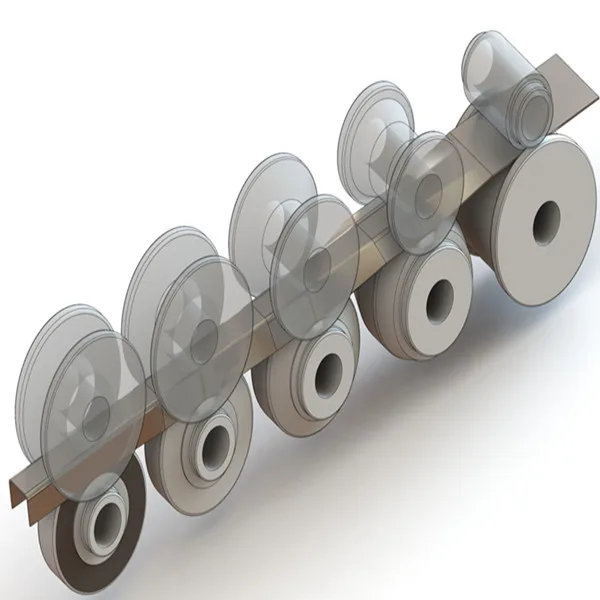
The rollers are the heart of a standing seam roof panel roll forming machine — they determine panel finish, accuracy, and machine life. A cheap roller set can fail within six months.
Was zu überprüfen ist
Roller material grade: Premium: GCr15 bearing steel (AISI 52100 equivalent), HRC 58–62. Mid-range: 40Cr steel, HRC 50–55. Entry-level: unhardened carbon steel that marks panels within weeks.
Heat treatment: Best practice: furnace heating → oil quenching → double tempering. Avoid single-tempered rollers — residual internal stress causes micro-cracking and early failure.
Surface treatment: Chrome plating at 0.05–0.08 mm, plus polishing to Ra ≤ 0.8 μm for pre-painted coil.
Roller accuracy: Runout ≤ 0.05 mm. Ask for the inspection report per roller set.
Number of stations: 12–18 for standing seam profiles. Fewer stations risk panel cracking at the seam.
Roller Quality Tiers Comparison Table
| Tier | Walzenmaterial | Härte | Surface Treatment | Machining Tolerance | Expected Life |
|---|
| Einstiegslevel | Kohlenstoffstahl | HRC 40–45 | Keiner | 0.15–0.20 mm | 1–2 years |
| Mittelklasse | 40Cr-Stahl | HRC 50–55 | Chrome 0.03 mm | 0.08–0.12 mm | 3–5 Jahre |
| Premium (Beli) | GCr15 Wälzlagerstahl | HRC 58–62 | Chrome 0.05–0.08 mm, polished | ≤ 0.05 mm | 8–10+ years |
Questions to Ask the Supplier
- “Can you provide the material certificate and heat treatment report for the roller set?”
- “What is the chrome plating thickness, and do you provide a polishing step?”
- “How many roller stations does this machine have for standing seam profiles?”
- “Can I see the runout inspection report for each roller?”
A serious manufacturer answers these questions with documentation, not vague assurances. If a supplier cannot provide material certificates, that is a red flag.
For more on cold-formed steel tooling standards, see the Metal Construction Association technical resources, und die Metal Building Manufacturers Association (MBMA) for design guides covering standing seam roofing systems.
2. Machine Frame and Structural Integrity
The frame keeps your standing seam roof panel roll forming machine in alignment after months of production. A twisted frame ruins panel accuracy — and is expensive to fix.
Was zu überprüfen ist
Frame construction: Heavy steel plates (≥18 mm) welded into a monocoque structure, then stress-relieved. Avoid tubular frames at panel widths above 600 mm — they flex under load.
Stress relief: Heat to 600–650°C, hold several hours, cool slowly. Ask for the temperature chart as proof.
Flatness tolerance: ≤0.10 mm over the full machine length. Verify during factory acceptance with a straightedge and feeler gauges.
Side frame stiffness: Must resist 5–8 tons roll-forming force. A 0.2 mm flex shifts the roller gap and produces inconsistent seam height.
Foundation: The supplier must provide a foundation drawing with anchor bolt positions and concrete thickness spec.
Beli’s standing seam roof panel roll forming machines use normalized steel plate frames with precision-machined assembly surfaces. The result is consistent panel geometry even after years of operation. You can see the frame construction details on our metal roof roll forming machine page.
3. PLC Control System and Automation Level
The PLC is the brain of your standing seam roof panel roll forming machine — it controls speed, length measurement, punching sync, diagnostics, and production data. A poorly chosen PLC means slow troubleshooting and avoidable downtime.
Was zu überprüfen ist
PLC brand: Siemens (S7-1200/1500), Mitsubishi (FX5/Q), Delta (AH/AS). Avoid generic brands — replacement modules may be unobtainable in three years.
HMI: 10-inch color touchscreen with 50–100 profile recipe storage, speed adjustment, production counting, and fault history.
Length accuracy: Encoder: ±1.0 mm over 6 m. Laser: ±0.5 mm for architectural projects. Verify with ten consecutive panels during FAT.
Fault diagnostics: Clear text error codes with timestamps, not just a blinking light. Saves hours of troubleshooting.
Remote diagnostics: Ethernet port for supplier’s remote access. Beli includes this as standard on all roof panel lines.
PLC and Control System Tiers Comparison Table
| Besonderheit | Basic System | Mid-Range System | Advanced System (Beli) |
|---|
| PLC-Marke | Generic / Unknown | Delta / Omron | Siemens / Mitsubishi |
| Rezeptspeicher | 10–20 profiles | 30–50 profiles | 100+ profiles |
| Längengenauigkeit | ±2.0 mm | ±1.5 mm | ±1.0 mm (laser: ±0.5 mm) |
| HMI Type | Button panel | 7-inch touchscreen | 10-inch color touchscreen |
| Fault Logging | NEIN | Yes (basic) | Yes (with timestamp) |
| Remote Support | NEIN | Optional | Standard (ethernet port) |
| Production Report | NEIN | Basic count | Detailed (count, length, downtime) |
When you evaluate a standing seam roof panel roll forming machine, spend at least 30 minutes testing the HMI. Try switching between profiles. Try entering a new panel length. Try triggering a fault (safely) to see how the system responds. The usability of the control system has a direct impact on your daily productivity.
4. Forming Speed and Real Production Output