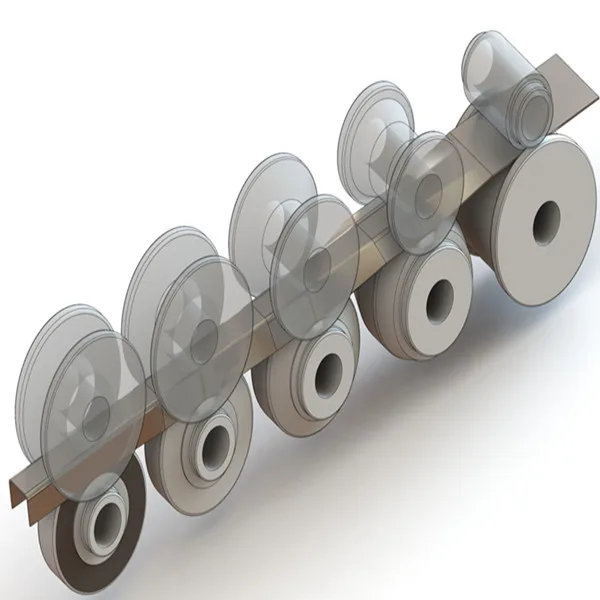
In the high-stakes world of industrial manufacturing, the Shaft for Roll Former acts as the silent backbone of the entire production line. While rollers often receive the most attention for profile accuracy, it is the shaft that maintains the geometric integrity and prevents the dreaded “roll gap” expansion. Choosing a high-performance material isn’t just a technical preference; it is a critical strategy for ensuring machine ROI and minimizing downtime in 2026’s competitive market.
Why Material Selection for a Shaft for Roll Former Dictates Machine ROI
Doğruyu seçmek Shaft for Roll Former material directly impacts the variables of “Springback” and “Deflection” that plague high-precision profiles. When a shaft lacks the necessary yield strength, it subtly bends under the forming load—a phenomenon known as shaft deflection. This leads to inconsistent dimensions and accelerated tool wear.
To ensure maximum longevity, a Shaft for Roll Former must be selected based on its Akma Gücü Ve Torsional Rigidity. While 45# Carbon Steel is the baseline for light-duty work, high-speed industrial lines require 40Cr Alloy Steel veya GCr15 Rulman Çeliği to resist deflection and surface fatigue, significantly extending the machine’s operational lifecycle.
Top 6 Material Choices for a Shaft for Roll Former
1. 45# Carbon Steel: The Reliable Standard
Often considered the “workhorse” of the industry, 45# carbon steel offers a balanced combination of strength and ductility. It is highly weldable and easy to machine, making it a cost-effective choice for standard building material profiles. However, for a high-speed Shaft for Roll Former, it requires surface hardening to prevent premature wear.
2. 40Cr Alloy Steel: The Industrial Upgrade
For those moving beyond basic profiles, 40Cr is the gold standard for a Shaft for Roll Former. The addition of Chromium enhances hardenability and toughness. When quenched and tempered, 40Cr achieves a core toughness that prevents the “snapping” often seen in cheaper materials under sudden torque spikes.
3. GCr15 (Bearing Steel): Precision Personified
When your roll forming line handles high-strength steels (HSS) or ultra-thin materials where a 0.05mm variance is a failure, GCr15 is the answer. Known for extreme hardness and wear resistance, it maintains its diameter even after millions of cycles, making it a premium choice for a Shaft for Roll Former.
4. 42CrMo (Chromoly): The Heavy-Duty Powerhouse
As solar racking and heavy highway guardrails demand thicker gauges, 42CrMo has become essential. Its high creep strength and fatigue limit mean it can handle the immense vertical loads of thick-gauge forming without permanent deformation.
5. Stainless Steel (304/316): For Corrosive Environments
Used primarily in food-grade or chemical-resistant roll forming lines. While softer than alloy steels, its resistance to oxidation is mandatory for specific niche manufacturing sectors where a Shaft for Roll Former might be exposed to moisture or chemicals.
6. Specialized Tool Steels (D2/SKD11): The Ultimate Wear Resistance
While expensive, using D2 for a Shaft for Roll Former is a “set it and forget it” strategy. It offers extreme surface hardness, making it nearly immune to the abrasive wear caused by metal-on-metal contact at high speeds.
The Impact of Heat Treatment on Shaft Longevity
A material choice for a Shaft for Roll Former is only as good as its heat treatment. At Beli Rulo Şekillendirme, we focus on two primary processes:
Quenching & Tempering (Q&T): Treats the entire shaft to achieve a uniform hardness (typically HRC 28-32).
Induction Hardening: Hardens only the surface layer where the rollers sit, leaving the core tough and flexible.
Technical Specification Table: Shaft Materials
Malzeme
Hardness (HRC)
Best Use Case
Longevity Rating
45# Steel
20-25
Light-duty profiles
Good
40Cr
28-34
Standard Industrial
Excellent
42CrMo
35-40
Heavy-gauge / Solar
Superior
GCr15
58-62
High-precision / HSS
Elite
How to Calculate Shaft Diameter to Prevent Deflection
To ensure your Shaft for Roll Former doesn’t fail, engineers must account for the bending moment using the formula:
By selecting materials with a higher modulus of elasticity (E) and optimizing the diameter, we ensure the shaft remains within the elastic deformation zone.
Shaft Deflection & Torque Calculator
Calculate the mechanical limits of your Shaft for Roll Former.
Max Deflection: mm
Status:
6 High-Value FAQs
What is the best material for a heavy-duty shaft for roll former?
42CrMo is the best choice for heavy-duty applications due to its high fatigue resistance.
How does 40Cr compare to 45 steel in roll forming?
40Cr offers much better hardenability and toughness than standard 45 steel.
Why is shaft deflection a problem?
It causes the roll gap to widen, leading to inaccurate dimensions and increased springback.
What hardness level (HRC) should a shaft have?
Most industrial shafts are tempered to HRC 28-32 to balance hardness with shock absorption.
How often should a shaft for roll former be inspected?
We recommend a precision micrometer check every 6 months to ensure no localized wear.
Can I upgrade my existing shafts?
Yes, existing mills can often be retrofitted with high-strength alloy shafts to improve machine tolerance.
Optimize Your Roll Former in 2026
As noted by industry experts at the Amerikan Demir ve Çelik Enstitüsü (AISI), material fatigue is the leading cause of mechanical failure in cold-forming. Our internal data shows that a Shaft for Roll Former manufactured with 40Cr increases machine life by 40% over standard carbon steel.
For a deeper dive into machine optimization, see our:
The Shaft for Roll Former is far more than a simple mechanical component; it is the fundamental determinant of machine precision, profile consistency, and long-term operational ROI. By prioritizing high-performance materials like 40Cr Ve 42CrMo, and integrating rigorous heat treatment protocols, manufacturers can effectively eliminate the “information gap” between theoretical machine capacity and actual production floor performance. In an era where 24/7 high-speed production is the industry benchmark, metallurgical expertise is no longer optional—it is a competitive necessity.
Are you ready to eliminate machine downtime and elevate your profile precision?
Don’t let inferior shaft materials compromise your production quality. For a custom-engineered solution that withstands the rigors of 2026 manufacturing standards, contact the experts at Believe Industry Company. Our team provides the technical depth and metallurgical precision required to scale your operations.