









# Floor Deck Fire Compliance: 7 UL and ASTM Standards for Roll Formed Decks
Metadata
Title options:
- Floor Deck Fire Compliance: 7 UL and ASTM Standards for Roll Formed Decks
- Floor Deck Fire Compliance: 7 Proven Standards You Must Meet
- Floor Deck Fire Rating: 7 UL and ASTM Rules for Steel Deck
Meta descriptions:
- Floor deck fire compliance rests on UL 263 and ASTM E119 ratings. Learn the 7 standards that decide whether your composite steel deck passes code.
- What does floor deck fire compliance really require? See 7 UL and ASTM standards, fire ratings, and the test data specifiers cite.
- Floor deck fire compliance guide: 7 UL and ASTM standards, from UL 263 assemblies to ASTM E119 tests, with numbers buyers can verify.
URL slug: floor-deck-fire-compliance-ul-astm-standards Categories: Compliance & Standards, Roll Forming Machine Tags: floor deck fire compliance, composite floor deck fire rating, UL 263, ASTM E119, steel deck fire rating, floor deck building code, roll formed steel deck, fire resistance rating, Beli Rollforming, Believe Industry
What Floor Deck Fire Compliance Means for Composite Steel Deck
Floor deck fire compliance means the composite steel deck assembly carries a tested fire-resistance rating from a recognized lab such as UL 263 or ASTM E119. The rating is a time, most often 1, 2, or 3 hours, during which the assembly must hold its load and keep heat from passing through. A composite slab is the deck plus the concrete fill plus the shear studs that tie them together. The steel deck alone does not earn the rating. The whole assembly does.
Why this matters for buyers: a roll formed deck that looks identical on the job can have very different ratings depending on slab depth, concrete cover, and deck thickness. The Steel Deck Institute (SDI) provides design provisions, but the legal rating comes from a fire test report. If your project needs a 2-hour floor, you must cite a specific UL fire-rated assembly or an ASTM E119 test, not a generic claim. That is the line between compliant and rejected at inspection.
The Roles of UL 263 and ASTM E119 in Fire Endurance
UL 263 and ASTM E119 are the two reference methods for fire endurance in North America. UL 263 is published by Underwriters Laboratories (UL) at https://www.ul.com/. ASTM E119 is published by ASTM International at https://www.astm.org/. The two methods are technically equivalent and both appear in the model codes. The difference is mostly who issues the listed design. UL publishes its results as Design numbers such as the D900 series for steel deck assemblies. ASTM E119 is the test method that labs like Intertek and ANSI-accredited facilities run.
For a composite deck, the rating you buy is tied to a specific construction: deck profile, deck thickness, concrete cover, and slab depth. Change one of those and the rating can drop. ASTM E1966 is the method written specifically for composite steel deck floor assemblies, so it is the one most deck tests now follow. UL 263 stays the umbrella standard that the code references, which is why both names appear on almost every compliance submittal.
How a Steel Deck Fire Test Is Run (ASTM E1966 and E119)
A steel deck fire test starts with a full size sample built exactly like the field assembly. The lab places the composite slab over a test furnace and loads it to the design live plus dead load. Then the furnace ramps to the ASTM E119 time temperature curve, which reaches about 1000°C at 5 minutes and about 1100°C at 1 hour. Instruments record temperature on the unexposed side and watch for flame or gas passage.
The assembly passes when three things hold for the full rated time. First, the average unexposed surface stays below 140°C above ambient. Second, no single point exceeds 180°C above ambient. Third, the assembly carries its load without collapse. ASTM E1966 adds rules for the composite action between deck and concrete, including shear stud spacing and embedment. A 1-hour, 2-hour, or 3-hour result is recorded, and the lab issues a report you can show the authority having jurisdiction. Beli covers the same profile rules in our metal floor deck roll forming machine buying guide.
| # | Standart | Issuing Body | What It Covers | Typical Rating or Result |
|---|---|---|---|---|
| 1 | UL 263 | Underwriters Laboratories (UL) | Fire endurance of full assemblies | 1 to 3 hour ratings |
| 2 | ASTM E119 | ASTM Uluslararası | Equivalent fire endurance test | 1 to 4 hour ratings |
| 3 | ASTM E1966 | ASTM Uluslararası | Composite steel deck floor assemblies | 1 to 3 hour ratings |
| 4 | UL 723 | Underwriters Laboratories (UL) | Surface burning, flame spread | Class A to C |
| 5 | ASTM E84 | ASTM Uluslararası | Surface burning, flame spread, smoke | Class A (0 to 25) |
| 6 | ASTM A653/A653M | ASTM Uluslararası | Zinc-coated steel sheet for deck | G30 to G90 coating |
| 7 | ASTM E136 | ASTM Uluslararası | Noncombustibility at 750°C | Pass, noncombustible |
Deck Thickness, Rib Depth, and Concrete Cover vs Fire Rating
Deck thickness and concrete cover drive the fire rating more than any other variable. A thin 0.9 mm deck at 22 gauge with 38 to 50 mm ribs and 50 mm of concrete cover typically earns a 1 to 1.5 hour rating. Move to a 1.2 mm deck at 18 gauge, 51 to 76 mm ribs, and 65 mm cover and you reach 2 hours. A 1.5 mm deck at 16 gauge with 76 to 100 mm ribs and 75 mm cover supports a 3-hour rating. The concrete is the thermal barrier. The steel gives the load path.
Rib depth changes the slab volume, so deeper profiles carry more concrete and push the rating up. The deck steel itself is noncombustible under ASTM E136, which is why steel deck never adds fuel to the fire. What fails is loss of strength as the steel heats. More concrete cover delays that heat. Our floor deck profile guide on 6 types including dovetail and deep rib shows which profiles pair with which slab depths. Roller quality sets whether the deck holds its section; see 7 steel grades compared for roll forming rollers.
| Deck Thickness | Rib Depth | Concrete Cover | Typical Fire Rating |
|---|---|---|---|
| 0.9 mm (22 ga) | 38 to 50 mm | 50 mm | 1 to 1.5 hours |
| 1.2 mm (18 ga) | 51 to 76 mm | 65 mm | 2 saat |
| 1.5 mm (16 ga) | 76 to 100 mm | 75 mm | 3 hours |
Restrained vs Unrestrained Assemblies and Shear Studs
A restrained assembly is supported on all four edges by beams or walls that hold it in place as it expands under heat. An unrestrained assembly has free or single edge support and is allowed to deflect and rotate. Restraint raises the rating because the deck stays flatter and carries load longer. Most composite floors are detailed as restrained when the deck is welded to the beams and the slab carries into the framing.
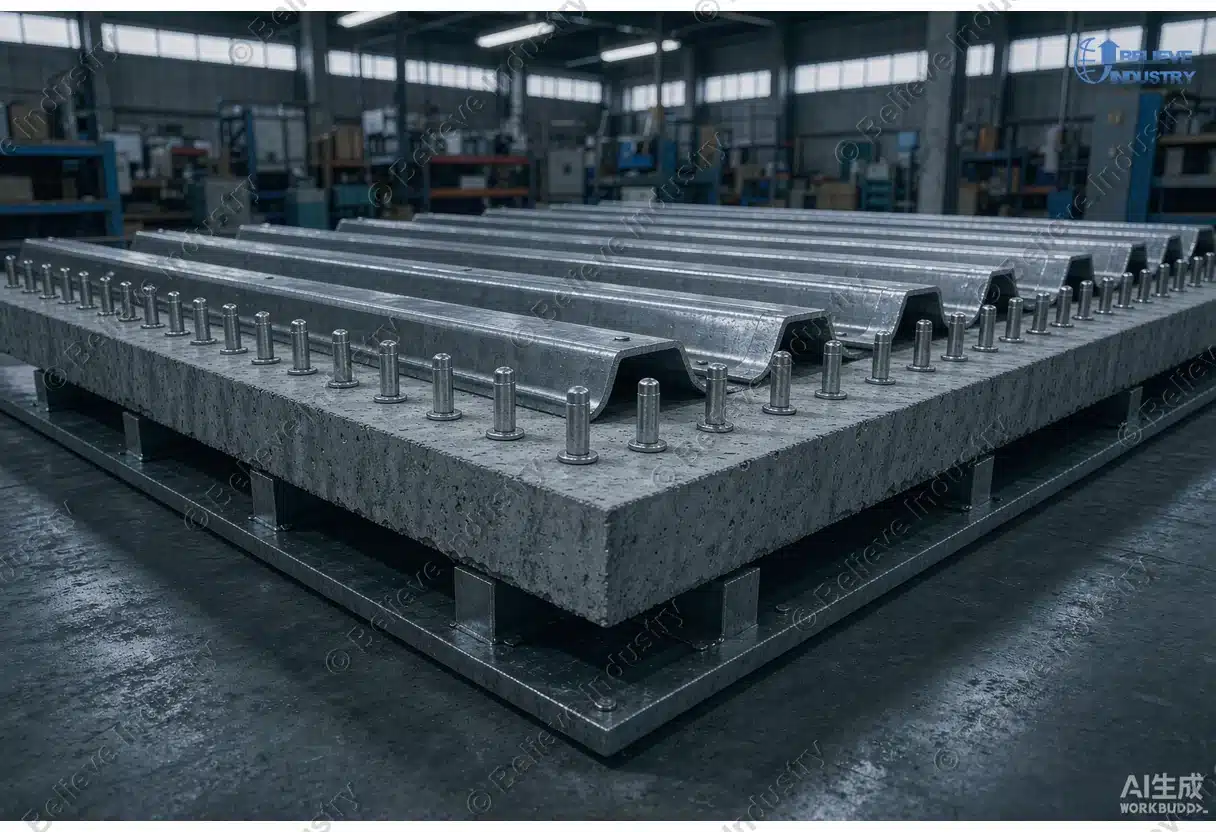
Shear studs are what make the composite slab act as one piece. The fire test fixes stud diameter, length, and spacing, often 19 mm studs at 300 to 600 mm spacing, and the rating only applies if you build to that layout. If you widen stud spacing or shorten embedment, the composite action weakens and the rating no longer holds. That is why the posted assembly drawing, not the deck alone, controls compliance. SDI standard roll forming tolerances explain how profile accuracy protects that composite bond in the field.
| Assembly Type | Edge Support | Rating Impact | Design Note |
|---|---|---|---|
| Restrained | Supported on all edges | Higher rating, less deflection | Common in composite floor |
| Unrestrained | Free or single edge | Lower rating | Use when framing is unknown |
Code Adoption Through the IBC and ICC, and Reading a Rating Report
The International Code Council (ICC) publishes the International Building Code (IBC) at https://www.iccsafe.org/. The IBC adopts UL 263 and ASTM E119 by reference, so a valid listing there is what the inspector accepts. Your job at submittal time is to name the exact design or test report, not the standard in general. Write “UL Design D900, 2-hour restrained composite deck” not “ASTM E119 compliant.”
To read a manufacturer’s fire rating report, check four fields. First, the design or report number and the issuing lab, for example UL or Intertek. Second, the listed deck profile and deck thickness, since a 0.9 mm deck cannot carry a 3-hour rating. Third, the required concrete cover and slab depth, because field concrete that falls short fails the rating. Fourth, the restraint condition and shear stud spacing. If all four match your drawing, the floor deck fire compliance is documented and the inspection should pass. For budget context on the line that makes these decks, see our floor deck machine price by 5 cost tiers.
Çözüm
Floor deck fire compliance rests on a tested assembly, not on the steel deck by itself. UL 263, ASTM E119, and ASTM E1966 set the fire endurance, while deck thickness, concrete cover, and shear stud spacing set the number of hours you can claim. Cite the exact design, match the field build to the report, and the rating holds. Beli Rollforming supplies the roll forming machine lines that form these compliant decks for fabricators worldwide.
SSS
1. What is floor deck fire compliance? Floor deck fire compliance means the composite steel deck assembly carries a tested fire-resistance rating from a recognized lab such as Underwriters Laboratories (UL) 263 or American Society for Testing and Materials (ASTM) E119. The rating states how long the assembly holds load and blocks heat, most often 1, 2, or 3 hours. Compliance is shown with a specific design number or test report, not a generic statement that the deck is fire rated.
2. What is the difference between UL 263 and ASTM E119? UL 263 and ASTM E119 are technically equivalent fire endurance test methods adopted by the model codes. UL 263 is published by Underwriters Laboratories (UL) and its results appear as Design numbers such as the D900 series. ASTM E119 is published by ASTM International and is the method run by third party labs like Intertek. For a composite deck, ASTM E1966 is the method written specifically for composite steel deck floor assemblies, while UL 263 remains the umbrella reference in the code.
3. How is a composite steel deck fire test run? A composite steel deck fire test builds a full size sample with the rated slab depth and loads it to design weight over a furnace. The furnace follows the ASTM E119 time temperature curve, reaching near 1000°C at 5 minutes and about 1100°C at 1 hour. The assembly passes when the unexposed face stays below 140°C average and 180°C local rise, carries its load, and shows no flame passage for the full rated time.
4. Does deck thickness affect the fire rating? Deck thickness affects the fire rating, but concrete cover affects it more. A 0.9 mm deck with 50 mm cover typically earns 1 to 1.5 hours, a 1.2 mm deck with 65 mm cover reaches 2 hours, and a 1.5 mm deck with 75 mm cover supports 3 hours. The steel deck is noncombustible under ASTM E136, so it never adds fuel, but it loses strength as it heats, which is why more concrete cover extends the rating.
5. What does restrained versus unrestrained mean for a deck? A restrained assembly is supported on all four edges by beams or walls that hold it during heating, which raises the rating. An unrestrained assembly has free or single edge support and is allowed to deflect, which lowers the rating. Most composite floors are detailed as restrained when the deck is welded to the beams. The restraint condition on the fire report must match the field condition for the rating to apply.
6. How do shear studs affect floor deck fire compliance? Shear studs make the deck and concrete act as one composite slab, which is what the fire test assumes. The rating fixes stud diameter, length, and spacing, often 19 mm studs at 300 to 600 mm centers. If you widen stud spacing or shorten embedment, the composite action weakens and the listed rating no longer applies. The posted assembly drawing, not the deck alone, controls compliance.
7. Which ASTM standards apply to steel deck fire performance? The key ASTM standards are ASTM E119 for fire endurance, ASTM E1966 for composite steel deck assemblies, ASTM E84 for surface burning, ASTM A653/A653M for the zinc-coated steel sheet, and ASTM E136 for noncombustibility at 750°C. UL 263 and UL 723 are the UL equivalents for endurance and surface burning. Together these seven standards cover the deck substrate, the assembly test, and the rating you cite.
8. How do I read a manufacturer’s fire rating report? Read four fields on the report. Check the design or report number and issuing lab such as UL or Intertek. Check the listed deck profile and deck thickness, because a 0.9 mm deck cannot carry a 3-hour rating. Check the required concrete cover and slab depth, since short field concrete fails the rating. Check the restraint condition and shear stud spacing, and confirm all four match your drawing before submittal.
9. Is steel deck considered noncombustible? Steel deck is noncombustible because cold formed steel passes ASTM E136 in a vertical tube furnace at 750°C. The deck does not add fuel to a fire, which is one reason steel framing earns credit in code. The fire risk is loss of strength as the steel heats, so the rating depends on concrete cover and slab depth that delay heat reaching the deck, not on the steel burning.
10. Does the IBC require UL 263 or ASTM E119? The International Building Code (IBC), published by the International Code Council (ICC), adopts UL 263 and ASTM E119 by reference for fire-resistance testing. A valid listing or test report under either method is what the inspector accepts. You must name the exact design or report number on the submittal, such as “UL Design D900, 2-hour restrained composite deck,” rather than a general claim of compliance with the standard.