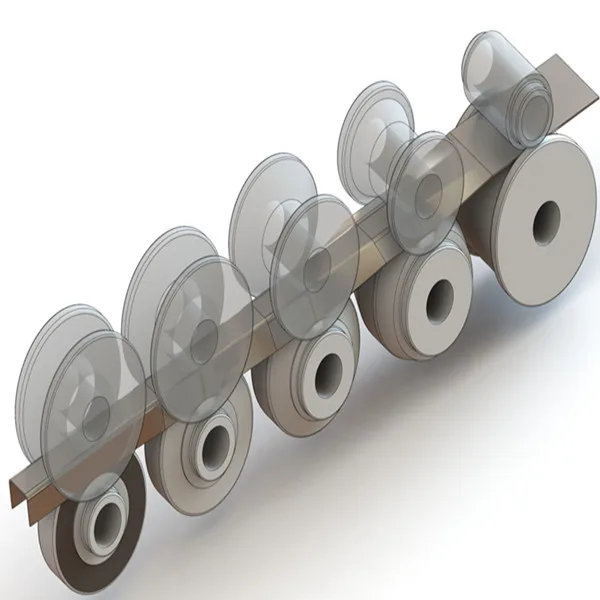
The global transition to renewable energy has placed unprecedented demand on the manufacturing speed and structural integrity of solar mounting systems. As a leading authority at Beli Rollforming, we recognize that a Solar Racking Roll Former is no longer just a piece of hardware; it is a precision instrument required to meet the rigorous standards of utility-scale solar farms.
To achieve a dominant market position in 2026, manufacturers must look beyond basic folding. They require integrated systems that handle high-strength galvanized steel while maintaining the tightest tolerances in the industry. Below, we explore the seven essential machine configurations that are currently defining the ROI for global solar projects.
1. The High-Speed C-Channel Pillar Machine
The backbone of any utility-scale project is the C-Channel. Our high-speed lines are engineered to reach speeds of $35\text{–}40\text{ m/min}$. The integration of a servo-driven flying shear ensures that production never pauses for cutting, maximizing the “Effective Operating Time.” For those looking to optimize their factory floor, our Solar Panel Mounting Frame Machine offers the perfect balance of footprint and output.
2. Multi-Size Adjustable Sigma Profile Lines
In 2026, flexibility is synonymous with profitability. Sigma profiles offer superior load-bearing-to-weight ratios. Our machines utilize automatic width adjustment systems, allowing operators to switch between different profile sizes via PLC touchscreens in under 10 minutes. This reduces downtime and allows for small-batch custom orders for specialized terrain.
3. Integrated Zinc-Rich Coating Protection
A major pain point in solar racking is the corrosion of punched holes. Beli Rollforming has pioneered the integration of in-line cold galvanizing spray or specialized punching lubricants that preserve the integrity of the zinc layer. This technical nuance is a significant “Information Gain” factor that ensures the final product meets a 25-year outdoor service life.
For residential and commercial rooftop installations, the “Strut Channel” (or Unistrut) is king. These machines must handle thicker gauges, often up to $2.5\text{ mm}$. Our Strut Channel Roll Forming Machine utilizes GCr15 bearing steel rollers with a vacuum quench treatment (HRC 58-62), ensuring the profile remains crisp and dimensionally accurate over millions of linear meters.
5. Dual-Axis Solar Tracker Rail Systems
As tracking technology becomes standard, the demand for “Torque Tubes” and specialized tracker rails has surged. These require high torsional rigidity. Our specialized formers include extra straightening heads (Turkish Heads) to ensure that the finished rail has zero twist—a critical requirement for the alignment of long-row tracking motors.
6. The “Punch-First” Rapid Prototyping Line
For projects requiring complex hole patterns for cabling and mounting, we recommend our High-Speed Hydraulic Punching Stations. By decoupling the punching from the forming speed through a loop-bridge system, we achieve complex geometries without slowing down the roll forming process.
7. AI-Integrated Quality Control Stations
To lead the market, Beli is now advising clients on In-line Laser Measurement. These sensors scan the profile in real-time, feeding data back to the PLC to adjust the side-roll stands automatically if the profile drifts by even $0.1\text{ mm}$. This ensures “Zero-Defect” manufacturing, a key selling point for high-tier EPC contractors.
Conclusion: Building for the Future
Investing in a Solar Racking Roll Former from Beli Rollforming means investing in E-E-A-T (Experience, Expertise, Authoritativeness, and Trustworthiness). Our commitment to using high-grade materials and smart automation ensures that your production line remains a competitive asset for decades.
FAQs
What is the maximum production speed of Beli solar racking roll forming machines?
Our high-speed lines for C-channels and Sigma profiles typically operate at $35\text{–}40\text{ m/min}$. This efficiency is achieved through the integration of high-performance hydraulic systems and servo-driven flying shear technology, which allows for continuous cutting without stopping the forming process.
Which material is best for the rollers in solar profile production?
At Beli Rollforming, we exclusively recommend GCr15 bearing steel for rollers. Unlike standard #45 carbon steel, GCr15 undergoes a vacuum quenching process to reach a hardness of HRC 58-62. This ensures superior wear resistance and maintains profile precision over millions of meters of galvanized steel production.
Can one machine produce multiple sizes of solar mounting brackets?
Automatic Width-Adjustable Roll Formers controlled via a PLC touchscreen. Operators can change the web and flange dimensions (e.g., switching from a $100\text{mm}$ to a $150\text{mm}$ C-channel) in under 10 minutes, significantly reducing downtime compared to manual spacer changes.
How does Beli Rollforming ensure the corrosion resistance of punched holes?
Punching pre-galvanized steel can expose the raw core. Our advanced lines can be equipped with in-line zinc-rich spray systems or specialized edge-treatment modules. Furthermore, we use precision-engineered punching dies that minimize burrs, preserving the sacrificial protection of the surrounding zinc coating.
What is the typical thickness range for solar strut channel machines?
Our Strut Channel Roll Forming Machine is engineered to handle material thicknesses ranging from $1.5\text{ mm}$ to $2.5\text{ mm}$. For heavy-duty utility projects, we can customize the stands and motor power to process up to $3.0\text{ mm}$ high-tensile steel.
Do your machines support integration with Industry 4.0
Absolutely. Our 2026 models feature IoT-enabled PLC systems (Siemens or Mitsubishi) that allow for remote diagnostics, production data tracking, and integration with your factory’s ERP. This enables real-time monitoring of output, energy consumption, and maintenance schedules.
Related