When buyers ask us what a roll forming machine costs, the honest answer is: it depends on what you’re making. A simple C-channel line and a high-speed box beam production system sit at opposite ends of a price spectrum that spans from roughly 20,000 to 200,000. That range is wide enough to be useless unless you understand what’s actually driving the numbers.
This guide walks through the seven variables that determine roll forming machine price in 2026. We cover material constraints, line speed, control systems, auxiliary equipment, logistics, and the hidden cost traps that catch first-time buyers. By the end, you’ll have a realistic budget framework — and a checklist for comparing supplier quotes without getting burned.
In 2026, new tech is changing the metal world. Because of this, prices go up and down. If you want to buy a roll forming machine, you need to know exactly what changes the cost. You do not want to pay too much. You also do not want a cheap machine that breaks.
What Determines Roll Forming Machine Price in 2026?
The cost of a roll forming machine is not a single line item. It’s a configuration puzzle where every choice you make pushes the price up or down. Most buyers fixate on the forming section alone, but that typically accounts for only 40–60% of the total investment. The rest lives in upstream and downstream equipment, controls, and the logistics of getting a working production line onto your shop floor.
Here are the seven factors that matter most.
1. Profile Geometry: Why a Simple Shape Costs Less
The complexity of your finished profile is the single biggest driver of machine cost. Every bend, step, hole punch, and edge detail in your cross-section adds stations to the line, additional tooling, and engineering time.
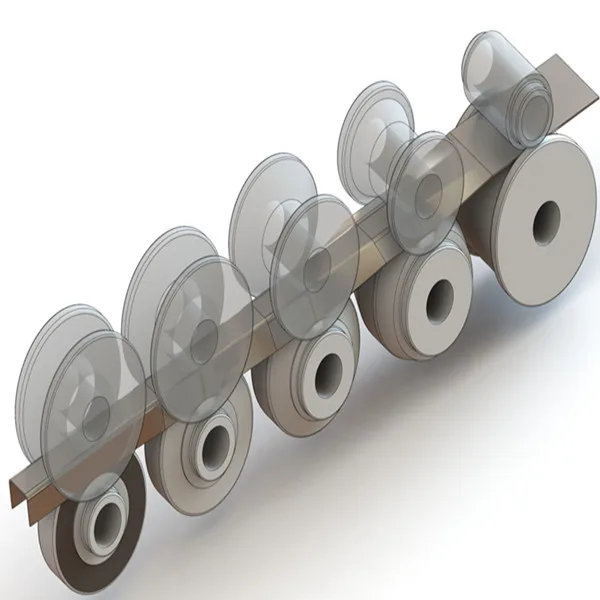
Simple open profiles — C-sections, Z-purlin, U-channels — typically require 8–14 forming stations. The tooling is straightforward, tolerances are well-established, and most manufacturers have standard cassette designs that reduce lead times. A basic C/Z purlin roll forming machine for these profiles falls in the 20,000–45,000 range.
Complex closed profiles — including square tube, rectangular box beam sections, and architectural trim — require more stations, tighter tolerance control, and often special side-guide systems to prevent twisting during the transition from open to closed shape. These lines commonly run 60,000–120,000 or more.
Structural profiles with high load requirements — such as bridge deck panels, solar strut channel sections, or marine structural members — demand heavier gauge materials, reinforced stands, and sometimes water-cooled forming tools. Expect 100,000–200,000+ for these configurations.
A practical note from our quoting process: buyers who come in with a sketch of their desired profile get a much more accurate roll forming machine price estimate than those who only say “something for steel framing.” The number of bends, the flange width, and whether you need closed sections all change the math significantly.
2. Material Specs: Metal Type and Thickness
The metal you plan to form limits your equipment options — and some combinations carry steep roll forming machine price premiums.
Thickness range is the first constraint. Most standard roll forming machines handle 0.5–3.0mm thickness. Going beyond 3.0mm (heavy structural sections) requires step-beam roll forming or press-brake-based approaches that can double or triple the cost. For context, a machine rated for 0.5–2.0mm aluminum costs considerably less than one spec’d for 1.5–6.0mm structural steel.
Yield strength matters too. High-strength low-alloy (HSLA) steels above 450 MPa require stronger forming rolls, often with heat-treated surfaces or tungsten carbide coatings. These materials extend tool life but increase the upfront machine cost by 15–25%. For technical specifications on steel grades, refer to ASTM A653 for galvanized steel and EN 10346 for European material standards.
Material comparison for roll forming applications:
Material
Typical Thickness
Yield Strength
Tooling Cost Factor
Formability
Galvanized Steel (DX51D)
0.5–2.5mm
250–350 MPa
1.0x (baseline)
Excellent
Cold-Rolled Steel (DC01)
0.4–2.0mm
270–330 MPa
1.0–1.1x
Excellent
Aluminum (3003/5052)
0.6–3.0mm
100–190 MPa
1.1–1.3x
Very good
Stainless Steel (304)
0.5–2.5mm
215–310 MPa
1.4–1.8x
Good
High-Strength Steel (HSLA S350)
1.5–6.0mm
350–500 MPa
1.5–2.5x
Moderate
If you’re uncertain which material grade fits your application, ask your supplier for a material data sheet comparison. Running the wrong spec — whether it’s too thick, too hard, or incompatible with your roller materials — causes premature tool wear and surface defects that are expensive to fix after the machine is on your floor.
3. Line Speed and Cutting System: The Productivity Variable
Speed is where buyers often get sticker shock. The difference between a standard line and a high-speed production system can account for 40–50% of the total machine cost.
Standard forming lines typically run at 8–15 meters per minute. This is adequate for job-shop operations, prototype runs, and low-to-medium volume production. The mechanical components are simpler, motor sizes are smaller, and the overall system complexity is manageable. A standard C-channel or Z-purlin roll forming line in this speed range costs 25,000–60,000.
High-speed production lines push into the 30–60 m/min range. Achieving these speeds requires servo feeding systems, precision flying cutoff or shear systems, automated stacking, and PLC-based synchronized control across all stations. These are engineering-intensive machines. A high-speed metal forming equipment package for solar mounting or commercial construction profiles typically runs 80,000–150,000.
Flying shear vs. stop shear is a choice that directly affects both the roll forming machine price and product quality:
System
Speed Capability
Cut Accuracy
Cost
Best For
Stop Shear (guillotine)
Up to 20 m/min
+/- 1.0mm at low speed
3,000–8,000 per station
Short lengths, thick material
Flying Shear
20–60+ m/min
+/- 0.5mm at high speed
12,000–30,000
Long continuous runs
Flying Saw
15–40 m/min
+/- 0.5mm
15,000–40,000
Hard materials, stainless
For most structural purlin and deck panel applications, a flying shear hits the sweet spot of speed and accuracy. Stop shear works fine for short panels under 3 meters. Flying saw is preferred when cutting stainless steel or high-strength alloys where the shear blade would work-harden the cut edge.
One often overlooked cost: the relationship between speed and throughput. A line running at 40 m/min with a flying shear can produce the same annual output as three slower lines — but the per-unit labor cost drops dramatically. If you’re evaluating ROI, run the numbers on throughput, not just the roll forming machine price.
4. Control System: PLC, HMI, and Industry 4.0 Features
The control system is the brain of the roll forming line, and in 2026 it increasingly determines whether your machine talks to your factory’s ERP or runs in isolation.
Basic PLC systems (Siemens S7-200 SMART, Omron CP1E, or equivalent) handle start/stop, speed regulation, length counting, and fault alarms. These are reliable, well-documented, and cost 3,000–8,000 added to the machine cost. Most standard roll forming applications don’t need more than this.
Advanced HMI touchscreens add recipe management, production tracking, and real-time speed/quality monitoring. A Mitsubishi iQ-R or Siemens HMI panel with multi-recipe storage typically adds 5,000–15,000. For shops running multiple profiles, this is worth the investment — switching profiles by selecting a stored recipe is far faster and more reliable than manual adjustment.
Industry 4.0 and IoT integration is where the premium systems diverge. Machines with Ethernet/IP or PROFINET connectivity, remote diagnostics, OEE tracking, and cloud-based production dashboards add 10,000–25,000 to the package. This is increasingly requested by buyers in Europe and North America who need production data for quality certification and customer reporting.
PLC brand comparison for roll forming applications:
Brand
Model
Typical Use
Remote Access
Cost Range
Siemens
S7-200 SMART
Standard lines
Limited
3,000–6,000
Mitsubishi
FX5U / iQ-R
Mid-range
Yes (via gateway)
5,000–12,000
Omron
NX1P2 / CP1E
Standard to mid
Yes
4,000–10,000
Delta
AS Series
Budget to mid
Yes
2,000–8,000
We recommend sticking with brands that have established service networks in your region. A machine with a technically superior PLC is worthless if your local technician can’t program it.
5. Auxiliary Equipment: The Line Behind the Line
The main roll forming machine is the headline, but auxiliary equipment often represents 30–50% of the total investment. Buyers who budget only for the former get an unpleasant surprise at installation.
Decoiler (uncoiler) — holds and feeds the coil stock into the line. Manual decoilers are cheap (500–2,000) but require an operator standing by throughout the run. Motorized decoilers with brake control (3,000–8,000) are the practical minimum for any production run over 30 minutes. Double-head decoilers (6,000–15,000) allow continuous feeding by switching between coils without stopping.
Punching and notching stations — integrated hydraulic or servo punching units add 8,000–30,000 per station depending on complexity. If your profile needs prepunched holes or notches for fasteners, factor this in early — retrofitting a punching station onto an existing line is far more expensive than ordering it built in.
Automatic stacking and bundling — for high-speed lines, automated stacking systems (15,000–50,000) prevent the bottleneck that manual stacking creates at the output end. Without it, your fast line ends up waiting for an operator to pile up finished panels.
A typical production line equipment breakdown:
Component
Budget Range
Notes
Main forming machine
25,000–120,000
Core of the system
Motorized decoiler
3,000–8,000
Essential for production runs
Flying shear/cutter
12,000–40,000
High-speed lines need this
Hydraulic punching station
8,000–30,000
Per station, varies by complexity
Automatic stacker
15,000–50,000
Recommended for 30+ m/min lines
Electrical cabinet + PLC
5,000–20,000
Brand-dependent
Installation and debugging
3,000–15,000
Often quoted separately
Get a line-by-line quote, not a single lump sum. Suppliers who bundle everything into one package are often hiding weak components.
6. Shipping, Installation, and Site Preparation
เดอะ roll forming machine price on the quote is not the landed cost. For international buyers, logistics can add 8–20% on top of the machine price, and site preparation can add another 5–15%.
Sea freight from China to major ports: a standard 40-foot container holds one complete forming line (typically 15–25 meters in sections). Shipping costs range from 2,000–6,000 depending on destination and current freight rates. One more 40-foot container may be needed for lines with auxiliary equipment. For high-speed lines with large flying shear units, flat-rack containers may be required, which add a premium. For freight rate estimates, check Freightos Baltic Index or Xeneta.
Customs duties and taxes vary significantly by country. Key examples for roll forming equipment (classified under HS Code 8462):
Destination
Import Duty
VAT/TAX
Total Landed Cost Estimate
Key Requirements
United States
0%
None (B2B)
Machine price × 1.00
Section 232 steel tariffs may apply
European Union
0%
19–27% VAT
Machine price × 1.19–1.27
CE marking required
United Kingdom
0%
20% VAT
Machine price × 1.20
UKCA marking
Australia
5%
10% GST
Machine price × 1.155
GOTS may apply
Canada
0%
5–13% GST/HST
Machine price × 1.05–1.13
Varies by province
UAE / GCC
5%
5% VAT (UAE)
Machine price × 1.10
Free zone options available
Saudi Arabia
5–20%
15% VAT
Machine price × 1.20–1.35
SASO certification required
India
7.5%
18% GST
Machine price × 1.265
BIS certification may apply
Brazil
14%
17–19% ICMS + PIS/COFINS
Machine price × 1.35–1.40
INMETRO certification
Mexico
0%
16% VAT
Machine price × 1.16
USMCA preferential rate
South Africa
15%
15% VAT
Machine price × 1.32
SABS marking for safety
Southeast Asia
0–15%
7–10% VAT
Machine price × 1.07–1.27
Varies by country
Japan
0%
10% Consumption Tax
Machine price × 1.10
JIS standards recommended
South Korea
8%
10% VAT
Machine price × 1.18
KC safety certification
Note: These rates are indicative for HS Code 8462 (machine tools for working metal, excluding forge/hydropress). Actual landed costs also include freight, insurance, port handling, and local agent fees. Consult a customs broker in your destination country for a formal calculation.
Site preparation is frequently underestimated. A roll forming line requires a level concrete floor (minimum 150mm reinforced slab), three-phase power (typically 380V/50Hz or 480V/60Hz depending on region), compressed air supply (6–8 bar), and adequate clearance for coil storage and finished product handling. We typically ask buyers to confirm site readiness before shipping — sending a machine to an unprepared facility costs everyone time and money.
Installation and debugging (start-up service) typically runs 3,000–15,000 depending on machine complexity and whether it’s domestic or international. Our standard practice is to include remote commissioning support in the machine price, with on-site startup as a separate line item. Budget for at least 3–5 days of on-site debugging for a new production line.
7. Quality, Support, and the Hidden Cost of Cheap Machines
This is the section that separates informed buyers from those who get burned. The roll forming machine price gap between a 25,000 machine and a 70,000 machine is not just about brand — it’s about what’s inside the machine and what happens when something goes wrong.
Roller material and hardness is one of the most important quality differentiators. Cheap machines use low-grade tool steel (HRC 52–56) that wears out in 3–6 months of production on structural steel. Quality machines use GCr15 bearing steel at HRC 58–62 or CR12MOV die steel at HRC 60–64, with some manufacturers offering tungsten carbide rollers for high-volume stainless steel production. Roller replacement cost runs 500–3,000 per station — so skimping on roller quality is a false economy. For roller material specifications, refer to AISI/SAE standards.
Motor and gearbox brands matter for long-term reliability. Planetary gearboxes from reputable manufacturers (Neugart, Alpha Getriebe) carry 5-year warranties. No-name gearboxes sourced from generic catalogs may fail within 12–18 months, and the replacement process typically requires machine disassembly.
The real cost of downtime is something we see buyers consistently underestimate. In a structural steel fabrication shop, a machine that runs 22 days per month vs. 18 days per month — due to quality issues and breakdowns — costs roughly 40,000–80,000 per year in lost production at typical throughput rates. A $10,000 premium on the initial roll forming machine price is paid back in the first year if it prevents even one significant breakdown.
Questions to ask any roll forming machine supplier before signing:
What steel grade and hardness are the forming rollers?
What gearbox brand do you use, and what is the warranty?
Do you provide remote diagnostic support? What are the response times?
Can I get a reference from a buyer in my industry with a similar profile?
What is the lead time, and what are the payment terms?
Is debugging (commissioning) included, or is it quoted separately?
How to calculate total cost of ownership (TCO):
For a rough TCO estimate over 5 years, use this formula:
TCO = Purchase Price + (Annual Maintenance x 5) + (Downtime Hours x Hourly Production Value) + Roller Replacement Costs
A machine with a higher upfront cost but lower maintenance, longer roller life, and more reliable uptime often has a significantly lower 5-year TCO than the cheapest option.
Simple 2026 Cost Calculator
Use this simple web tool to guess your total starting cost based on standard 2026 prices.
Beli RollForming – Engineering Configurator
Machine Engineering Configurator
Select Machine Application
Choose a preset profile to load industry-standard parameters. These templates provide a baseline for Total Bend Angles and Profile Depth commonly found in global construction standards.
1. Material Specification Analysis
Material Thickness and Yield Strength determine the mechanical resistance. Higher yield materials (G550) require specialized shaft diameters and larger motor torque to ensure precision without springback.
2. Profile Geometry & Complexity
Total Bend Angles represent the cumulative work required. Profile Depth is critical; deeper walls require more transition stations to prevent material stress and edge waves (oil canning).
3. Performance & Output Settings
Line Speed scales the motor requirement. The Forming Gradation level determines how many degrees of bend occur per station; smoother gradation results in superior surface finish and stability.
4. Logistics & Setup Options
Include the estimated Shipping Cost and onsite Setup Cost to generate a fully comprehensive turnkey budgetary estimate.
สถานีขึ้นรูป0
กำลังมอเตอร์หลัก0 kW
Total Estimated Cost$0
*Budgetary range includes the forming unit, drive system, shipping, and setup. Final pricing depends heavily on automation options, cutting systems, and material handling solutions.
How Much Does a Roll Forming Machine Cost? Quick Reference
Machine Type
Roll Forming Machine Price Range
Typical Speed
Best For
Basic C/Z purlin line
30,000–45,000
8–15 m/min
Low-volume job shops, prefab buildings
Mid-range structural line
45,000–80,000
15–25 m/min
Commercial construction, solar racking
High-speed production line
80,000–150,000
30–60 m/min
Large projects, repeated profiles
Complex structural/high-strength
100,000–200,000+
15–40 m/min
Bridge, marine, heavy structural
These roll forming machine price ranges reflect standard configurations. Custom engineering, special materials handling, and non-standard profiles will push costs toward the upper end or beyond.
คำถามที่พบบ่อย
What is the typical lead time for a roll forming machine?
Standard configurations (C-section, Z-purlin, U-channel lines) typically ship within 4–8 weeks after order confirmation and deposit. Custom profiles with non-standard geometry require tooling fabrication and typically take 10–16 weeks. High-speed lines with servo controls and flying shear systems may require 14–20 weeks. Always confirm the lead time in writing before placing a deposit.
How long does it take to install and debug a roll forming line?
A standard decoiler-to-stacker line typically requires 5–10 days for installation and debugging, assuming the site is prepared (level floor, correct power supply, compressed air). High-speed lines with flying shear, multiple punching stations, and automated stacking can require 10–20 days. Remote commissioning support from the manufacturer, combined with local electrician assistance, is the standard approach for international installations.
What is the ROI for a high-speed roll forming machine?
A high-speed line running at 40 m/min produces approximately 500–700 linear meters of C-section per 8-hour shift, compared to 150–200 meters from a standard 10 m/min line. At a typical selling price of 3–8 per linear meter for structural sections, the through put difference represents 1,000– 4,000 per shift in additional revenue. A 40,000 price premium for a high-speed upgrade can pay back in 80–200 production days depending on utilization rates and margin structure.
What warranty do manufacturers typically offer?
Standard warranties cover mechanical components for 12–24 months, with electrical components typically warranted for 12 months. Roller/tooling wear is usually treated as a consumable item not covered under warranty. Extended warranties are available from some manufacturers at additional cost. Always get the warranty terms in writing and confirm what “warranty” actually means — some suppliers define it as “we’ll diagnose the problem” while others include parts and labor.
Can I upgrade an existing roll forming machine later?
Partial upgrades are possible but have practical limits. Adding a punching station, upgrading the PLC, or installing a new HMI are feasible retrofits. Increasing the forming speed of an existing line is generally not practical — the mechanical frame, rollers, and gearbox are sized for their original speed rating. If you anticipate needing higher speed in the future, specify it in the original order rather than betting on a future upgrade.
What power supply does a roll forming machine need?
Most industrial roll forming machines require three-phase power. Asian-manufactured machines typically run on 380V/50Hz; machines destined for North America are configured for 480V/60Hz. Some European machines accept 380–415V/50Hz universal input. Power consumption varies from 15–30 kW for small lines to 80–200 kW for high-speed structural lines. Confirm your supply voltage and amperage capacity before ordering — transformer upgrades are expensive.
What materials can a standard roll forming machine process?
Most machines handle galvanized steel (GI), cold-rolled steel (CRS), and galvalume (AZ) without modification. Aluminum requires different roller materials (steel rollers can leave marks on aluminum; hard chrome or polymer coatings are preferred). Stainless steel requires either polished rollers or covers to prevent surface contamination, and the machine must be rated for the material’s specific yield strength. High-strength advanced high-strength steel (AHSS) requires step-beam technology or specialized heavy-duty stands.
How do I choose between a Chinese and a European roll forming machine manufacturer?
Chinese manufacturers typically offer lower machine prices (30–50% below comparable European equipment) with increasingly competitive quality on standard configurations. European manufacturers often lead on complex geometries, tight tolerances, and advanced control systems, with shorter service response times for buyers in Europe and North America. For a buyer evaluating total cost of ownership over five years, the quality gap on key components (rollers, gearboxes, PLCs) matters more than the purchase price difference. Ask to tour the factory and talk to existing customers before deciding.
What is the difference between roll forming and press braking?
Roll forming is a continuous process where sheet metal passes through a series of rollers, gradually bending into the desired profile. It produces long lengths efficiently with consistent cross-sectional geometry. Press braking uses a hydraulic press to bend sheet or plate at discrete stations. Press brakes handle thicker materials (up to 25mm+) and offer greater flexibility for short runs or one-off parts, but are far slower for long-length production. For profiles longer than 2 meters and running in volume, roll forming is typically 5–10x more productive.
What maintenance does a roll forming line require?
Daily: visual inspection of rollers for debris, check oil levels, verify coil alignment. Monthly: grease bearings (if not sealed), inspect roller surfaces for wear marks, check belt tension. Quarterly: gearbox oil analysis, electrical connection inspection, calibration check on cut-to-length accuracy. Annual: replace worn rollers, inspect gearbox for play, full PLC diagnostic. Budget approximately 1–2% of the machine price per year for scheduled maintenance parts. For detailed preventive maintenance schedules, consult your equipment manufacturer or refer to ISO 10816 for mechanical vibration measurement guidelines.
How accurate is cut-to-length on a roll forming line?
Modern lines with servo-controlled flying shears achieve cut-to-length accuracy of +/- 0.5mm at 30 m/min, and +/- 1.0mm at 60 m/min. Stop shear systems are typically +/- 1.0mm at low speed. Flying saw accuracy is generally +/- 0.5–1.0mm depending on the material and saw blade condition. Profile tolerance along the length (bow, twist, camber) depends on the forming process quality and is typically controlled to +/- 1.5–2.0mm per meter for standard structural profiles.
What countries does Believe Industry ship to, and what are common lead times?
We have shipped roll forming machines to over 40 countries including the United States, Canada, United Kingdom, Australia, South Africa, UAE, Saudi Arabia, India, Philippines, Indonesia, Vietnam, Mexico, Brazil, and others. Our standard Incoterms are EXW or FOB for most orders. We work with freight forwarders who specialize in industrial machinery and can arrange container loading, crating, and ocean freight to destination port. Typical ocean freight lead time from Shanghai to major ports is 25–45 days depending on carrier and route.
Next Steps If you’re ready to get a specific roll forming machine price for your application, here’s what helps us give you an accurate quote:
Send a profile drawing or sketch — even a rough hand sketch with key dimensions is more useful than a verbal description.
Specify your material — steel grade, thickness range, and yield strength.
Tell us your target speed and annual volume — this helps us recommend the right configuration.
Share your power supply — voltage, frequency, and available amperage.
Mention any existing equipment — if you already have a decoiler or stacker, we can configure the line to integrate with it.
We respond to detailed inquiries within 24 hours with a preliminary configuration and price estimate. For complex projects, we typically schedule a 30-minute video call to clarify requirements before issuing a formal quotation.