






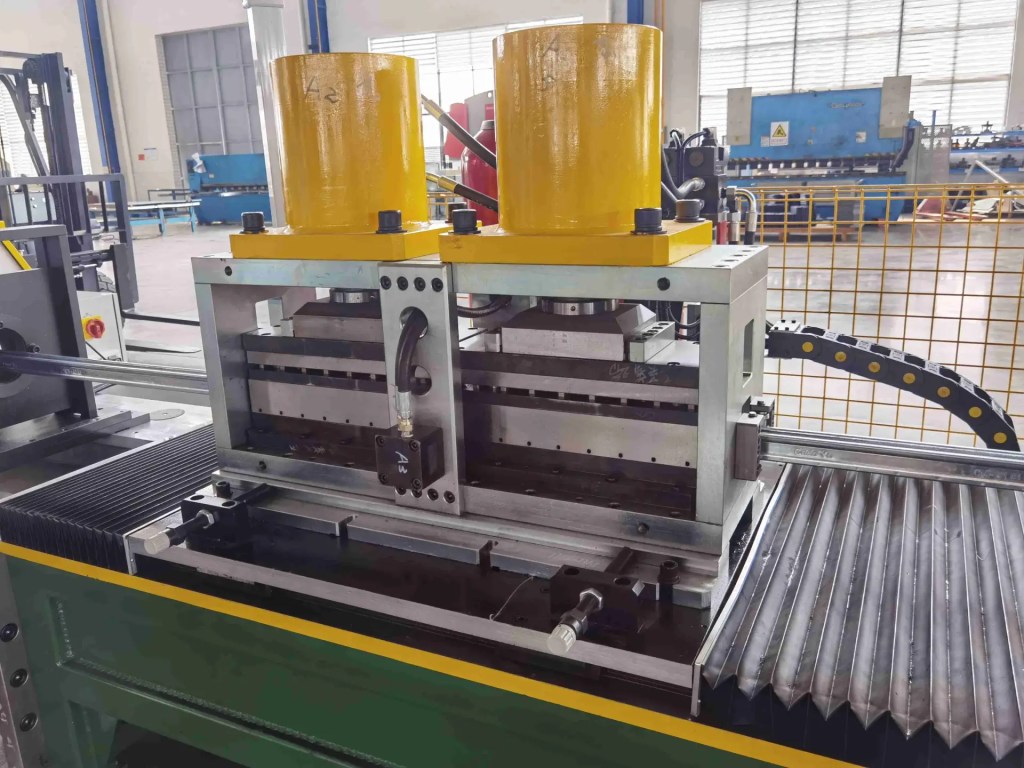
A purlin line rarely runs at the speed on its nameplate. The forming stands can often take more strip than the punching unit can handle. When that happens, the whole line waits for the punch. On most lines, purlin line punching speed is the number that decides real output. The gap between forming capacity and punching capacity is the first thing to measure on a slow line.
Purlin line punching speed matching means setting the punching method, feed accuracy and changeover routine so the punch keeps pace with the forming stands. The goal is not the highest number on the punch data sheet. It is a line where the punch, the forming rolls and the cutoff all run at the same steady rate.
This guide covers six bottlenecks that hold purlin lines back, with the cycle time and accuracy figures behind each fix. If you are comparing machine types first, our visão geral da máquina de conformação por rolagem sets out the main sections of the line.
Why the punch sets the real line speed
A purlin line has three rate limits: the forming stands, the punching unit and the cutoff. Output is always set by the slowest of the three. On most Z and C purlin lines, punching is that limit because each hole pattern takes time to position and strike.
The mismatch is easy to see in the numbers. A typical forming line runs between 20 and 45 m/min. Inline hole punching depends on the method. Mechanical flying punching can reach 30 m/min on simple patterns. Servo hydraulic punching trades some speed for accuracy and pattern flexibility. When the punch cannot follow the strip, the operator turns down the whole line, and forming capacity sits unused.
Hole position accuracy raises the stakes. A slot for a bolt must land within tolerance at every length. Pushing a punch past its accurate range produces parts that form well but fail assembly. Speed matching means finding the fastest rate that still holds position, not the fastest rate the machine can physically strike.
For the standards behind hole and dimension tolerance on cold formed members, see AISI S100 and EN 10162. The World Steel Association publishes background on forming cold rolled strip, and SAE covers the tool and material side.
Compare the four punching methods
Before fixing a bottleneck, confirm that the punching method suits the order mix. Many speed problems are a method choice made for a different product.
| Método | Practical speed | Precisão | Best fit |
|---|---|---|---|
| Pre punch on flat coil | Up to line speed | High, hole set before forming | Fixed patterns, long runs |
| Mechanical flying punch | Around 30 m/min on simple patterns | Medium to high | High volume, repeat patterns |
| Servo hydraulic punch | Lower, pattern dependent | High, software-defined holes | Mixed patterns, frequent changes |
| Rotary punch | High on continuous runs | Médio | Simple repeated holes, long strips |
A deeper comparison of punching systems appears in the Z purlin buying guide. O punching unit guide explains how the servo and hydraulic options are built.
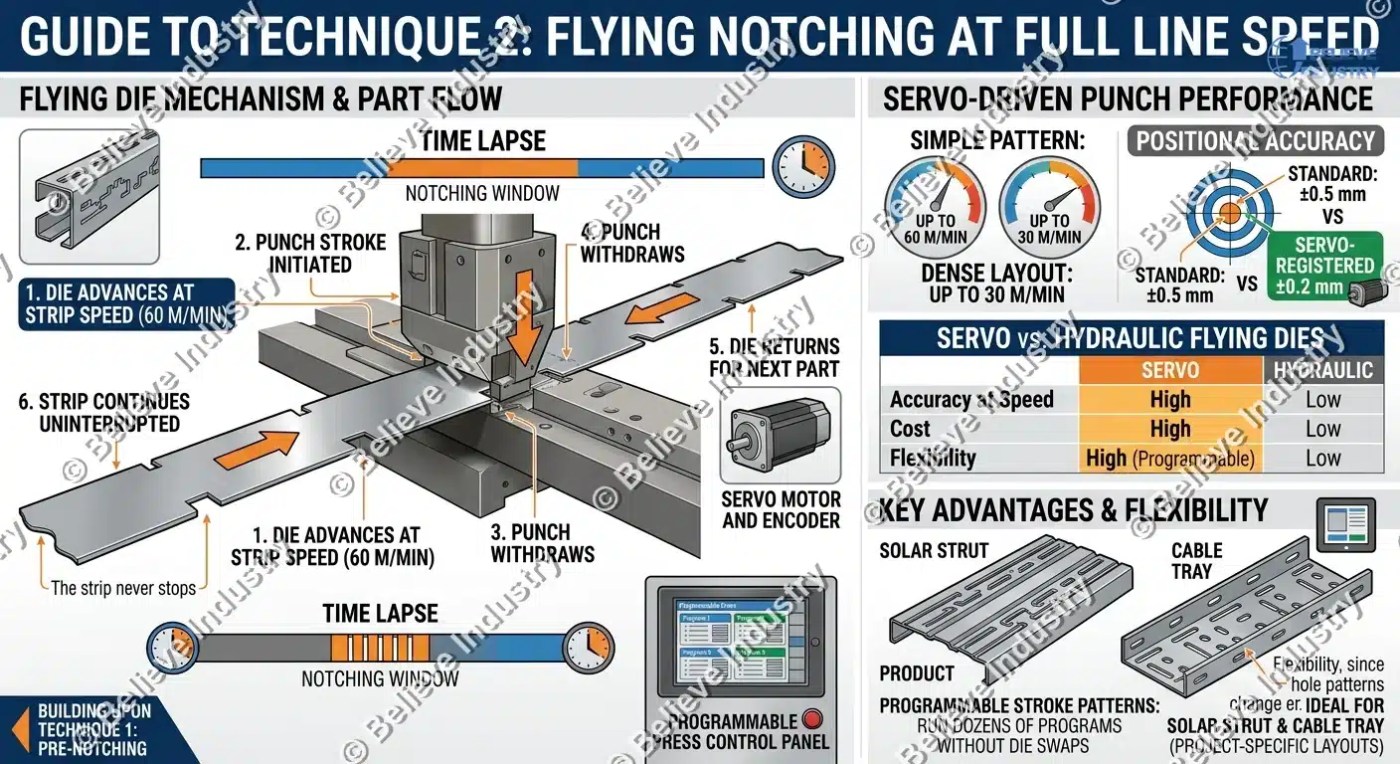
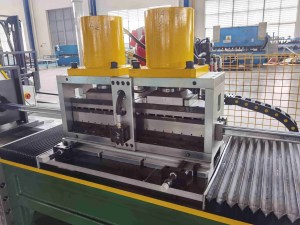
A flying punch tracks strip travel so holes stay in position at line speed.
The 6 purlin line punching bottlenecks
Work through these in order. Each one targets a different limit on purlin line punching speed. The first three are usually enough to close a modest gap. The last three matter on lines with frequent pattern changes or unreliable feed.
- Find the true bottleneck with a timed run. Run 50 m of strip at a fixed setting and time the punch strikes and the stops. If the punch fires on every cycle with no waiting, the punch is the limit. If the line stops between strikes, the fault is feed or synchronization. Measure before you change anything.
- Sync the flying punch to strip travel. A flying punch must track the strip at line speed while it strikes. If the encoder feedback or the tracking window is off, holes drift and the operator slows the line to compensate. Recalibrate the encoder against a measured length of strip and confirm the tracking window matches current line speed.
- Match hole pattern to the punch method. Long runs of one fixed pattern suit pre punching on flat coil, which removes punching from the line rate entirely. Mixed patterns suit a servo unit even at lower speed because it avoids die changes. Choosing the wrong method for the order mix is the most common cause of a permanent speed gap.
- Cut changeover time between hole patterns. On manual die setups, a pattern change can take an hour or more. Group orders by pattern so the line runs one family at a time. Keep the most used die sets mounted and use quick-change fixtures for the rest. Every avoided change is free output.
- Stabilize coil feed and entry tension. A strip that tracks unevenly makes the punch wait for position correction. Set entry guides and coil tension so the strip feeds straight into the forming stands. The edge wave and strip tension guide covers the feed corrections that keep hole positions steady.
- Balance punching with the cutoff. A slow cutoff creates the same downstream queue as a slow punch. Check that the flying shear can clear a cut length before the next hole pattern starts. Our C-to-Z changeover guide shows how profile switches change both the hole layout and the cut sequence.
Steps 2 and 3 recover the most speed on a typical purlin line. Step 4 matters most for job shops with short runs.
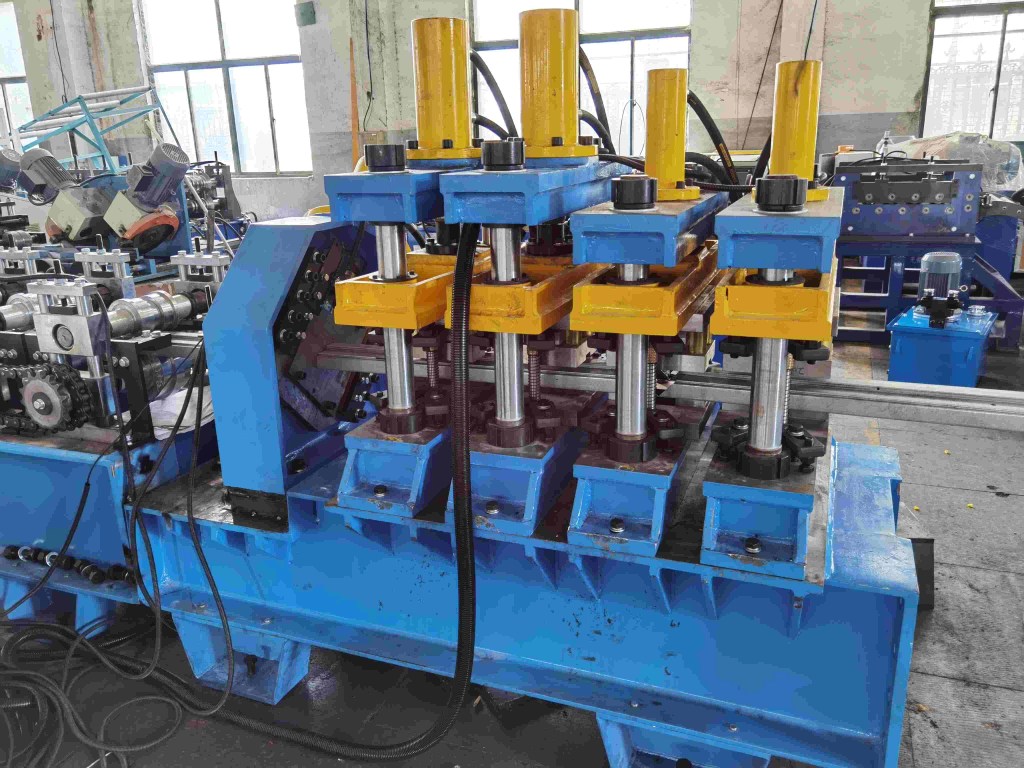
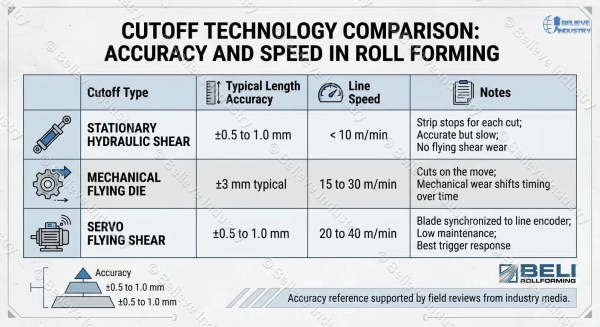
The cutoff and punch must finish inside the same cycle window.
Work the cycle time in numbers
Cycle time turns a vague complaint into a target. Take a 6 m cut length with four holes per length. At 30 m/min the line delivers one length every 12 seconds. The punch must place four holes inside that window, including travel and return.
| Velocidade da linha | Time per 6 m length | Time available per hole |
|---|---|---|
| 20 m/min | 18 s | 4.5 s |
| 30 m/min | 12 s | 3.0 s |
| 45 m/min | 8 s | 2.0 s |
If the punch needs more time than the table allows, the line has to slow down. You can close the gap by reducing the number of in-line holes through pre punching, by grouping patterns, or by moving to a faster punch method. You cannot close it by asking the forming stands to run faster.
Hold accuracy while you chase speed. Set hole position tolerance from the customer drawing, then confirm it at the start and end of each 6 m length. A punch that gains speed but loses position on the final hole is not faster in any useful sense. The Metal Construction Association publishes guidance on profile dimensions and tolerances for exactly this kind of check.
If hole drift appears near the cut end rather than along the whole length, the cause may be strip tension rather than the punch. Our guide to mechanical punch selection explains the trade-offs between press types for this situation.
Beli Rollforming has built roll forming lines since 2005 and delivered more than 500 machines to customers in over 50 countries. Every line carries a 24-month warranty on the complete machine. Our engineers set punching and forming rates together against your hole patterns before a line ships.
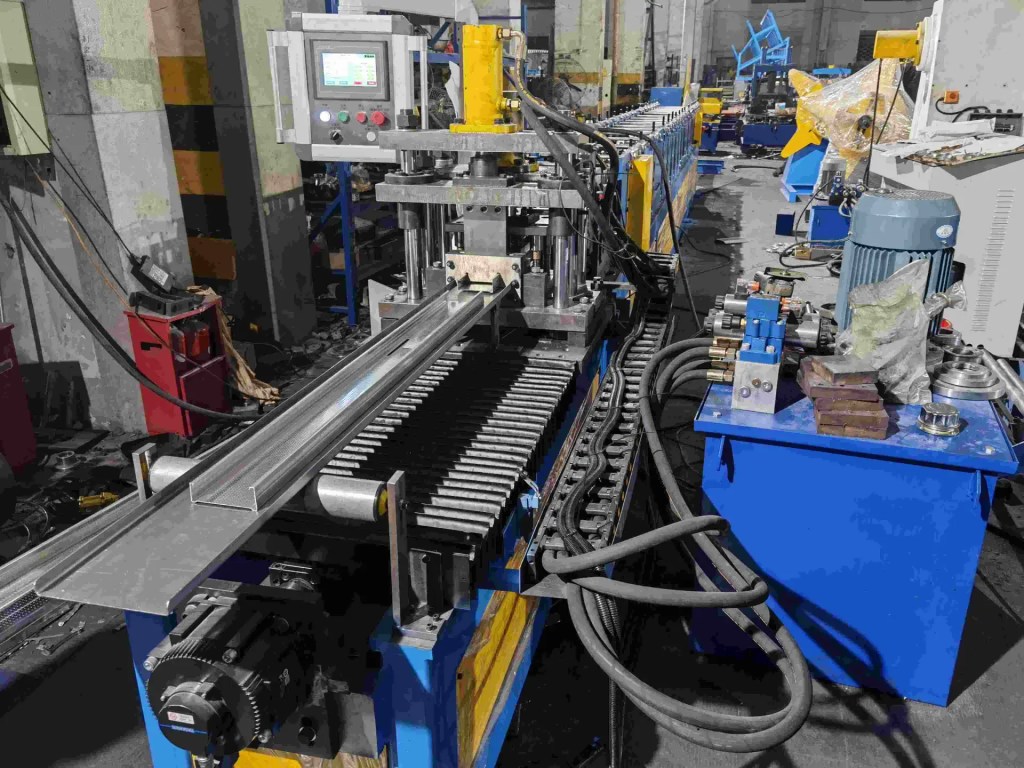
A slow cutoff can queue strip just as a slow punch can.
Perguntas frequentes
1. What limits purlin line punching speed most often? The punching method and pattern changes. A servo unit handling many short orders, or a mechanical punch asked to track a fast line, usually sets the real output.
2. How do I find the bottleneck on my line? Time a 50 m run. If the punch strikes continuously, punching is the limit. If the line pauses between strikes, look at feed, encoder sync or the cutoff.
3. What line speed can a flying punch follow? Mechanical flying punching reaches around 30 m/min on simple patterns. servo hydraulic punching is slower but holds accuracy on complex patterns. Always confirm speed against hole position tolerance.
4. Why do holes drift at higher speed? The flying punch is not tracking strip travel accurately. Recalibrate the encoder against a measured strip length and check the tracking window against line speed.
5. Does pre punching flat coil really raise output? Yes, for fixed patterns and long runs. Pre punching removes hole making from the line rate, so the forming stands can run at their own limit.
6. How much time does a punch pattern change cost? Manual die setups can take an hour or more. Group orders by pattern, keep common dies mounted, and use quick-change fixtures to recover that time.
7. Can coil feed problems slow the punch? Yes. Uneven tracking makes the punch wait for position correction. Set entry guides and coil tension so the strip feeds straight and hole positions stay repeatable.
8. How do I calculate the time available for each hole? Divide 60 by line speed in m/min to get seconds per metre, multiply by cut length, then divide by holes per length. At 30 m/min and 6 m lengths, you have 12 seconds, or 3 seconds per hole for four holes.
9. Should I upgrade the punch or the cutoff first? Fix whichever times slower in a measured run. A slow cutoff queues strip just as a slow punch does, and upgrading one without measuring the other often wastes the spend.
10. What accuracy standard applies to purlin holes? Use the customer drawing as the authority. AISI S100 and EN 10162 give the wider framework for cold formed steel dimensions and members.
Choosing a faster press is not the only way to raise purlin line punching speed. Most lines gain more from synchronization, pattern grouping and steady feed than from a larger machine. Measure first, then spend.
Última atualização: 2026-11-27
Histórico de alterações do artigo
- 2026-11-27: Initial publication with 6 bottleneck fixes, cycle time tables, and 10 FAQ entries.
Próximos gatilhos de revisão
- Revise speed figures when a new punching method is added to the product range.
- Update the cycle time table if typical cut length or hole count changes.
- Revisit encoder sync guidance after a control system upgrade.


 Português