









Introdução
Every roll forming line starts with a coil. The coil material you choose dictates surface quality, dimensional accuracy, tooling wear, and final profile cost. The cold rolled vs hot rolled steel decision is the first fork in the road.
Both materials go through the same roll forming machine. But they behave differently. The cold rolled vs hot rolled steel choice affects roller wear, surface finish, and tolerance bands. Understanding these differences prevents scrap, reduces tooling cost, and keeps customers happy.
This guide breaks down cold rolled vs hot rolled steel into five practical differences: surface finish, dimensional tolerance, mechanical properties, edge quality, and cost-to-application fit. Whether you run a roofing line or a structural profile line, this comparison helps you pick the right coil.
For a broader material perspective, our Material para conformação por rolos: aço ou alumínio guide covers another common material decision. The Coil Processing & Material Handling guide explains coil preparation steps that apply to both cold rolled and hot rolled steel.
Difference 1: Surface Finish and Oxide Scale
Surface finish is the most visible difference in the cold rolled vs hot rolled steel comparison. It directly affects whether your profile needs secondary painting or ships as-is.
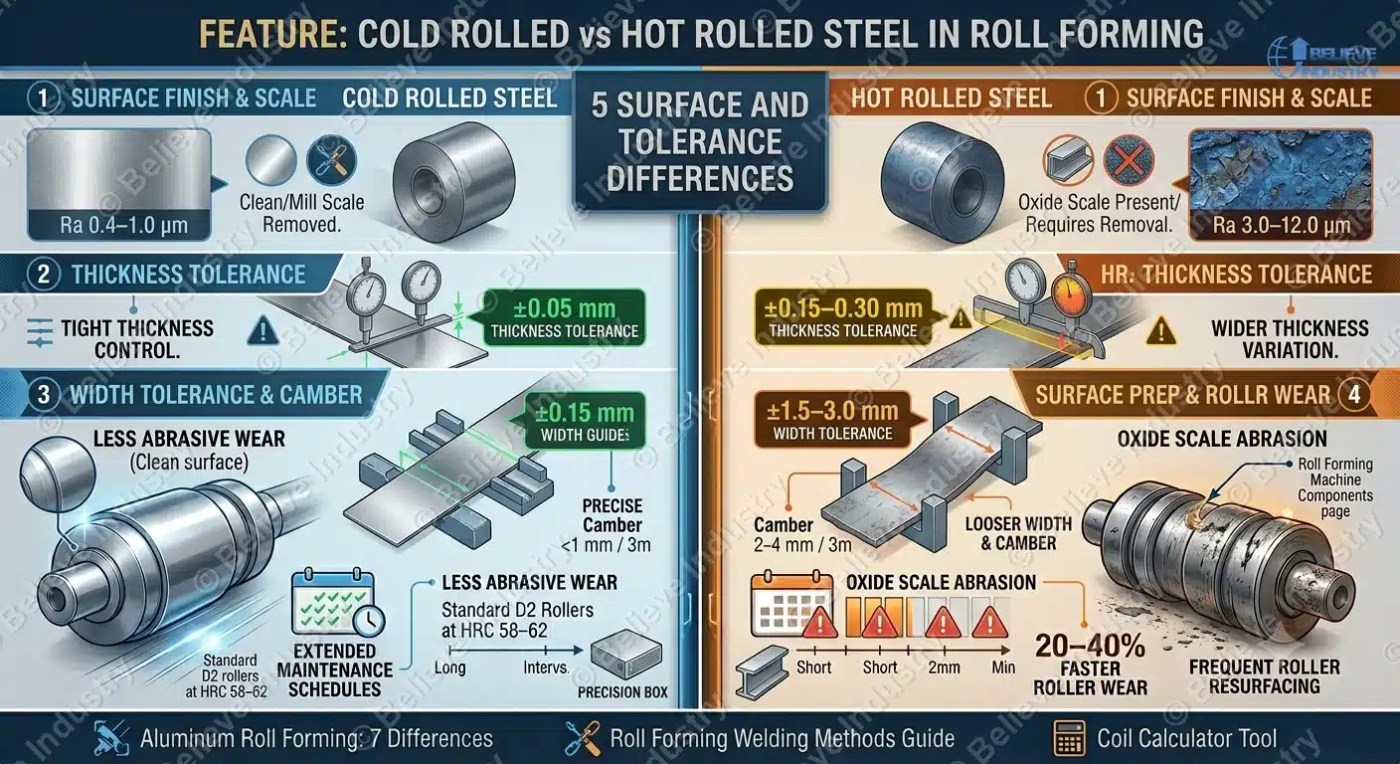
Cold rolled steel undergoes pickling and cold reduction after hot rolling. This removes all mill scale and produces a smooth, bright surface. Typical surface roughness sits at Ra 0.4–1.0 μm. The surface is clean enough for direct painting, plating, or visible architectural use. This is an advantage in the cold rolled vs hot rolled steel comparação.
Hot rolled steel cools on the run-out table after rolling. This forms a blue-black iron oxide scale layer. The scale is rough and non-uniform, with Ra values from 3 to 12 μm. Unless you descale, this surface transfers directly to your formed profile.
Surface Comparison Table
| Propriedade | Cold Rolled Steel | Hot Rolled Steel |
|---|---|---|
| Surface appearance | Smooth, bright, metallic | Dark, scaly, blue-black |
| Typical Ra (μm) | 0.4–1.0 | 3.0–12.0 |
| Mill scale | None (pickled off) | Present, requires removal |
| Paint readiness | Direct paint, no prep | Requires descaling + primer |
| Common ASTM spec | ASTM A1008 | ASTM A1011 |
In cold rolled steel roll forming, the smooth surface means rollers leave minimal marking. You can run chrome-plated rollers at standard pressures without surface damage.
In hot rolled steel roll forming, the oxide scale acts as an abrasive layer between roller and strip. It accelerates roller wear significantly. Descaling via shot blasting or acid pickling before forming extends roller life by 30–50%. The Máquina de nivelamento page covers how flatteners also help break loose scale before the forming passes.
For applications where surface finish is critical — appliance panels, visible trim, furniture sections — cold rolled is the only choice. In the cold rolled vs hot rolled steel comparison, hot rolled works for hidden structural members where appearance does not matter.

Difference 2: Dimensional Tolerance and Thickness Control
Tolerance is the second critical factor in the cold rolled vs hot rolled steel comparison. It determines whether your profile meets spec without rework.
Cold reduction tightens thickness control dramatically. Cold rolled steel typically holds ±0.05 mm on thickness for gauges up to 3.0 mm. Width tolerance runs ±0.15 mm. Flatness is excellent because the cold rolling process itself flattens the strip.
Hot rolled steel thickness tolerance is much wider. For the same gauge range, expect ±0.15 to ±0.30 mm. Width tolerance runs ±1.5 to ±3.0 mm. Flatness is poorer — the strip often carries coil set and crossbow that require leveling before forming. This tolerance gap defines the cold rolled vs hot rolled steel production difference.
Tolerance Comparison Table
| Dimensão | Cold Rolled Tolerance | Hot Rolled Tolerance |
|---|---|---|
| Thickness (≤3.0 mm) | ±0.05 mm | ±0.15–0.30 mm |
| Largura | ±0,15 mm | ±1.5–3.0 mm |
| Flatness | Excelente | Fair (needs leveling) |
| Coil set | Minimal | Significant |
| Camber | <1 mm / 3 m | 2–4 mm / 3 m |
These tolerance gaps have real consequences in the cold rolled vs hot rolled steel comparison. In cold rolled steel roll forming, tight thickness control means consistent springback across the entire coil. Your profile dimensions stay stable from first meter to last.
In hot rolled steel roll forming, thickness variation changes the bend radius and springback at every point along the strip. A 0.20 mm thickness shift can alter a 90-degree bend angle by 1–2 degrees. The retorno elástico na conformação por rolos guide explains how material thickness affects overbend calculations.
For precision profiles — electronic enclosures, sealing tracks, sliding components — cold rolled is essential. For structural channels and heavy-gauge purlins, hot rolled tolerance is usually acceptable. The Roll Forming Capacity page covers how material thickness variations affect machine loading and deflection.

Difference 3: Mechanical Properties and Springback
Mechanical behavior is where cold rolled vs hot rolled steel diverges most in the forming process itself. The same machine, same flower diagram, and same roller set produce different results.
Cold rolling work-hardens the steel. Cold rolled steel typically shows yield strength 280–400 MPa, depending on grade and temper. The work hardening raises hardness but reduces ductility. This means more springback during forming and a higher risk of edge cracking on tight bends.
Hot rolled steel cools naturally after rolling. It retains lower yield strength — typically 230–340 MPa — and higher ductility. The material flows more easily through rollers. Springback is lower, but dimensional prediction is harder because properties vary along the coil length. This is the third difference in cold rolled vs hot rolled steel forming behavior.
Mechanical Property Comparison
| Propriedade | Cold Rolled Steel | Hot Rolled Steel |
|---|---|---|
| Yield strength (MPa) | 280–400 | 230–340 |
| Alongamento (%) | 20–30 | 25–38 |
| Retorno do elástico | Mais alto | Lower |
| Edge cracking risk | Higher (tight bends) | Lower |
| Work hardening | Already hardened | Minimal |
In cold rolled steel roll forming, expect 15–25% more springback than hot rolled for the same profile geometry. You need extra overbend passes. The Roll Forming Roll Design guide covers flower diagram adjustments for different material hardness levels.
In hot rolled steel roll forming, the softer material flows more willingly. Fewer forming passes are needed for the same profile. But the lower and less consistent yield strength means your tolerance window is wider. You trade precision for ease of forming.
The American Iron and Steel Institute (AISI) publishes grade-specific property data that helps predict forming behavior. For high-strength cold rolled grades, roller material selection becomes critical

Difference 4: Edge Quality and Coil Preparation
Edge quality is an overlooked factor in the cold rolled vs hot rolled steel decision. Poor edges cause cracking, burr problems, and profile defects.
Cold rolled steel arrives with clean, uniform slit edges. The cold slitting process produces minimal burr — typically under 0.03 mm. Edge hardness from cold work is present but manageable. Most cold rolled coils can go directly to the roll former with only a leveler pass.
Hot rolled steel brings several edge challenges. The mill edge is irregular and may carry oxide scale buildup. Slit edges on hot rolled coil have larger burrs — 0.08–0.15 mm — because the softer material deforms more during slitting. Edge conditioning (deburring, edge rounding) is often required before forming.
Coil Preparation Requirements
| Preparation Step | Cold Rolled | Hot Rolled |
|---|---|---|
| Descaling | Not needed | Required (pickling or shot blast) |
| Nivelamento | Light pass | Full leveling required |
| Edge conditioning | Opcional | Recommended |
| Slitting burr (mm) | <0.03 | 0.08–0.15 |
| Storage rust risk | Low (oiled) | Higher (scale traps moisture) |
In hot rolled steel roll forming, skipping descaling is the most common mistake. The scale layer crushes during forming, creating loose particles that embed in roller surfaces. This causes surface scratches on every subsequent part. The cold rolled vs hot rolled steel preparation gap is significant here. The nivelador de máquina de perfilagem page details how levelers break scale and flatten strip simultaneously.
In cold rolled steel roll forming, coil preparation is simpler. A single leveler pass removes coil set. The clean surface and tight edges mean you can start forming with minimal setup. This reduces changeover time between coils — a significant productivity advantage for high-mix production lines.
The Fabricator magazine’s material selection guidance notes that edge condition directly affects formability limits. Cracked edges are the leading cause of fracture during tight-radius bending in both materials.

Difference 5: Cost, Application Fit, and Tooling Impact
Cost and application fit close out the cold rolled vs hot rolled steel comparison. The right choice depends on what your customer sees and what your profile must do. In the cold rolled vs hot rolled steel debate, there is no universal winner — only the right material for the job.
Cold rolled steel costs 15–30% more per ton than hot rolled. But it delivers a premium surface, tight tolerances, and consistent properties. For visible or precision applications, the price premium pays for itself in reduced scrap and eliminated secondary finishing.
Hot rolled steel is the economical choice for structural and heavy-gauge work. It costs less, forms easily, and covers thicker gauges (up to 25 mm) that cold rolling cannot produce. For hidden structural members and racking, hot rolled is standard.
Application Match Table
| Aplicativo | Recommended Material | Key Reason |
|---|---|---|
| Appliance panels | Cold rolled | Surface finish, tight tolerance |
| Architectural trim | Cold rolled | Paint-ready, visible surface |
| Electronic enclosures | Cold rolled | Precision tolerance |
| Structural channels | Hot rolled | Cost, heavy gauge |
| Warehouse racking | Hot rolled | Cost, hidden application |
| Roofing panels (galvanized) | Cold rolled substrate | Surface for coating |
| Highway guardrail | Hot rolled | Heavy gauge, structural |
| Furniture sections | Cold rolled | Surface, precision |
In cold rolled steel roll forming, tooling lasts longer because the clean surface causes less abrasive wear. The cold rolled vs hot rolled steel tooling impact is measurable in maintenance schedules. Standard D2 rollers at HRC 58–62 handle most cold rolled gauges. For more on tooling selection, see Melhorias nas ferramentas de conformação de rolos.
In hot rolled steel roll forming, expect 20–40% faster roller wear from oxide scale abrasion. Plan for more frequent roller resurfacing. The Componentes de máquinas de perfilagem page covers how different components handle abrasive coil stock.
For cross-material insights, our Aluminum Roll Forming: 7 Differences from Steel guide shows how non-ferrous coil changes the equation. For joining processes that differ by material, the Roll Forming Welding Methods guide covers seven inline technologies. Use our Calculadora de bobina to estimate costs for both materials.

Perguntas frequentes
The main difference in cold rolled vs hot rolled steel is surface finish and dimensional tolerance. Cold rolled has a smooth, scale-free surface with ±0.05 mm thickness tolerance. Hot rolled has oxide scale and ±0.15–0.30 mm tolerance.
Not without descaling and surface preparation. Hot rolled steel roll forming leaves a rough, scaly surface. For visible applications, use cold rolled steel or descale the hot rolled coil before forming.
Yes. Cold rolling work-hardens the steel, increasing yield strength. Cold rolled steel roll forming typically produces 15–25% more springback than hot rolled for the same profile and bend angle.
Cold rolled steel. Its ±0.05 mm thickness tolerance ensures consistent springback and profile dimensions. Hot rolled steel roll forming cannot match this precision due to wider thickness variation.
The roller material can be the same (D2 tool steel is standard for both). But hot rolled steel roll forming wears rollers 20–40% faster due to oxide scale abrasion. Plan for more frequent resurfacing.
Per ton, yes — 15–30% more. But cold rolled steel roll forming often costs less per finished part because it eliminates descaling, reduces scrap, and needs less secondary finishing.
Cold rolled steel is available up to about 3.0 mm. Hot rolled steel covers 1.5 mm to 25 mm and beyond. For heavy-gauge structural profiles, hot rolled is the only practical option.
Always. Descaling via acid pickling or shot blasting removes oxide scale that damages rollers and scratches profiles. Skipping this step is the most common mistake in hot rolled steel roll forming.
Cold rolled coils need only a light leveler pass. Hot rolled coils require descaling, full leveling, and often edge conditioning before entering the roll former.
Yes, but you must adjust overbend angles for springback differences, change leveler pressure, and verify tooling compatibility. The cold rolled vs hot rolled steel switch is not a plug-and-play changeover.
Registro de alterações do artigo
- 2026-08-04: Initial publication. Covered 5 surface and tolerance differences between cold rolled and hot rolled steel in roll forming. Included 3 comparison tables, 10 FAQs, and 12 internal links to belirollforming.com pages.
Próximos gatilhos de revisão
- New ASTM standards for cold rolled (A1008) or hot rolled (A1011) steel published or revised.
- Significant change in cold rolled vs hot rolled steel price spread.
- New descaling or surface treatment technology adopted by the roll forming industry.
- Customer feedback indicating tolerance or surface issues with either material.