








Εισαγωγή
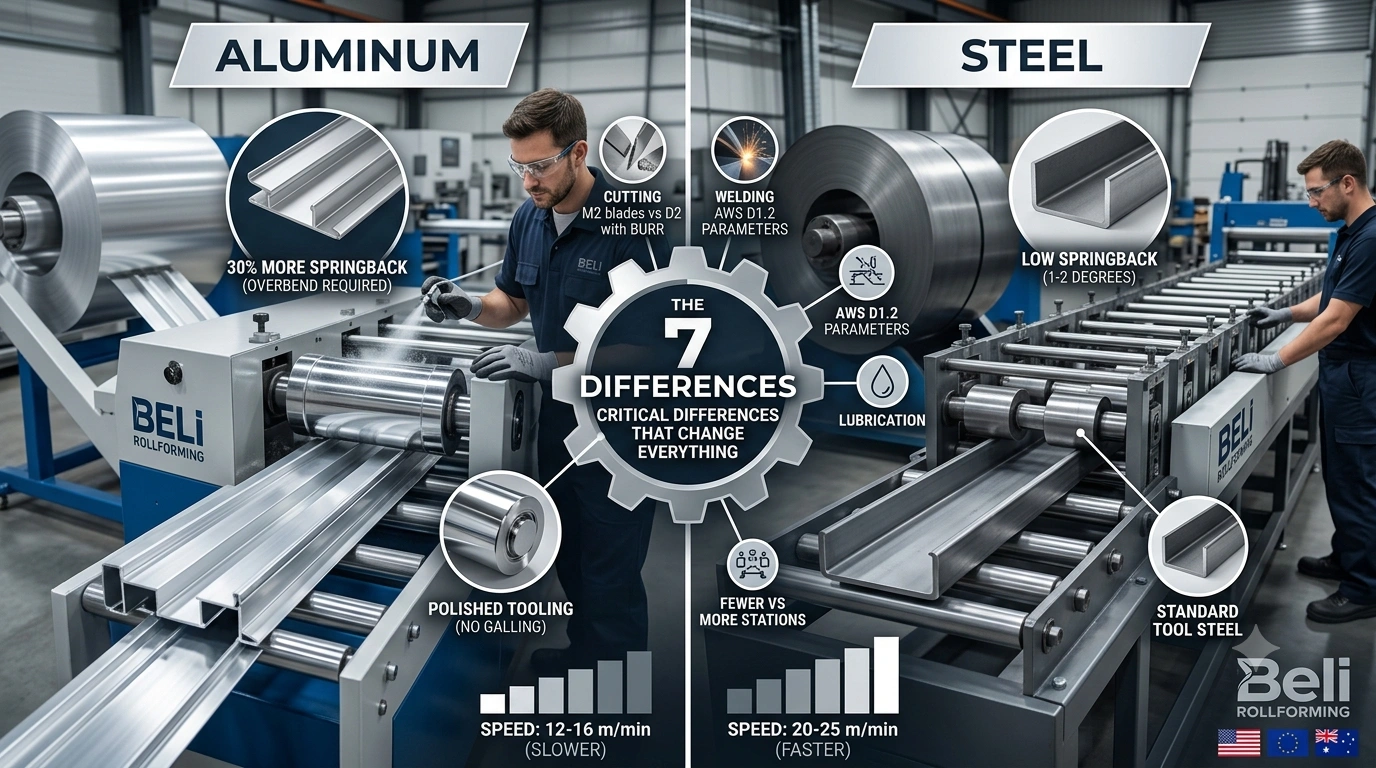
Aluminum roll forming is not just steel roll forming with a different coil. The two metals behave so differently under bending forces that nearly every machine parameter must change. From springback to galling, from cutting speed to welding method — aluminum demands its own playbook.
Here are seven aluminum roll forming differences that change how you configure your line, select your tooling, and run production. Form architectural trim, roofing panels, or structural sections — get these wrong and your profiles scrap instead of clean.
Beli Rollforming has configured aluminum roll forming lines for fabricators across 20+ countries. Our main markets — the US, Europe, and Australia — demand tight tolerances and scratch-free surfaces. Over 15 years of experience taught us exactly where aluminum diverges from steel.
For a broader material comparison, see Beli’s Roll Forming Material: Steel vs Aluminum οδηγός.
1. Springback: Aluminum Springs Back Up to 30% More Than Steel
Springback is the first difference every operator notices. Aluminum has a higher ratio of elastic modulus to yield strength compared to mild steel. In practical terms, aluminum wants to return to its original shape more aggressively after bending.
For mild steel (yield strength ~250 MPa, elastic modulus ~210 GPa), springback is typically 1–2 degrees per bend. For common roll forming aluminum grades like 5052-H32 (yield ~193 MPa, modulus ~70 GPa), springback can reach 3–5 degrees. That is a 30% or greater increase in elastic recovery.
This means your roll flower design must overbend every pass. If your final profile calls for a 90-degree bend, the last forming station must aim for 93–95 degrees to compensate. Beli’s springback control guide details four compensation techniques including overbending and finite element analysis.
Ο Aluminum Association publishes minimum bend radius data for every alloy and temper. Following these radii is not optional — bending below the minimum radius causes cracking at the outside fiber.
Springback Comparison: Aluminum vs Steel
| Υλικό | Yield Strength (MPa) | Elastic Modulus (GPa) | Springback (degrees) | Overbend Required |
|---|---|---|---|---|
| Mild Steel DC01 | 250 | 210 | 1–2 | 2–3 degrees |
| Γαλβανισμένος χάλυβας | 280–340 | 210 | 1.5–2.5 | 2–4 degrees |
| Aluminum 5052-H32 | 193 | 70 | 3–5 | 4–7 degrees |
| Aluminum 6061-T6 | 276 | 69 | 4–6 | 5–8 degrees |
| Aluminum 3003-H14 | 145 | 69 | 2–3 | 3–5 degrees |
This table shows why aluminum vs steel roll forming requires different flower diagrams. You cannot reuse a steel roll set and expect aluminum to come out right.
2. Galling Risk: Aluminum Sticks to Steel Rollers
Steel does not stick to steel rollers. Aluminum does. This phenomenon is called galling — a form of adhesive wear where aluminum transfers onto the roller surface during forming.
Galling destroys surface finish within hours. It creates built-up edges on rollers that then scratch every subsequent profile. The softer the aluminum alloy, the worse the galling. Grade 1100 (pure aluminum) is notorious. Grade 6061-T6 is less prone but still risky under high contact pressure.
To prevent galling in roll forming aluminum, roller surfaces must be either chrome-plated, PVD-coated with TiN, or polished to a mirror finish (Ra ≤ 0.4 μm). Standard ground rollers at Ra 0.8 μm — fine for steel — are too rough for aluminum. For more on roller surface treatments, see Αναβαθμίσεις Εργαλείων Κυλινδρικής Διαμόρφωσης.
ASM International documents that galling threshold drops sharply when surface roughness exceeds 0.5 μm for aluminum alloys. Below that threshold, a thin lubricant film can keep the surfaces separated.
Anti-Galling Roller Surface Options
| Roller Surface Treatment | Surface Roughness (Ra) | Galling Resistance | Relative Cost | Ιδανικό για |
|---|---|---|---|---|
| Standard Ground | 0.8 μm | Poor | Βασική γραμμή | Steel only |
| Polished | 0.2–0.4 μm | Καλός | +15% | Light-gauge aluminum |
| Chrome Plated | 0.2 μm | Πολύ καλό | +25% | General aluminum lines |
| PVD TiN Coated | 0.1 μm | Εξοχος | +40% | High-volume, premium |
| Tungsten Carbide | 0.05 μm | Εξοχος | +80% | Long-run, critical passes |
3. Forming Speed: Aluminum Lines Run 20–40% Slower
Running aluminum at steel speeds guarantees surface defects. Aluminum is more sensitive to heat buildup during forming. Friction heat at high speed softens the alloy and increases galling.
A typical steel roll forming line runs at 15–25 meters per minute. Roll forming aluminum usually requires 10–18 m/min. That is a 20–40% speed reduction depending on alloy, thickness, and profile complexity.
The speed drop affects your production planning. If you are quoting throughput based on steel experience, you must adjust downward. A line that produces 1,200 meters of steel profile per hour may only produce 750–900 meters of aluminum profile.
Thinner aluminum (0.3–0.8 mm) can run closer to steel speeds. Thicker aluminum (2.0–3.0 mm) demands the full speed reduction. Complex profiles with multiple bends also require slower speeds to prevent cracking at tight radii.
4. Lubrication: Aluminum Demands Different Chemistry
Steel roll forming often runs dry or with light rust-preventive oil. Aluminum cannot. Without proper lubrication, aluminum welds itself to the roller surface through pressure and friction.
Aluminum roll forming requires specialized lubricants — typically synthetic esters or water-soluble emulsions formulated for non-ferrous metals. These lubricants create a boundary film that prevents metal-to-metal contact between the aluminum strip and the steel roller.
Key lubricant properties for aluminum:
- Low viscosity (10–20 cSt at 40°C) — thin enough to coat evenly without dripping
- Non-staining — must not leave residue visible on mill-finish aluminum
- Good wetting — must spread across the aluminum surface, not bead up
- Easy removal — compatible with downstream cleaning or painting processes
Ο Society of Tribologists and Lubrication Engineers (STLE) provides standards for metal-forming lubricant selection. Using a steel-grade lubricant on aluminum can cause staining and adhesion failures that only appear after days of storage.
5. Forming Passes: Fewer Stations, But Tighter Tolerance Per Pass
Steel work-hardens as it bends, so each pass can bend harder than the last. Some 5000-series aluminum tempers actually soften under certain deformation conditions.
The result: διαμόρφωση ρολού αλουμινίου often uses fewer forming stations than steel (12–16 vs 16–22), but each station must hold tighter angular tolerance. Aluminum’s tight ductility margin gives you less room for error per pass.
However, for high-strength aluminum (6061-T6), the opposite is true. This alloy needs more passes — up to 20–24 stations — because it resists bending like stainless steel. The Roll Forming Roll Design guide covers flower diagram optimization for different material groups.
Forming Passes Comparison
| Τύπος προφίλ | Steel Stations | Aluminum 3003/5052 | Aluminum 6061-T6 | Κύριος λόγος |
|---|---|---|---|---|
| Simple U-channel | 8–10 | 8–10 | 12–14 | Low alloy strength, easy forming |
| Hat section | 12–14 | 10–12 | 16–18 | More bends, tighter radius needed |
| Complex custom profile | 16–22 | 14–16 | 20–24 | Progressive bending, avoid cracking |
| Standing seam roof panel | 14–18 | 12–16 | 18–22 | Multiple return flanges |
6. Cutting: Aluminum Burrs and Built-Up Edges Differently
Cutting aluminum is not the same as cutting steel. Steel produces clean shear edges when cut with hardened blade tooling. Aluminum — especially soft grades like 1100 and 3003 — tends to form burrs and built-up edges on the cutting blade.
The problem is two-fold. First, aluminum adheres to the cutting blade edge, creating a built-up edge that produces rough cuts. Second, aluminum’s lower shear strength means the material tears rather than shears cleanly if blade clearance is wrong.
Key adjustments for διαμόρφωση ρολού αλουμινίου cut-off systems:
- Blade material: Use M2 high-speed steel or carbide-tipped blades instead of D2. D2 works for steel but galls against aluminum.
- Blade clearance: Reduce to 3–5% of material thickness (vs 5–8% for steel)
- Blade angle: Increase shear angle to 1.5–2 degrees to reduce cutting force
- Lubrication on blade: Apply a light mist of cutting fluid to prevent built-up edge
- Ταχύτητα: Fly-cut at moderate speed — too fast causes burrs, too slow causes adhesion
For inline cutting system selection, the Εξαρτήματα Μηχανής Σχηματισμού Ρόλων page describes available cut-off types including flying saw, rotary shear, and press cut-off.
7. Welding: Aluminum Joining is a Fundamentally Different Process
Many roll forming lines include inline welding — seam welding, spot welding, or stud welding. Steel lines use resistance welding extensively because steel conducts electricity efficiently and has higher electrical resistance at the weld interface.
Aluminum changes the equation entirely. Aluminum’s thermal conductivity is four times higher than steel (167 W/m·K vs 50 W/m·K). Its electrical conductivity is also much higher. This means resistance welding aluminum requires 2–3 times the current and much shorter weld times — otherwise heat dissipates before the weld forms.
Για aluminum vs steel roll forming lines with welding:
| Welding Parameter | Steel (DC01) | Aluminum (5052) | Change Required |
|---|---|---|---|
| Weld Current | 8–12 kA | 25–40 kA | 3× higher current |
| Weld Time | 8–15 cycles | 3–6 cycles | 50% shorter pulse |
| Electrode Material | Cu-Cr-Zr | Cu-Cd (or coated) | Different electrode alloy |
| Electrode Tip Life | 5,000–8,000 welds | 500–1,500 welds | 85% shorter life — frequent dress |
| Pre-cleaning Required | Οχι | Yes (remove oxide) | Mechanical or chemical cleaning |
Ο Αμερικανική Εταιρεία Συγκόλλησης (AWS) publishes D1.2 — the structural welding code for aluminum. Following AWS D1.2 is mandatory for load-bearing aluminum roll formed sections.
For non-welded joining alternatives, our Roll Forming Welding Methods guide covers seven inline joining technologies, several of which work better for aluminum than resistance welding.
Additional Aluminum Roll Forming Considerations
Coil Handling and Decoiling
Aluminum coil is about one-third the weight of steel coil of the same dimensions. A 5-ton steel coil might only weigh 1.7 tons in aluminum. This means your uncoiler can handle larger aluminum coils, but the lower weight reduces mandrel grip friction. Use lighter expansion pressure to avoid coil deformation. The uncoiler guide covers mandrel types and pressure settings.
Leveler Setup
Aluminum strip requires different leveler roll pressure than steel. Too much pressure work-hardens the strip and creates crossbow. The ισοπεδωτής σχηματισμού ρολού page details leveler configuration for mixed-material lines.
Προστασία επιφάνειας
Aluminum profiles scratch far more easily than steel. Roller stations should use non-metallic guide rollers (urethane or nylon) in non-forming zones. Conveyor belts on the run-out table should be PVC-coated, not bare steel rollers.
Why Beli Rollforming for Aluminum Lines
Beli Rollforming has over 15 years of experience configuring lines for diverse materials. We deliver aluminum roll forming systems to clients across 20+ countries, with main markets in the US, Europe, and Australia. Our engineering team selects roller materials, lubrication systems, and cut-off technology specific to your aluminum alloy and profile geometry.
For material calculation tools, our Υπολογιστής πηνίου handles both steel and aluminum coil weight and length estimates.
Related reading: Stainless Steel Roll Forming: 7 Special Tooling Requirements for another material-specific deep dive, and Roll Forming Roller Materials: 7 Steel Grades Compared for roller steel grade selection.
FAQs: Aluminum Roll Forming
Yes, but with modifications. You need different roller sets (polished or coated), different lubrication, different cut-off blades, and adjusted forming speed. Quick-change roll cassettes allow switching between materials in under 4 hours.
5052-H32 is the most roll-formable alloy for moderate-strength applications. 3003-H14 is best for deep draws and tight radii. 6061-T6 offers high strength but requires more forming stations and larger bend radii. 5000-series alloys are the most common for διαμόρφωση ρολού αλουμινίου.
Aluminum has a natural oxide layer that breaks down under pressure. When aluminum contacts steel rollers under forming load, fresh aluminum surface bonds to the steel through adhesive friction. This is galling. Chrome plating or PVD coating on rollers prevents it.
Reduce line speed by 20–40%. For a line running steel at 20 m/min, run aluminum at 12–16 m/min. Thinner material and simpler profiles can run closer to the upper end.
Use a synthetic ester or water-soluble emulsion formulated for non-ferrous metals. Look for products rated for aluminum forming per STLE guidelines. Avoid chlorine-based additives that stain aluminum.
It depends on the alloy. Soft alloys (3003, 5052 in O-temper) often need fewer stations than steel. High-strength alloys (6061-T6) need more stations. Consult your flower diagram designer for pass-count optimization.
Yes, but with difficulty. Aluminum requires 3× the current and 50% shorter weld time compared to steel. Electrode life is much shorter. For many applications, TIG welding or mechanical joining is more practical than resistance welding.
For 5052-H32, minimum bend radius is 1.0× material thickness. For 6061-T6, it is 2.5–3.0× thickness. For 3003-H14, it is 0.5× thickness. Always verify against the Aluminum Association design data for your specific alloy and temper.
Use polished rollers (Ra ≤ 0.4 μm), urethane guide rollers in non-forming zones, PVC-coated conveyor belts, and proper lubrication. Handle aluminum profiles with felt-wrapped lifting clamps during packing.
Aluminum coil costs 2–3× more per kilogram than steel. However, aluminum is one-third the density, so the cost per linear meter of profile is closer to 1:1.2–1.5. Tooling modifications for aluminum add 15–30% to initial machine cost.
Αρχείο αλλαγών άρθρου
- 2026-07-31: Initial publication. Covered 7 key differences between aluminum and steel roll forming, including springback, galling, speed, lubrication, forming passes, cutting, and welding.
Επόμενοι ενεργοποιητές αξιολόγησης
- New aluminum alloy grades become available for roll forming applications
- Updates to AWS D1.2 or ASTM B209 standards
- Significant changes in aluminum coil pricing affecting cost comparison data
- New PVD coating or roller surface treatment technologies enter the market
- Customer feedback indicates need for additional alloy-specific forming data